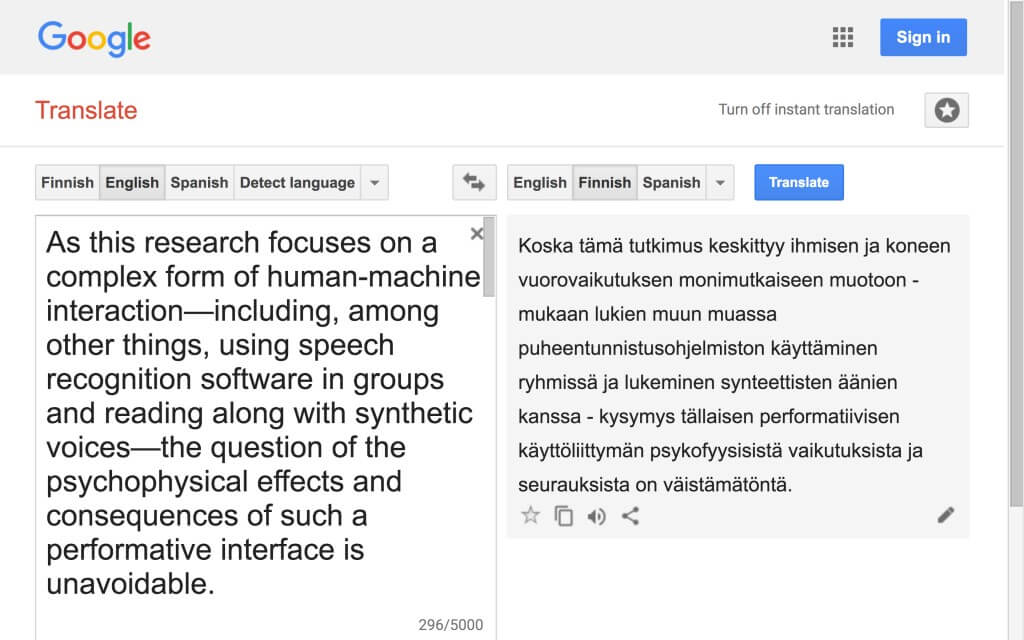
Issues mentioned in passing have proven to be of importance in this thesis. In this response to fragment 14, I deal with reading, a topic secondary in DAR’s adaptation, but—interestingly enough—central to the corresponding Hayles passage (see adapted from Hayles passage 12). Within dashes DAR brings up the act of “reading along with synthetic voices.” By this, they make reference to reading practices rehearsed and performed in love.abz, the first artistic part of this research, in which human performers collaborate with their digital co-actors (synthetic voices, in this case) in the reading of new or previously created dramatic texts.

However, this is only one example of a reading practice rehearsed and performed within the framework of this research, as the preceding parts of this thesis indicate. Taking my cue from DAR and Hayles, I would now like to focus specifically on reading. The underlying idea is that reading and writing are in fact inseparable tasks in love.abz and more generally.
First artistic part: love.abz (Kiasma Theater, 2013)
As the introductory video above demonstrates, reading is at the heart of the writing method developed in love.abz, as the performers write in relation to stimulus texts that they read either independently or in tandem with a computer (for an example of such a stimulus text, see video 2.2.2). As is mentioned in video 2.2.1 EN, these stimulus texts are algorithmically back-and-forth translated or looped fragments of my Finnish-language play Rakkauden ABZ (“An ABZ of Love”) (Huopaniemi 2015EN). (In the second artistic part, (love.abz)3, we instead use looped versions of texts created in rehearsals by the performers themselves, texts that are, for this reason, already significantly further removed from the textual starting point of the process, my play.)
To picture the performance situation, it is essential to note that the stimulus texts are presented before the writing, either by the human performers alone or in collaboration with the synthetic voices. The text fragments created in the performances are also read, immediately after the writing (by computer voices in love.abz and by the human performers in (love.abz)3). Reading and writing therefore form a cyclical group translation process, in which more and more translations and rewrites are created from the chosen starting point. This relates to what Lori Emerson calls readingwriting: “The practice of writing through the network, which as it tracks, indexes, and algorithmizes every click and every bit of text we enter into the network, is itself constantly reading our writing and writing our reading” (Emerson 2014, xiv). Provided that the performative structure stays intact, this process can go on endlessly.
Adaptive Reading
What sort of performative reading is the aforementioned? How does it compare to other types of reading? Is it a human or machinic form of reading? Or a hybrid?
I describe in more detail the performative reading practiced in the artistic parts of this research in section 2.7. Here, instead, I would like to point out a few more general considerations in light of the discussion on reading in Hayles. In the third chapter of her book, “How We Read: Close, Hyper, Machine,” Hayles offers tools for reflecting on these and other questions concerning reading.
The starting point of Hayles’s examination is the impact of digital media on reading at a time when—at least in communities possessing advanced technology—more reading is happening off of different kinds of screens than ever before. Hayles’s concern is, how increased digital reading can be turned into better overall literacy. The crisis of reading shown by studies—or more specifically, the decrease in reading of print media, and the decline in reading comprehension—is the immediate backdrop here. (Hayles 2012, 55–56)
In order to meet the challenge these changes pose, Hayles asks how to bridge between increased (and presumably improved) digital reading and print literacy. By close reading she refers to focused, relatively long-term, detailed reading that is learned through the reading of (printed) texts, through practice that is. Close reading forms the traditional basis of reading for the arts and humanities (and, of course, in many cases for artistic research). (Hayles 2012, 57–59)
Hyper reading, on the other hand, is reader-controlled, screenic, computer-assisted reading. In practice, whenever we are searching for information on the Internet or some other digital network we are hyper reading. Among the examples of this form of reading that Hayles cites are search engine queries, filtering using a keyword, hyperlinking, skimming, “pecking” (picking individual snippets from a longer text), fragmenting, juxtaposing (keeping multiple windows open at the same time while cross-reading between different texts), and scanning (close to skimming). (Hayles 2012, 61).
Hayles points out that hyper reading, like close reading, is a skill that must be learned. It stimulates different brain functions than the reading of printed text. In hyper reading, reading is rather a decision-making situation. When reading from a screen we are constantly confronted with apparently small and yet significant choices: one click might banish (at least momentarily) the connection we have with the text we are reading and cause us to be confronted with content of a totally different nature. (Hayles 2012, 62)
Perhaps as a result of this higher relative mutability and fast tempo, hyper reading is often sloppy, as maintaining attention in a hypertext environment requires considerable self-discipline. In addition, studies have shown that hyper reading does not necessarily work well in conjunction with close reading, due to the manner in which it retrains or repurposes our brains (see 2.1). Being in constant decision-making mode develops our working memory. We become more efficient micro-level decision-makers. Hyper reading does not, however, necessarily support long-term acquisition of knowledge, long-term memory, in the same manner. Hyper reading may thus alter the structure of the brain in a way that actually makes close reading more difficult (which is also related to the way it changes the linearity of reading). (Hayles 2012, 62)
Despite these risks—which are obviously to be taken seriously—Hayles calls for a wider range of reading strategies, covering both forms of close reading and hyper reading, that would allow for a better understanding and command of their mutual relations. Hyper reading is here to stay, and in many instances it has become the norm. For Hayles, it is a strategic reaction to our information-laden media environment, one that serves different purposes than close reading. (Hayles 2012, 61)
Hybrid Reading
The practice of performative reading in love.abz/(love.abz)3 (2.2EN1) is a cross between close and hyper reading, as it combines focused, internalizing reading with faster screenic “pecking,” pinpointing stimuli. I encourage the performers to look for something in the (often arcane, deformed) texts—no matter how small a detail—that feeds their writing, instead of trying to get a grip of their entirety, thus pushing them more in the direction of hyper reading. Without having internalized something of personal significance from the texts, however, the performers would hardly be able to write from them, which is why this reading-writing practice remains in the vicinity of close reading (2.2EN2).
In this practice, there may also be features of the third type of reading Hayles deals with, machine reading, as the performers often read with the synthetic voices of the computer, although usually not in unison. However, by machine reading Hayles refers to human-assisted machine reading in contrast to hyper reading, which is machine-assisted human reading (the latter pertaining more to the artistic parts of this research). (Hayles 2012, 70) My project, therefore, only touches on machine reading, an area whose performative potential needs to be explored further in the future.
In machine reading proper, algorithms are used to analyze patterns and models in text quantities that are too large for human comprehension. At its simplest, this can be the calculating of word frequencies in a given text or sets of texts. In more advanced forms of machine reading, phrases and subject clusters are searched for and compared. More efficient natural language processing, along with developments in computer learning and probabilistic reasoning have allowed for wider use of machine reading, and its forms continue to evolve as algorithms acquire further learning capacities and become more versatile. (Hayles 2012, 70) In the context of digital artistic research, the question arises whether machine reading can be used for the purposes of artistic research and, if so, how.
Notes
2.2EN1
When referring to features or parts present in both, I use the common name love.abz/(love.abz)3 of the artistic parts of the research.
2.2EN2
In “Reading Digital Poetry—Interface, Interaction, and Interpretation,” Matti Kangaskoski suggests the playful conflation of close and hyper reading. For Kangaskoski, “hyper close reading” and “close hyper reading” “designate a reading that investigates the performance of hyper reading closely.” (Kangaskoski 2017EN, 68)
love.abz production info
Working group: Otso Huopaniemi (concept and direction), Anna Maria Häkkinen (performance), Leo Kirjonen (performance), Alexander Komlósi (performance), Teemu Miettinen (performance), Heikki Paasonen (spatial and lighting design), Joonas Pehrsson (sound design)
Venue: Kiasma Theater, Helsinki, Finland
Performance dates: February-March 2013
Languages: English, Finnish
Supported by: University of Arts Helsinki (Theatre Academy), Finnish Cultural Foundation, Uusimaa Regional Fund, Samuel Huber Art Foundation and the Arts Promotion Center Finland