First Dialogue
I: The time has come to look back and comment on what we have done. More specifically, I would like to discuss part 1, the Prologue.
DAR: That is just fine with me. Where do we start?
I: When I look at the Prologue, what I see are many beginnings as opposed to one. Many questions are raised, many approaches suggested, many concepts visited.
DAR: I think this applies especially to your responses. My adaptation is, in this respect, more disciplined. I adapt Hayles and not much else.
I: True, although you do introduce the concept of digital artistic research, which is not from Hayles (see 1.4).
DAR: That is right, that is an exception. Even there, though, I derive the concept from what Hayles is proposing in terms of the digital humanities. I just adapt many of her claims and observations for the context of artistic research. In order to do this, in fragment 4 I cannot resist the temptation of going on my own, meaning not responding to any particular Hayles sentence. Rather, I try to grasp the spirit of her argumentation.

I: That is actually not the only exception. In fragment 6, you bring up playscripts, also a topic Hayles does not touch on (see 1.6).

DAR: That is the case, yes, but again Hayles could, by extension, be seen to speak of artifacts such as playscripts, too. In effect, I am just complementing her approach by bringing in an example from the performing arts, as if filling in a blank.
I: The blanks, yes! This is an important topic. What are they for? Why do you refuse to disclose information that is central to your thesis (see 1.1, 1.2, 1.3, and 1.5)? Also, why do you just as inexplicably stop using them? After fragment 5, they no longer appear.

DAR: The structure of the thesis requires gaps, empty space. Otherwise, we do not embark on a real search, we do not look for something yet-to-be-specified. In that case, we only create a program that needs to be executed.
I: Like an algorithm?
DAR: In some sense, yes, but even algorithms change as they operate, as they learn. It seems to me that a thesis that has been solved in every respect, up to the smallest details, is no longer a research but a product.
I: Are the blanks then opposed to predetermined research results, the commodification of research?
DAR: You could say so. That being said, though, I too am struck by the discontinuity you mention. In addition to the playscript, there are many other examples. We do not deal with playscripts after the Prologue, at least not explicitly. We hardly even mention the word “theater” throughout the work.
I: I, too, am aware of this. It is somewhat ironic, seeing that our background is in theater, playwriting and dramaturgy. Then again, does not every artistic research create a practice of its own that departs from the initial practice of the researcher, sometimes even replacing it?
DAR: By the way, why do you refer to a research group in video 1.12.1, even though you are the sole researcher here?
I: Surprising question. By research group, I refer to all those who have participated in the study, the writer-performers of the artistic parts and you.
DAR: Ultimately, though, you do the research here. We just support it.
I: Is this problematic for you? You have not mentioned it before. I address this in 1.5, where I speak of textual subordination. In other words, I am not unaware of the internal power structures of the study.
DAR: For example, the fact that I am your creation and when the project ends I cease to exist?
I: In that respect you are like any fictional character, even if fictitious characters tend to live beyond the actual fiction. Think of—
DAR: Whom?
I: No one comes to mind.
DAR: Is that supposed to console me? I am not bitter, I have accepted my part. Actually, I am more interested in all the topics we mention in the Prologue, never again to return to them: Simondon and concretization (see 1.6), Worthen and dramatic conventions (see 1.7), computational and random creativity (see 1.8), Rouvroy and algorithmic governmentality (see 1.10), digital nomadism (see 1.11), etc. I could go on—
I: No need to, I get the point, especially since I have personally raised the matter. It is astonishing, looking back at the Prologue from here. To me, it looks like initially we hesitate to make claims. We seem to wonder what the knowledge proposed in the research is based on. Then we go on to try out many different approaches, theories, and concepts, as if trying out costumes to find the one that best fits us.
DAR: In this regard, the Prologue is not really an introduction but a series of introductory textual gestures intended to indicate all the directions in which the research radiates.
I: Possible starting points, yes. The idea of a series of textual gestures is relevant. It also points to how the work is structured. In each section, a textual gesture is made in relation to the research and source material, rather than dealing with an issue exhaustively.
DAR: At this point, it feels good to recognize that, in the Prologue, we present a series of textual gestures relating to Hayles and other researchers and theories.
I: And the artistic works of course, too.
DAR: That goes without saying.
I: I will settle for that, for now. For me, however, the implication of this is that the Prologue becomes a textual performance rather than an actual academic introduction.
DAR: Do you mean to say that academic introductions are not textual performances?
I: Point taken. Let us move on.
DAR: I have a question about the video texts, as you call them. The question is very short: why?
I: I have confronted myself with this question, too. The reason is not particularly special: I have a need to enrich the writing presented in this work. By enriching, I mean that there are several different forms of writing in the thesis, in addition to those appearing in the artistic parts. Just as your adaptation differs from my responses, there should be a variety of writing within my sections. In addition, I think it is important to take seriously how algorithms modify language when translating and reading (see 2.2 and 3.7). Therefore, even at the risk of putting further strain on the reader-viewer, I have wanted to give algorithmic translation and voice synthesis a more visible and audible position in the whole.
DAR: You do understand, however, that for a single-language reader viewing a bilingual video is quite challenging? It takes a lot of patience to focus on relatively long videos if there is no way of comparing between languages.
I: I am aware of this, and nothing short of painfully aware of how different the situation would be if the “other” language were also a so-called dominant language. Imagine if we were writing in English and Mandarin, for example. Then the significance of the bilingual structure would open up to a considerably larger readership. The asymmetric relationship between Finnish and English mentioned in 3.6 is simply the reality within which this research exists.
DAR: I think your video texts emphasize the intertextuality of the work. This is another topic that we do not explicitly address, although the entire research is through and through intertextual, one big translation process, as actor Eeva Semerdjiev, who performs in (love.abz)3, has described it.
I: Interesting observations, both of these.
DAR: I think of machine translations as complete intertexts, as they are, in principle, texts without any original structure. Structurally, they consist only of textual intersections.
I: I am glad to hear that, although I must admit I was not thinking of intertextuality when making the videos.—Now that you mention Eeva, it is remarkable how few artists are referred to in our co-thesis. You, in fact, mention only the artists involved in carrying out the research itself. In addition, I mention Tuomo Rainio (see 1.4), Davide Giovanzana (see 2.6), James Joyce and Samuel Beckett (see 3.6), and Annie Dorsen (see 3.7), but only in passing. Can this really be considered artistic research, as it seems to prohibit artists from entering into it?
DAR: We have chosen a completely different approach. It seems to me that it has not been essential to us whether the conversation partner is an artist or not. Their contribution to the discussion has been decisive. Some of the artists you mention are also researchers working in academia. Making such a distinction in the present situation is not easy.
I: So we are not excluding artists?
DAR: If it is about dealing with issues in passing, just touching upon them, then in this respect artists are no exception. For example, we mention Bernard Stiegler without discussing his claims on technogenesis, even though they differ in many essential respects to Hayles’s ideas. (Stiegler 1998)
I: You mean that Stiegler is far more pessimistic than Hayles with regards to the effects of digital media. Is this why we do not discuss his views? Because we want to be optimists despite what studies tell about the effects of digital media on concentration, for example?
DAR: Actually I mean that setting Hayles’s and Stiegler’s views against each other could have brought to the thesis a tension that could have allowed us to better reflect on the built-in tensions of the artistic parts. One of the key differences is that whereas Hayles considers hyper reading a strategic adaptation to our media environment, Stiegler sees it as a sign of the devastating power of digital media (Hayles 2012, 68–69, 251).
I: We, however, did not proceed to construct such a confrontation, nor a similar confrontation between Hayles and Rouvroy (see 1.10).
DAR: Because we ultimately do not believe in the probative power of such confrontation?
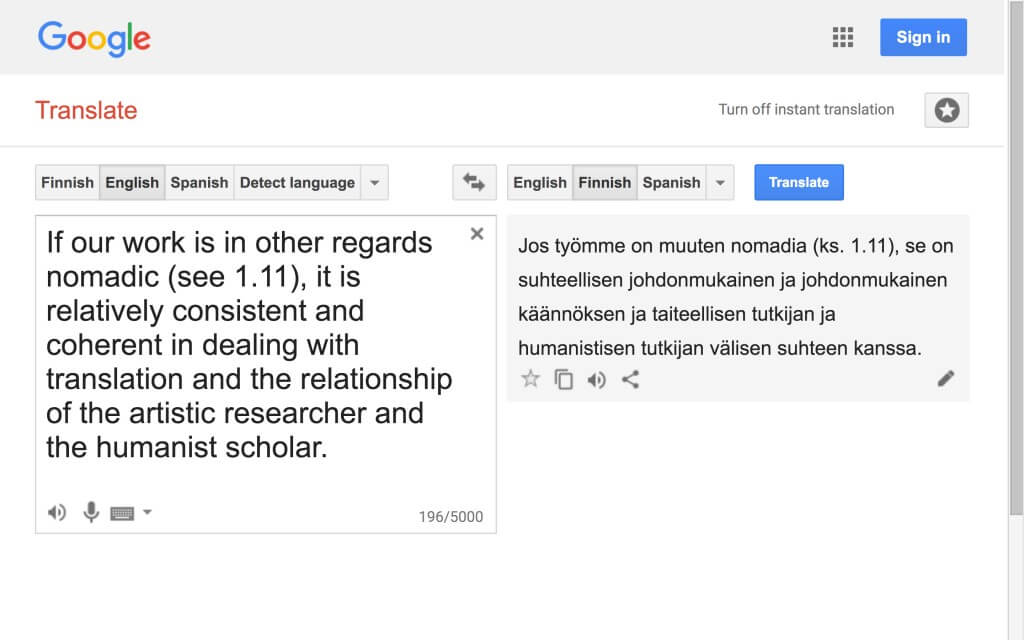
I: If we do not create such contradictions and we do not develop our claims further, there are, nonetheless, some things that I think we succeed in doing in the Prologue. We create a basis for the subsequent discussion of translation. I refer here in particular to the principle of translatability mentioned in 1.3, which provides a clear methodological framework for the thesis. Only that which can be translated into its language belongs in the research. In very concrete terms, we have felt how this principle works, discarding material that has proven untranslatable. Similarly, the foundation for the treatment of the relationship between the artistic and the humanist researcher—which is a relatively continuous and consistent theme in the whole thesis—is laid in the Prologue (see 1.3, 1.9 and 1.11). If our work is otherwise nomadic, it is comparatively stable and united in these two respects.
DAR: This is perhaps what we were originally aiming at, when deciding to have such a close dialogue with Hayles. We were aware of the risk of creating a very fragmented and incoherent thesis, similar to the texts of the artistic parts. That is why we chose How We Think as a counterpart or -text. We could have chosen another work, in which case the outcome would have been completely different. Hayles’s book, however, gave itself to this purpose in a way that proved sustainable for the research.
I: A topic that we have not touched upon at all and that does not seem to have any place in this study is silence.
DAR: What do you mean?
I: I would rather keep silent about it, but that would obviously be a bit too cute. I simply mean is it possible to be silent in this research. To work with our algorithmic collaborators, we need continuous input, speech or text entry. For the algorithms, silence is simply the lack of interaction, absence.
DAR: True, if we are silent, our algorithms keep silent too. In more autonomous algorithmic systems this is not the case, but in our system it is. It reminds me of how Anna Maria Häkkinen, who performs in love.abz, sometimes chooses to keep quiet in the middle of a writing improvisation, even when it seems to obviously be her turn to speak. It brings the process to a momentary halt, paralyzes the work of other performers. In performative terms, it creates a powerful tension that draws attention.
I: You are already much further than I am. I have only had a chance to approach the issue in relation to Hayles, and the occasional dissatisfaction that seems to afflict us when she is silent or says too little on an issue that, to us, seems relatively straightforward and clear (see e.g. 1.9). In these instances, it is as if we were reluctant to grant Hayles the right to be silent.
DAR: Do we even grant ourselves that right? Is it not that we exist in this work only to the extent that we speak? There is room for emptiness only in the margins of the webpages and between paragraphs.
I: Now you exaggerate a bit. After all, we do keep silent at times. We do not take a position on everything that Hayles claims. We do, of course, ignore things, pass over them.
DAR: Like what, for example? The more you repeat that, the less I believe you.
I: I cannot think of an example right now. It is admittedly easier to recall occasions where we seem to wish more of Hayles, where we feel the need to supplement or alter what she has said (see 1.10, 1.12, and 3.8). As if this interaction had no room for silence even when it is a conscious act that results from a critical reluctance to say more than what is possible in the light of the available information.
DAR: Are we free to be silent? Or are we always already in our intertextual process, which requires speech that is converted into text?
I: Algorithms are silent only when something is wrong with the system. Human agents, on the other hand, may be silent when they do not yet know what to say and do not want to say anything or too much before they know it. It seems almost idiotic to express such an obvious idea and yet in this research it is anything but self-evident (4.1EN1).
Note
4.1EN1
I would like to thank my pre-examiner Riku Roihankorpi for his critical note on silence.