27th January 2020
Fieldwork day 28/46
Research year 3/8
The dance session in the daycare gym has just begun, and the opening circle has already dissolved into a constantly shifting constellation of movement spread across the space. Our first dance concerns the theme of birds, as suggested by the children. The space fills with a rich variety of motion as we explore bird-like, flowing movements together with the children and their teacher. Children are running, stepping, skipping, jumping, spinning, diving, and swinging their arms. From time to time, I gather movement ideas from the children, and we expand them by collectively mirroring and inventing new variations. Amid all this, one child remains still in the middle of the room, not joining the dance. The teacher gently encourages this child by inviting and asking questions. But the child remains rooted, hesitant and reluctant. I dance my way next to them, pause, and extend an open palm as an invitation to connect. The child touches it softly. I let the touch guide me into a small dance, ultimately returning to the child. I repeat this gesture a few times. With each touch, a new way of dancing emerges. Eventually, I respond to the touch by gently pressing back, guiding the child’s hand and body into motion. The child accepts the impulse, and a pathway opens to join the dance.
19thApril 2023
Prototype workshop 4/11
Research year 6/8
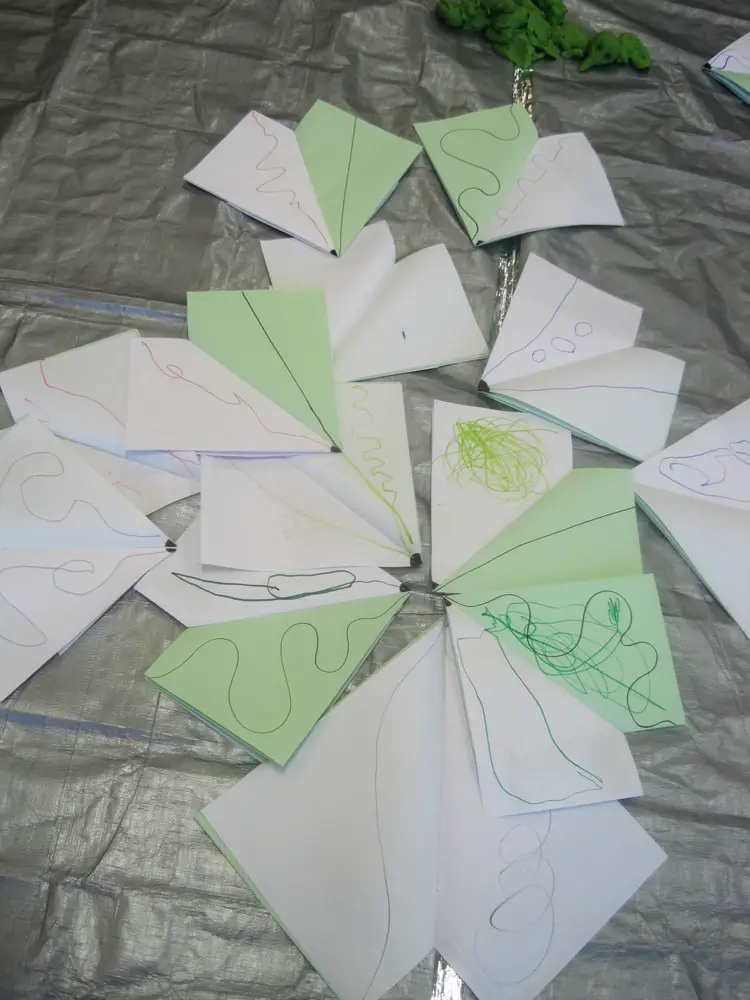
We are dancing using touch as an impulse to guide our movements. One child sits apart, arms wrapped tightly around their legs. I dance my way over and land beside them, stretching out my hand with an open palm as an invitation. I recall how this same gesture was effective during fieldwork, when a child struggled to create movements. But this time is different. The child rejects me, clearly upset by my close presence. I am unable to further negotiate participation, so I return to dancing with the group instead. Later, we gather in a circle with our prototypes—the first iteration of what would become the children’s version of this thesis. Everyone draws lines across their paper, imagining the markers as aeroplanes taking off and flying routes through the air, leading to curvy movement patterns of dancing hands in the air. To my surprise, the same child who rejected me earlier is now fully engaged—laughing, joining in, and tracing their own flight paths with excitement. (Colliander 2024)
1.1.1 Aims and Motivation
These two artistic-pedagogical episodes highlight both the joys and challenges I encountered while facilitating improvisation-based dance during this research. The children’s varied responses underscore the importance of contextual awareness and situational sensitivity, highlighting the need for alternative pathways and the challenge of offering a universal how-to guide for educators. Such a step-by-step educational approach implies a pedagogy conceived as a preconstructed, rigid space, in which the aim is to follow guidelines and complete prescribed dance tasks. Unintendedly, I constructed a comparable space for my pre-examined artistic component, which I narrate in the section ‘Sharing’ in the Pre-Examined Artistic Component Käännöksiä – Transpositions. Instead, through my research on intra-active early childhood dance pedagogy, I aim to create fertile ground for pedagogical thinking as a dynamic assemblage that educators can adapt creatively to their own contexts and communities across various educational settings. This adaptable framework has the capacity to transform dance education for children into a more inclusive practice of dance education with children.
Arts-Educational-Philosophical Grounding
My doctoral study focuses on improvisation-based dance pedagogy, drawing on posthuman philosophy and new materialist thought—especially the concept of intra-action in Karen Barad’s agential realism (2007), Hillevi Lenz Taguchi’s intra-active early childhood pedagogy (2010), and the process philosophies of Gilles Deleuze and Félix Guattari (1987). One of the central differences between applying the concept of intra-action instead of interaction lies in the ontological premises underlying these conceptions. Whereas interaction refers to exchanges between separate units, intra-action denotes a situation in which there is no separation to begin with (Lenz Taguchi 2010). In this view, bodies, materials, environments, movements, and ideas are always already entangled in ongoing constellations, which Deleuze and Guattari (1987) conceptualise as assemblages. This perspective encourages me to resist simple solutions or definitive statements about how to work with children. It also enables me to attend to rich complexities and to voices that are difficult to hear, such as those of children, whether in education or research.
As a dancer-pedagogue-researcher, I not only hear the linguistic voices of children, but also their embodied voices through their expressions of eagerness, hesitation, and withdrawal in and through various movements of their bodies. My concern is that these messages are not always understood and given enough space, time, and weight in often resource-limited educational work. I am responding to this question through an intra-active framework, which recognises knowledge as complex, plural, collective, and situated (Haraway 1991). This view recognises embodied modes of knowing as equally valuable and essential as conceptions that locate knowledge within linguistic expression. It fosters active, sensorial, and embodied forms of knowing, while encouraging acknowledgement and respect for children’s bodily ways of thinking with more/other‑than‑human[1] agencies as their companions.
Although philosophically complex, posthuman and intra-active theories align closely with the practical ways in which children orient themselves to the world with curiosity and holistic bodily engagement. Their actions fluidly intertwine beginnings and endings, dancing and playing, as well as human and more/other‑than‑human elements, which are dimensions that relational ontologies offer productive tools for exploring and understanding. These theories also support pedagogical thinking in the era of multiple unforeseen crises we are living through. They do this by encouraging a reconceptualisation of pedagogical relations beyond individualistic and anthropocentric paradigms, highlighting relationality and ethical entanglement through an active commitment to increasing awareness of one’s responsibilities. Barad (2007) describes this understanding as response-ability, referring to one’s sensitivity to being affected by and responding to the world’s circumstances.
Motivational Grounding
The motivational foundation of my research is both personal and professional. The deeply personal aspects are rooted in my embodied relation with my first child. His neurological differences invited a mode of attunement that exceeded verbal communication, whereby responsiveness emerged through gestures, rhythms, and atmospheres. Our early encounters became a relational choreography of becoming-with, revealing how movement arises from the entanglements of bodies and environment, rather than from individual intent (Barad 2007; Manning 2013). My professional background as an early childhood dance educator further informs my aims to enhance the inclusiveness of dance pedagogical practices and promote the accessibility of dance during childhood. In this context, inclusion refers to creating equal opportunities for all children to participate in pedagogical activities, while accessibility concerns the availability of dance, determining who can engage in dance and in which settings. These personal and professional experiences motivated me to pursue a master’s degree in dance pedagogy, which preceded this doctoral research, in order to further explore and conceptualise the various thoughts that had emerged from my experiences.
During my master’s studies dialogical pedagogy, particularly in the context of dance education (e.g., Anttila 2003; Kauppila 2012; Turpeinen 2015), significantly influenced me and led me to reconceptualise dance pedagogy in my own thinking. I explored the concept of dialogue as both a philosophical idea (Buber 1993; Freire 2005) and a pedagogical approach (Värri 2002). In my master’s thesis (Colliander 2016), I examined embodied interactions and artistic collaborations between adults and children. This shift urged me to view dialogue within dance education as an entanglement of embodied and verbal modalities, shaped by multiple agencies that co-compose the dancing experience.
My emerging practice of dialogical dance pedagogy, embedded within improvisation-based approaches to dancing, evoked not only joy but also critical attention to the distribution of agency across participants in pedagogical events. It prompted a rethinking of power dynamics, framing them as emergent within ongoing relations among bodies, materials, and affective forces, rather than as properties residing solely in the teacher or curriculum. This perspective also invited reconsideration of what constitutes teaching, learning, and artistic agency in early childhood dance education contexts. As these issues exceeded the scope of my master’s thesis, they became the driving force behind my doctoral research.
1.1.2 Research Questions
This study focuses on my experimentation with dance pedagogical and artistic research practices within Finnish early childhood education and care (ECEC). Its main goal is to generate practice-based knowledge and novel methodologies that bridge research and practices across dance education, ECEC, and artistic inquiry. The study is guided by the overarching research question:
How can improvisation-based, intra-active dance pedagogy transform prevailing approaches to dance education and facilitate its fuller integration into the embodied, play-based, and holistic learning environments of ECEC?
This research question is further supported by open-ended research propositions which work as catalysts that can trigger thinking beyond a linear narration of events (Murris and Bozalek 2019). Therefore, these propositions served as guiding principles to enhance attunement to micro-level events during collaborative work with children in the fieldwork context:
What emerges when a dancer–pedagogue–researcher spends several months in an early childhood education context, using her artistic expertise creatively and intuitively in child and adult encounters? Allowing time for discovery. To see and to become seen. To listen. To move and to be moved. To dance. To play. To be with. To not know.
During the analytical phases, these propositions also served as conceptual invitations to move with the research materials, such as my writings, drawings, recordings, and material artefacts. My research process has been a holistic endeavour, with practical experimentation, analysis, and synthesis not emerging as separate phases but as overlapping and intertwined activities. In this way, the intra-active approach was not limited to the dance pedagogical aspects of my inquiry but also encompassed the research methods and methodology. During the several-year-long research process, I continually revisited my research materials—what Barad (2007) describes as re-turning—and each encounter with the materials revealed new differences, fostering various perspectives and deepening my understanding.
I approached the analytical phase through a diffractive methodology (e.g., Barad 2007; Lenz Taguchi 2010; Murris and Bozalek 2019), according to which the production of different interpretations and the identification of where differences emerge are central. In my diffractive reading of the pre-examined artistic component Käännöksiä – Transpositions, I worked with my research material and related theoretical texts. During this work, I was guided by the question:
What new possibilities for dancing–teaching–researching does the pre-examined artistic component open up?
My aim is to illuminate what is ‘at play’ in ECEC dance education settings and how micro-level activities and events might intra-act with broader educational issues, concepts, and contexts, with each reciprocally shaping the others.
Note
1 My formulation of this term leans on Hughes and Lury’s (2018) notion of the more-and-other-than-human, which accounts for the technical and natural heterogeneities of the world.