This doctoral research is situated at the intersection of improvisation-based dance education, intra-active pedagogy, and artistic research informed by posthuman and postqualitative frameworks, with a specific focus on Finnish ECEC. In this paragraph, I provide a concise overview of the research context by outlining both the academic landscape and the practical sites where the study was conducted. I further discuss my motivations for advancing dance education and research in these settings, as well as the gaps this study seeks to address.
Although the contexts are presented here as coherent and familiar landscapes, they did not exist in this form at the outset of the research process. Instead, they emerged through a sustained and iterative de/re/construction of my understanding of theoretical concepts, philosophical thought, research methodologies, methods, and practices of inquiry. In this sense, the articulation of these frameworks is itself a result of this research, even though it is now presented as an outline of my evolved understanding.
1.2.1 Academic Contexts
Artistic Research
Finland, along with other Nordic countries, has played a pioneering role in establishing artistic research as an academic discipline situated at the intersection of artistic and scholarly investigation and education (Aavanranta and Välimäki 2025; Borgdorff 2012; Elo 2022; Gröndahl 2023; Varto et al. 2003). Artistic research is an emerging and evolving field, in which each contribution enriches the landscape by fostering community development and expanding the collective body of knowledge (Hannula, Suoranta, and Vadén 2014). Important local precursors relevant to my research include dance pedagogical studies by Jalkanen (2018), Valkeemäki (2017), Turpeinen (2015), Kauppila (2012), and Anttila (2003), as well as Kokkonen’s (2017) work employing a posthuman framework. These works, together with diverse contributions from research in other artistic fields, provide a context for this research.
A key aspect of artistic research is the holistic integration of art into the research, meaning that art is not viewed as a separate object of study, but rather the research originates from within the artistic process itself (Gröndahl 2023). Therefore, my research unfolds in, with, and through my dance pedagogical practices, instead of being about those practices (Borgdorff 2012). My approach to artistic research intersects with several other practice-based methodologies, including arts-based research (Leavy 2017), a/r/tography (Springgay, Irwin, and Kind 2005), collaborative inquiry (Heron and Reason 2006), research-creation (Manning and Massumi 2014), and performative research (Haseman 2006; Østern et al. 2023). Furthermore, the role of the artistic researcher aligns closely with the Reggio Emilia school of early childhood pedagogy’s concept of the atelierista as a specialised educator who serves as an artist-in-residence. In this context, art is not merely a product but a vital tool for fostering children’s learning, inquiry, meaning-making, and knowledge construction. (Kind 2023)
Artistic research is deeply rooted in the artistic practice of the artist–researcher (Gröndahl 2023), where the unique nature of artistic processes and the complexities of knowledge production create a dynamic and often tense relationship (Rouhiainen 2024). Over the course of this doctoral research, my professional identity as a dance teacher has gradually evolved, transforming my subject position into an interconnected entanglement of artist, pedagogue, and researcher. I refer to this evolving formation throughout this commentary as the dancer–pedagogue–researcher assemblage (Deleuze and Guattari 1987), a formulation that concisely encapsulates my professional trajectory and the sequence in which these roles emerged. Consequently, I have found posthuman and postqualitative research frameworks to be supportive of my approach to artistic research, particularly in my aim to acknowledge the researcher as an inseparable part of the research process, which I will elaborate on in the section ‘Warming Up’ with Methodology.
Intra-active Pedagogical Orientation
Intra-action is a foundational concept in Barad’s (2007) agential realist framework, which she develops through an interdisciplinary engagement with quantum physics[1], feminist theory, and poststructuralist philosophy, situated within and informed by broader posthuman literature. Unlike traditional notions of interaction that presume the existence of discrete, pre-established entities, Barad conceptualises intra-action as a process through which agency is mutually constituted in entangled relations. As she explains, ‘distinct agencies do not precede, but rather emerge through, their intra-action’ (Barad 2007, 33). As I adopt this perspective within the context of my dance pedagogical research, the focus shifts from individualistic and anthropocentric frameworks to emphasise relational and ethical entanglements through practices of response-ability (Barad 2007). I use this term to refer to the capacity to act and the ability to remain open to others’ responses. It is closely connected to ethical responsibility toward both oneself and others. This approach guides me to explore how the dancing unfolds in, with, and through collective assemblage, where the more/other-than-human bodies are included as entangled participants (Hickey-Moody, Palmer, and Sayers 2020; Lenz Taguchi, Palmer, and Gustafsson 2016).
Lenz Taguchi (2010) introduced the concept of intra-active pedagogy in her seminal work, Going Beyond the Theory/Practice Divide in Early Childhood Education. Her work provides an important point of departure for my inquiry, as this orientation promotes collaborative invention and creation between children and teachers, while also emphasising recognition, valuing, and active engagement with difference and diversity (Lenz Taguchi 2010). This orientation offers an alternative to many prevailing dance education practices in ECEC, where traditional educational hierarchies often continue to inform the work and where the emphasis has tended to be placed on the development of motor skills rather than on foregrounding artistic exploration (Gibbons and Nikolai 2019).
In recent years, research informed by posthumanist theories has grown substantially and expanded to encompass early childhood education and research. In parallel with this trend, the practical processes of planning and conducting research that engages with more/other-than-human worlds through a posthuman orientation constitute an emerging area of inquiry. My research responds to this growing area by engaging with existing literature and extending it through the articulation of new practice-based dance pedagogical insights into early childhood dance education, with a relational, intra-active, and posthuman orientation. Here, intra-active orientation to dance pedagogy is presented not simply as an alternative pedagogical lens for dance education, but as a radical reconfiguration of what it means to be and to know in the world. This approach also shifts my initial dialogical stance toward a broader enactment of relationality.
1.2.2 Practical Contexts
Improvisation-based Dance Education
My background as a dance teacher within the Finnish basic arts education (BEA) framework has provided me with broad experience in introducing dance to young children. This work has been carried out under the designation of creative dance, which is commonly used to refer to improvisation-based dance practised with children. While the term creative dance is often used interchangeably with improvisation, improvisation is more commonly linked to adult or professional contexts. Nonetheless, both terms describe movement practices grounded in spontaneity and real-time exploration, wherein the dancer’s imagination and embodied responsiveness replace fixed choreography (Foster 2003). In this study, I employ the term improvisation to challenge epistemic injustice (Murris 2013; 2016) and ageist assumptions. These assumptions position children’s dancing as fundamentally different from ‘proper’ dance, whereas my goal is to affirm it as a legitimate site of artistic and pedagogical inquiry that is not qualitatively different from any other improvisational practice.
In my pedagogical practice, I recognise and value children’s capacity for embodied thinking in their meaning-making, which often exceeds adult logic, and I remain committed to engaging with their artistic ideas and approaches with seriousness and respect. Central to this approach are cultivating joy in movement, supporting embodied and aesthetic experiences, and nurturing children’s creative agency in relation to themselves, others, and their surroundings. Therefore, I ground my research in improvisation-based practices that prioritise movement exploration over adherence to specific styles or techniques. In this view, improvisation becomes the central means of attuning to and responding to the world through embodied experience. This approach affirms that everyone possesses the capacity to dance, challenging the notion of a single right way of moving or performing, and instead embracing plurality and diversity of expression (Anttila 2013). Building on this perspective, I regard dance as a multifaceted, holistic artistic practice that functions both as a contemporary cultural phenomenon and as a performing art. It encompasses expressive, sensory, physical, creative, social, and cultural dimensions from which knowledge emerges through embodied experience (Anttila 2013; Anttila and Svendler Nielsen 2019).
In this study, improvisation serves as both the foundation of dance and the primary pedagogical framework for structuring dance education, thereby profoundly reshaping the educator’s role and pedagogical orientation. The focus of teaching consequently shifts from the transmission of pre-existing material to the facilitation of emergent movement (e.g., Foster 2011; Gilbert 2015; Manning 2009; Sheets-Johnstone 1999). This reorientation challenges traditional teacher–student hierarchies by repositioning the educator from transmitter of knowledge to co-creator in the learning process (e.g., Martin, Snook, and Buck 2018; Richard 2013). In doing so, it reshapes the power relations that determine who participates, how bodies move, which movements are valued, and how agency is distributed. Consistent with an intra-active orientation, I understand agency not as a characteristic possessed solely by (adult) humans, but as a relational force that also encompasses more/other-than-human entities (Barad 2007). Such perspectives may broaden understandings of children’s capabilities and expand possibilities for collaboration and shared discovery.
An improvisation-based pedagogical orientation draws on educational strategies grounded in the creative exploration of aesthetic expression and the playful dimensions of learning (e.g., Anttila 2007; Bruzzone and Stridsberg 2023; Stinson 1998; Svendler Nielsen 2009). As Lindqvist (2001) suggests, in early childhood educational contexts, the strength of improvisation lies in exploring unfamiliar movements, which both broadens movement skills and supports multiple artistic modes of interpretation. Payne and Costas (2021) further highlight that offering children opportunities to explore varied movements, dynamics, and spatial relationships encourages them to engage in non-preferred movements, disrupting habitual patterns and fostering flexibility in physical, cognitive, and emotional capacities. This approach may support the development of a contextually responsive dance vocabulary shaped by environment, relationships, and embodied experience (Pollitt, Blaise, and Rooney 2021).
Thus, the educator’s holistic presence foregrounds sensorial encounters, embodied relations, and response-ability that extend beyond spoken communication. This response-able orientation resonates with Stinson’s (2010) assertion that teachers’ somatic sensibility constitutes an essential pedagogical tool. Throughout this research, my aim has been to cultivate a relational orientation towards my own body, others, and more/other-than-human elements, such as space, time, and materialities, in pursuit of inclusive, adaptable modes of participation within heterogeneous groups.
Fieldwork in Early Childhood Education
I refer to the most central pedagogical practice of this research as fieldwork. This phase took place between 2019 and 2020 at a municipal ECEC institution called Forest, in East Helsinki[2]. Thus, the primary educational context of my study is Finnish ECEC, which is particularly significant for research in early childhood dance education, as it is the main institutional setting for children under school age. Despite the inclusion of dance in the Finnish national ECEC curricula, it is positioned as one of several areas of arts education, which in turn is positioned as one of several learning areas. (EDUFI 2018) Furthermore, conceptions of dance within ECEC often tend to emphasise physical skills, whereas its creative, playful, and improvisational potentials appear underutilised (e.g., Pastorek Gripson, Lindqvist, and Østern 2022). This situation provides a well-founded rationale for my study and opens up possibilities to investigate how an intra-active view on improvisation-based dance pedagogy could shift existing practices. Such an approach could enable a shift from adult-led, prescriptive models to more dynamic, collaborative engagements, in which children’s voices become more pronounced.
The daycare centre comprised six groups of children, but for practical reasons, I collaborated with three of them, which I refer to as Brook, Spring, and Pond. These groups consisted of children aged three to six years, totalling 46 children and 13 adults. The fieldwork was conducted over a five-month period and encompassed 46 working days. I approached this period through deep hanging out (Clifford 1997; Geertz 1998), which allowed me to engage not only in scheduled dance activities but also in the everyday life of the daycare centre. This approach enabled holistic and sustained ways of being with the community, aligning with Koro-Ljungberg’s (2015) view of a generous research approach. I elaborate on these methodological approaches in detail in the section ‘Warming Up’ with Methodology.
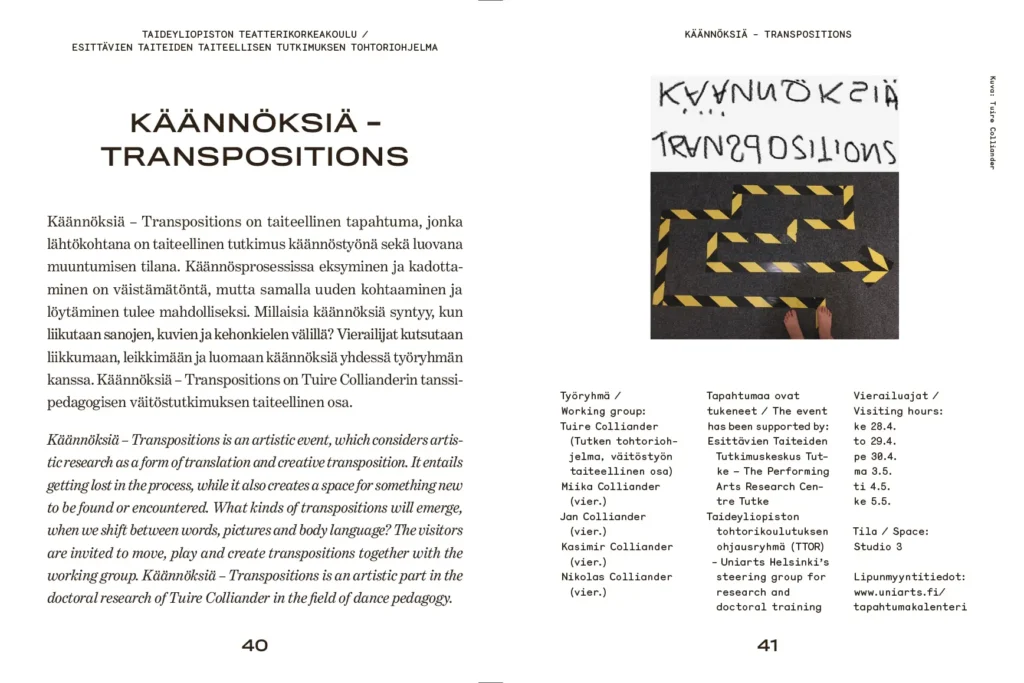
The Pre-examined Artistic Component Käännöksiä – Transpositions
My goal for the pre-examined artistic component of this research project was to present the key working practices and insights that emerged during my fieldwork in a format that would be shareable with the research participants and evaluable in the context of artistic doctoral research. Conceptualising artistic research as a process of translation, in alignment with Elo (2018), I articulated my experiences and pedagogical understandings from the fieldwork as translations from one phase of research into another. The title of the pre-examined artistic component, Käännöksiä – Transpositions, stems from this approach. The Finnish word Käännöksiä can mean both translation and turning, as in the physical movement, made, for example, while dancing. For the English part of the bilingual title, I chose the term transpositions because it felt like a kinaesthetic version of translation, making it more appropriate to my work. This term also connects with Derrida’s (1985) idea of poetic transposition, which does not denote a copy or transformation, but rather involves the growth of the original (Farquhar and Fitzsimons 2011).
I designed the pre-examined artistic component as an artistic–pedagogical event that would allow me to incorporate a diverse range of research insights and approaches that emerged from the fieldwork. This event combined elements of a dance workshop, an interactive installation, and a dance performance into an educational experience that productively blurred the boundaries between education and art. In addition to its institutional aspects of sharing and presenting research, I envisioned the pre-examined artistic component as a research laboratory, a space for experimentation, exploration, and the generation of new dimensions in my evolving understanding of intra-active dance pedagogy. I describe the process leading up to the event, as well as its structure and activities, at the beginning of the section ‘Sharing’ in the Pre-Examined Artistic Component Käännöksiä – Transpositions.
Notes
1 Given my background in the natural sciences, including a master’s degree in biochemistry, the connection between agential realism and quantum physics has played a significant role in shaping my engagement with Barad’s ideas. This connection has provided a familiar physical grounding from which I have been able to approach and extend into the complex, interdisciplinary discussions that reach beyond the natural sciences.
2 Regarding the fieldwork, I refer to the ECEC institution as a ‘daycare centre’ as this formulation has a less formal tone and better reflects my relationship with the institution. The name of the daycare centre and the groups are pseudonyms.