In this section, I focus on the Lines of Flight activity from the event, engaging in diffractive reading that brings the dance pedagogical activities, pedagogical documentation, and related theories into dialogue with one another.
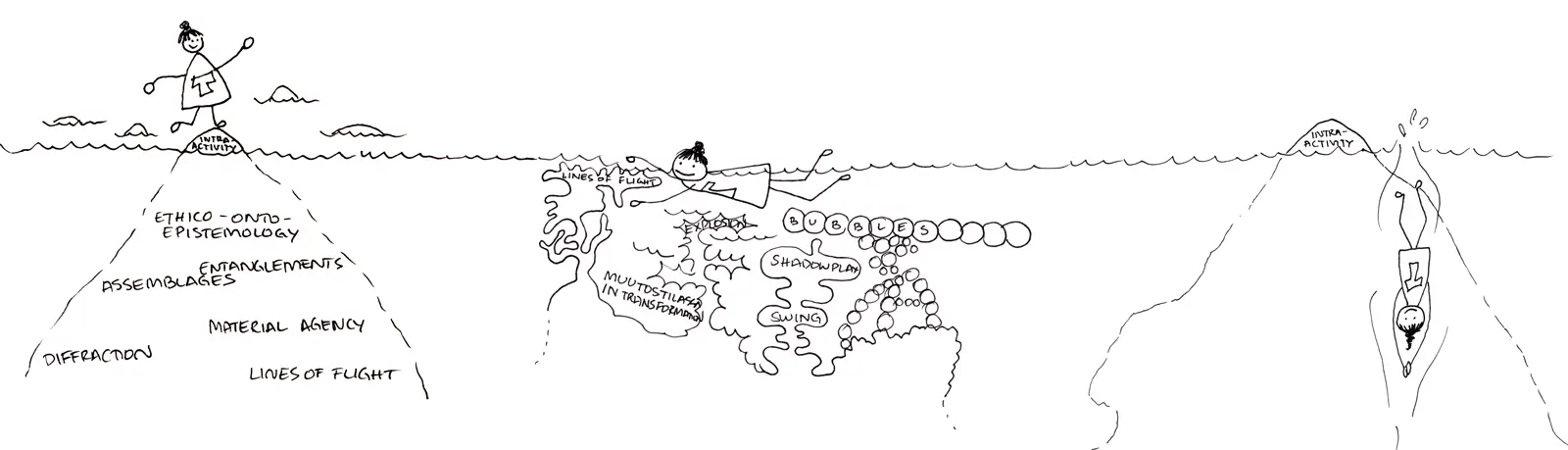
The process of diffractive reading was like diving into the depths of the ocean of my research. It was preceded by an initial phase of planning and fieldwork, serving as a grounding in intra-active theories. The subsequent phase, characterised by the implementation of the pre-examined artistic component, can be seen as swimming on the surface of the theory-practice entanglement created during the event. In this analytical phase, I aimed to explore this entanglement more deeply through diffractive reading, examining how posthuman and intra-active theories could be further developed and intertwined with my thinking and practices in dance pedagogy and artistic research. This process generated six translations and three openings, which I will elaborate on in the following paragraphs.
5.3.1 Setting the Scene for Diffractive Reading
I present the process of diffractive reading through multimodal pedagogical documentation as an artistic, pedagogical, and scholarly practice, making the process accessible for interpretation and alternative constructions, and illuminating the new directions for thought that arose from the pre-examined artistic component (Anttila, Tuovinen, and Jaakonaho 2024). In this paragraph, I will outline the starting points for this analytical phase.
The Aim and Outline of the Lines of Flight Activity
The aim of the Lines of Flight activity at the event was to engage participants with the philosophical concept by emphasising embodied ways of understanding and creating knowledge about it. My research goal was to deepen my understanding of the concept of lines of flight, both as a phenomenon within dance pedagogy and as inspiration to explore new approaches to working with drawing–dancing–thinking assemblages. I selected this part of the event for further analysis because, even during the early stages of working with the research materials, a noticeable glow emerged during the Lines of Flight activity, as it aligned most closely with my research interests.
The Lines of Flight activity involved a series of pre-structured stages: first, an introduction to the concept and its connection to our collective movement improvisation; next, participants visualised their thoughts by drawing lines on paper; then we improvised a dance inspired by those lines, accompanied by improvised guitar sounds. To conclude the activity, the drawn lines were attached together to form a growing collective installation. The Lines of Flight activity was performed during five of the eight total visits to the event. For my diffractive reading, I employed materials collected from all five visits. However, the images in this publication predominantly originate from the first visit, with a few exceptions.
Diffractive Reading through Multiple Translations
In my diffractive reading I trace the research process of the Lines of Flight activity by articulating key moments—conceptualised as translations—that were instrumental in deepening my understanding of the concept and phenomenon of lines of flight. I also explore the potentialities of the intra-active relationship between drawing and dancing within my dance pedagogy. Here, translations are understood as connections, displacements, movement, or shifts between the modalities. A condensed version of this work was previously published as a peer-reviewed research article, Drawn into Dancing and Danced into Drawing: Exploring Deleuze’s Lines of Flight through Dancing–Drawing Approaches in Early Childhood Dance Pedagogies (Colliander 2024). This commentary builds upon the original publication by offering a more detailed analysis by re-presenting my diffractive reading of the Lines of Flight activity through pedagogical documentation.
My diffractive reading is guided by a question that Massumi, the translator of A Thousand Plateaus, suggests as a way to approach the complex work of Deleuze and Guattari (1987, xv): ‘What new thoughts does it make possible to think?’. Translating this question into my research context, it can be rephrased as: What new possibilities for dancing–teaching–researching does the pre-examined artistic component open up? The emergent nature of my research approach and the presence of multiple more/other-than-human agencies influenced the planning of the pre-examined artistic component, resulting in a partial misalignment between the research aims outlined in my research plan and linking paper and the practical execution of the artistic component. Consequently, rather than concentrating on my original research questions for the pre-examined artistic component, I directed my attention toward the prior question, which was informed by Massumi’s writing. This way, I could shift my attention to uncover novel insights from the research materials, even when my original research objectives were challenging to fulfil. Rather than analysing the actions of individuals or isolated units, my aim has been to trace and describe the relations that emerge through entanglements—relations that may remain invisible and are continually shifting within each intra-action (Murris 2020). This way, the possibility of finding surprising new lines of flight leading to unexpected follow-on effects emerges, aligning with my approach to research as emergent.
My process of developing the pre-examined artistic component was marked by challenges, heaviness, and struggles, and it was followed by a sense of failure, which made even the thought of working with the research materials unsettling and off-putting. Therefore, I prolonged the initiation of the analysis process for several months after the event and continued re-turning (Barad 2007) to the materials over a four-year period. Hence, I experienced the research materials differently across time and space, allowing me to ‘stay with the trouble’ as Haraway (2008) proposes, as part of the slow methodologies (Millei and Rautio 2017) that I embrace. I view my artistic research process both during the event and after it as experimentation which engages risk, is driven by curiosity, and fosters creativity (Wolgemuth et al. 2018).
Working with the Materials on a Re/de/construction Site
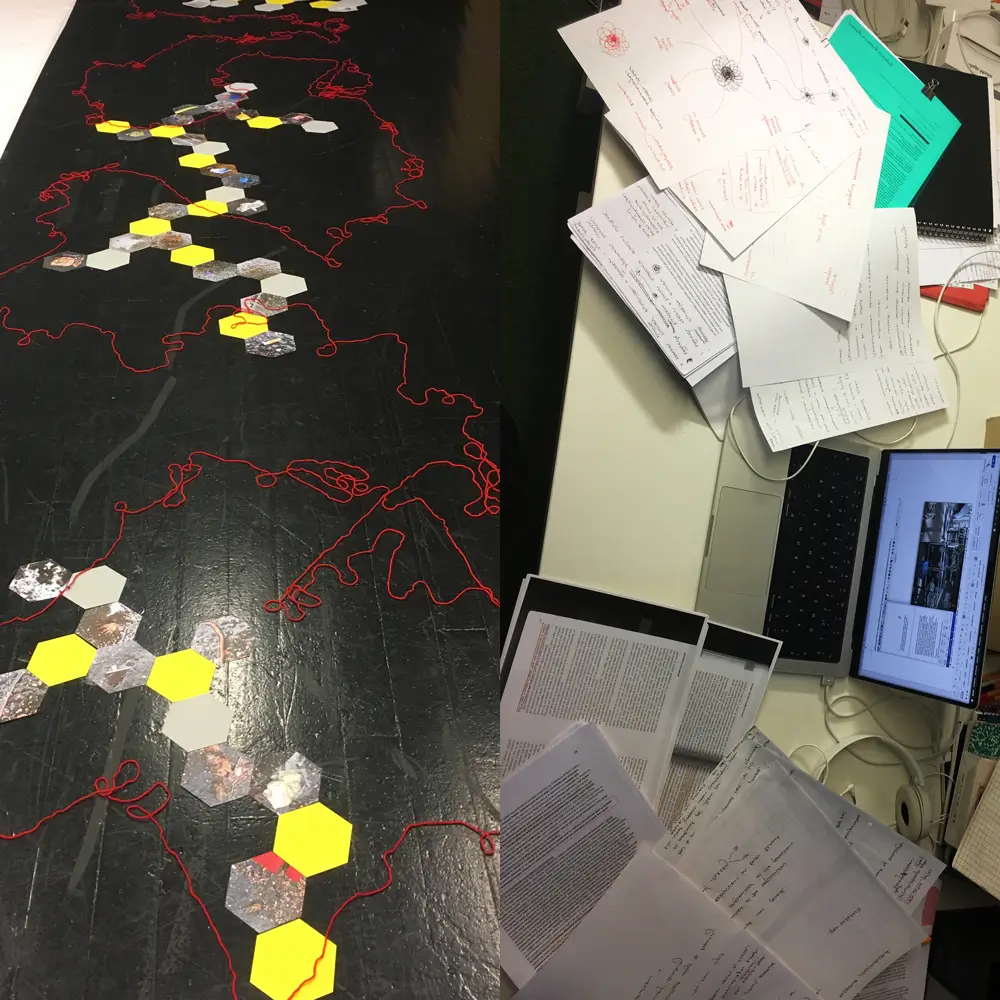
My approach to diffractive reading aligns with the activities on a construction site, involving continuous processes of re/de/construction by bringing different elements and agencies together within a shared conceptual space. This phase of working relates to the assembly of materials for the artistic event: collecting, re/de/constructing constellations, creating connections, and finding threads to think-with and through the materials. Through working with multimodal research materials, I aim to entangle multiple modes of knowledge while attuning to embodied ways of knowing in my iterative re/de/constructing process of creating new insight and deeper understanding. Here, the plurality of materials enhances the ability to create multiple perspectives on the research question of what this opens up.
Working diary
4thNovember 2021
Research year 5/8
I have been writing in my work diary on the computer, then reading, and accidentally came across an inspiring text by Erin Manning. I have also been writing and drawing in my notebook working diary, because ideas and reflections that involve drawing must be done by hand. So I’ve been tossing and turning between my web browser, my word processor, and my notebook.
My work within my dancing–teaching–researching and thinking–drawing–writing assemblages seemed to produce an endless web of entanglements, and each viewing of the videos uncovered new layers of potential interest and significance. The activity soon became like a physical workout—something I could only sustain for a while before feeling exhausted. My research diaries, which included observations, reflections, drawings, and numerous fragments of academic texts, theories, and research, became anintra-active assemblage involving both academic materials such as theories and research articles and material artefacts from the event. Through this process, I thought with and through these materials, creating new layers of reflection, drawings, and theories, which I refer to as pedagogical documentation. This process, unfortunately, also involved restricting and excluding several potential narratives and the insights they could have provided, although these remain available as resources for future investigations and writings. Nonetheless, I collected the glowing words, thoughts, and images, alongside theoretical quotes, in order to revisit them during the diffractive reading process, and have composed these in the form of pedagogical documentation for this commentary.
Reading through my working diaries made me realise that during the process of the pre-examined artistic component, I had not engaged in the practices of writing morning pages and Embodied Listening, along with other potentially important and useful notes. This observation was not pleasant, and my emotions ranged from shame to guilt, leaving me feeling like a failure as a researcher. At the same time, I consoled myself with the fact that this experience was an understandable consequence of the stressful and overloading situation of multiple crises being layered on top of each other. As a compensatory measure, I wrote down my memories of the event before I started working with the videos. Given my previous experience working with videos in the context of research and dance pedagogy, I was aware of the powerful role of video as an affective agent that could affect my experiences and transform my memories of the event. Therefore, the writing had to be done before the work with the videos, so that my memories wouldn’t be permanently altered or shaped by the video’s influence.
Combined with, data protection guidelines and the procedure of obtaining consent, which framed the research, made me think of the audiovisual materials as similar to radioactive materials in a laboratory, requiring careful planning beforehand and caution during and after handling. Therefore, I engaged with the videos through careful, iterative watching, listening, and note-taking. This approach suggests that video is not just an object of study but an active, agentive force that stimulates the movement of thought, and the idea of the transformative capacity of the audiovisual materials adds an extra layer of respect towards these agencies. In this way, the process was not just about me watching the video, but about the video simultaneously affecting me.
However controversial, the audiovisual recordings of the event played a significant part in my diffractive reading. A notable element of my approach was that I sought to conduct analysis with the video, rather than of the video, aligning with my view of my research as being done with children, not on children. My initial approach was to watch all the video material freely and intuitively, allowing thoughts to arise spontaneously while making notes through writing, drawing, or movement. With the videos, I was immediately taken aback by how little I remembered from the visits. Often, it felt as if I was observing a stranger who looked and sounded just like me, which made me feel very detached.
Notes after video analysis
4th November 2021
Research year 5/8
An essential insight after the last round was to think of this watching as creating a window—a window into the past, into space, time, and events. It’s a window at which I am simultaneously present on both sides, doubled. I am both the spectator and the doer, and the traces of my actions are imprinted on my body. When I look through the window, I exist in a different time and space, yet I spend the same amount of time at the window, and I remain in the same space.
To gain a stronger sense of sharing the same space that the videos were inviting me to participate in, I decided not only to watch but also to dance along with the videos. Therefore, I prepared for each session by warming up, just as I would for a dance class. I reserved studio space for each viewing so I could respond with movement when necessary. At this stage, I felt fully engaged as a dancer–pedagogue–researcher. I also experimented with using the sound of the recordings as an impulse for dancing and as a background for writing and exploring various research materials, engaged in the methodological assemblage of Hunting–Gathering with Embodied Listening using videos and soundscapes, and applied the Verbs and Lines approach to create pedagogical documentation of the process. This documentation is rich, complex, and constantly evolving, leading to unexpected connections, moments of insight, and a strong desire to explore further. I hope to share a small part of this journey in this commentary. Here, my aim is not to reconstruct or represent the event, but to suggest a novel way of viewing it through diffractive reading of the Lines of Flight activity, re-presented through multiple translations and my pedagogical documentation of the process.
5.3.2 Diffractive Reading Re-presented Through Pedagogical Documentation
In this chapter, I narrate how my diffractive reading unfolded through six translations across diverse modalities, as an assemblage of pedagogical documentation and theoretical and philosophical thinking. In the analysis, I draw on all four occasions when we engaged with this activity during the event. The most glowing moments that I describe, however, derive from two of these sessions, one of which took place during the pre-examination.
First Translation: From Affective to Visual
This first translation took place on the third day of my fieldwork, illustrating how different times and places interconnected and contributed to the analytical work.
1st translation – Autumn 2019
Memory written in spring 2024
Research year 7/8
I’m sitting in the staff coffee room at the daycare centre, having spent the morning getting to know a new group, the third of three who have agreed to participate in my research. It’s October 29, 2019, the third day of my fieldwork. I have reacted to this essential phase of my research by losing a significant amount of sleep last night. Although I’m tired, I feel restless and impatient. I’m pondering how to begin my dance sessions with the children. My thoughts keep circling back in the same old direction. Even when I think I’ve come up with a new idea, I find myself returning to familiar methods. Uncertainty is taking over me, manifesting as a frustrated drawing next to which I’ve written ‘the trajectories of my thoughts today’.
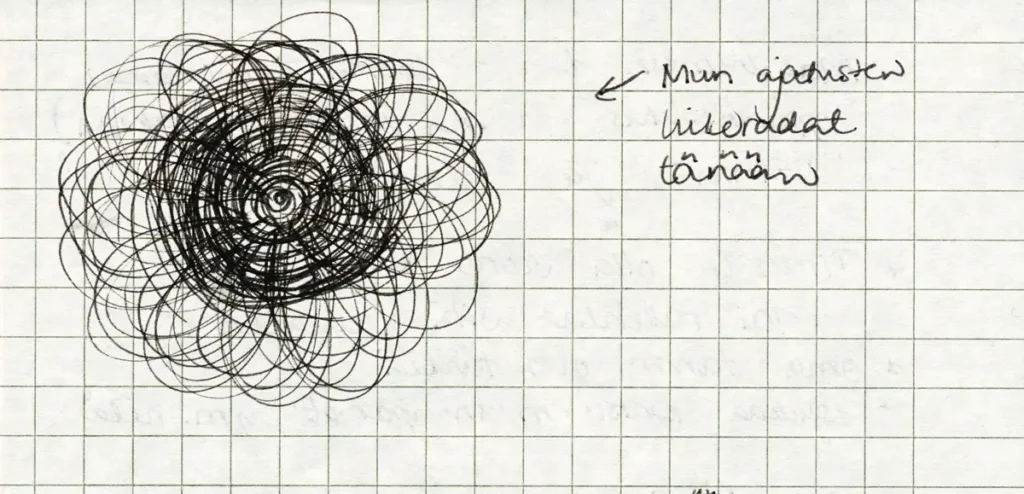
This Syherö—in Finnish, a hybrid of words meaning tangle, knot, and scribble—as one of the children called it, while another described it as a flower, served as a central agent in the Lines of Flight activity, pushing my thinking in several new directions. It also became a defining image during my fieldwork, crystallising my questions about how to balance the new with the old, risk with safety, and guidance with free exploration. This balancing was not an easy task, nor did it lead to linear progress; instead, it unfolded as a series of more or less successful experiments that offered rich material for reflection.
Second Translation: From Textual to Visual
2nd translation – Spring 2021
Memory written in spring 2025
Research year 8/8
I am spending time with Deleuze and Guattari’s A Thousand Plateaus (1987). For me, ‘spending time’ is another way of describing the activity of trying to read and grasp the text sporadically, as the work is quite challenging to understand. Fortunately, I find the notes of Massumi, who translated the work, which explain the meaning of the term flight/escape as encompassing ‘not only the act of fleeing or eluding but also flowing, leaking, and disappearing into the distance’ (Deleuze and Guattari 1987, xvii). Returning to my working diary, I notice that my drawing suddenly glows (MacLure 2013) with new significance. A real-life experience of the concept of lines of flight begins to emerge as my drawing is diffracted through my expanded understanding of the concept, based on the words of Massumi I just read.
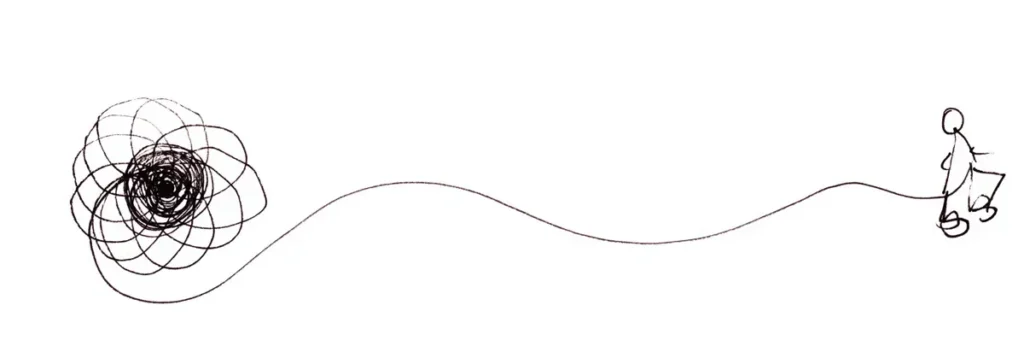
This layered version of the original image of the Syherö became both a visualisation and a starting point for our embodied explorations of the concept of lines of flight and the creation of new thoughts during the artistic event. In this process, I was curious to explore how I could work with this theoretical concept in a practical way with children. Furthermore, I wondered whether, and in what ways, it might also allow our thoughts to escape, leak, and dance.
Third Translation: From Thought to Visual
3rd translation – Spring 2021
Diffractive reading of research materials in spring 2025
Research year 8/8
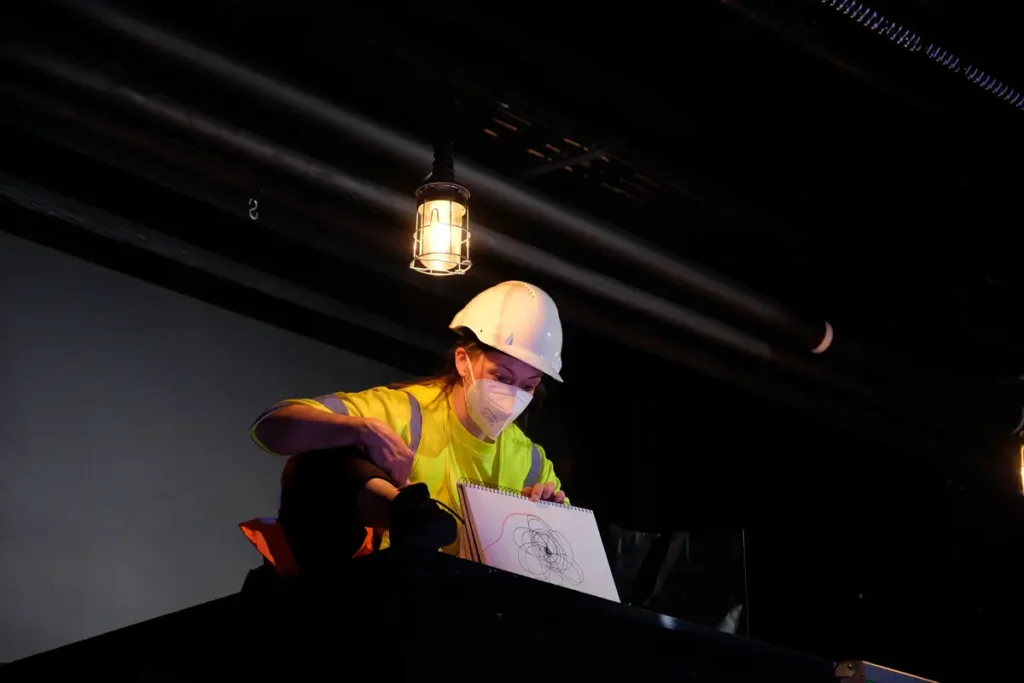
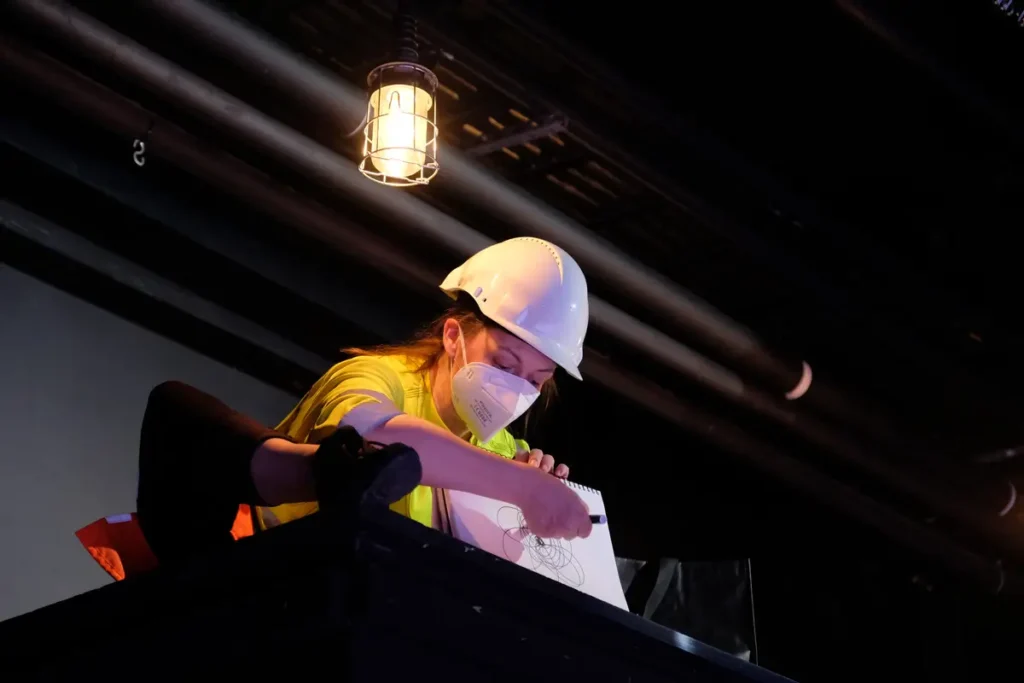
I climb up to the loft and tell the participants that I’ll be sending them messages in a bag, using a string to pull it up and down. The use of the loft is choreographed by the non-human viral particle we call the corona, allowing for a safe distance to be maintained.
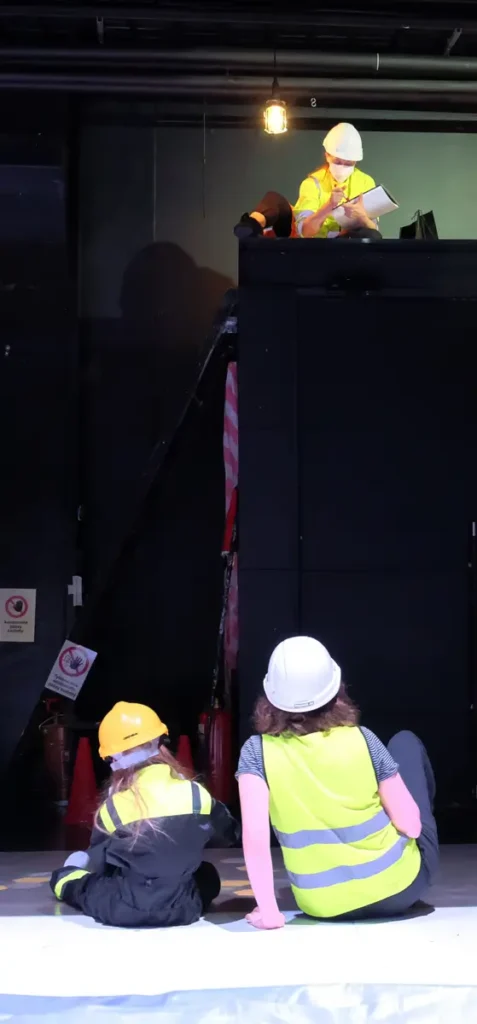
The setup of using the loft situates me in the highest position in the space, which feels uncomfortable. It ends up highlighting the very power dynamics I had hoped to soften. Instead of flattening the hierarchies between child and adult, student and teacher, or audience and performer, it ends up making them more visible, effectively deconstructing my idea of equality. Still, the up-and-down travelling bag is a playful way to correspond with the participants. As soon as the participants receive the picture of Syherö, it awakes interest. The participants had already noticed the same image on the floor near the studio entrance. Recognising it as a familiar element makes the image more interesting. A similar phenomenon was evident in the art exhibition under the bridge, which featured familiar places and settings.
The pedagogical potential of finding something familiar in an unfamiliar space, or something unfamiliar in a familiar one, seems like a significant tool for enhancing committed participation in educational settings. This is an approach that I hope to continue to explore in my dance pedagogical practices, including the children’s and adults’ dance pedagogical group.
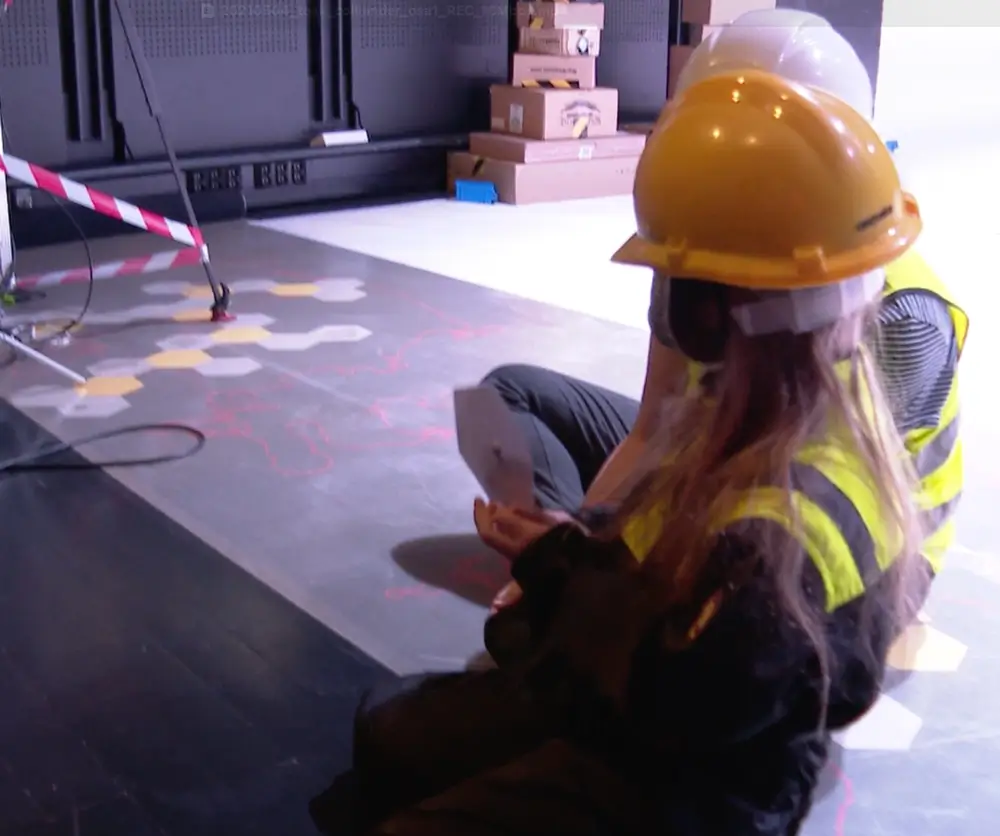
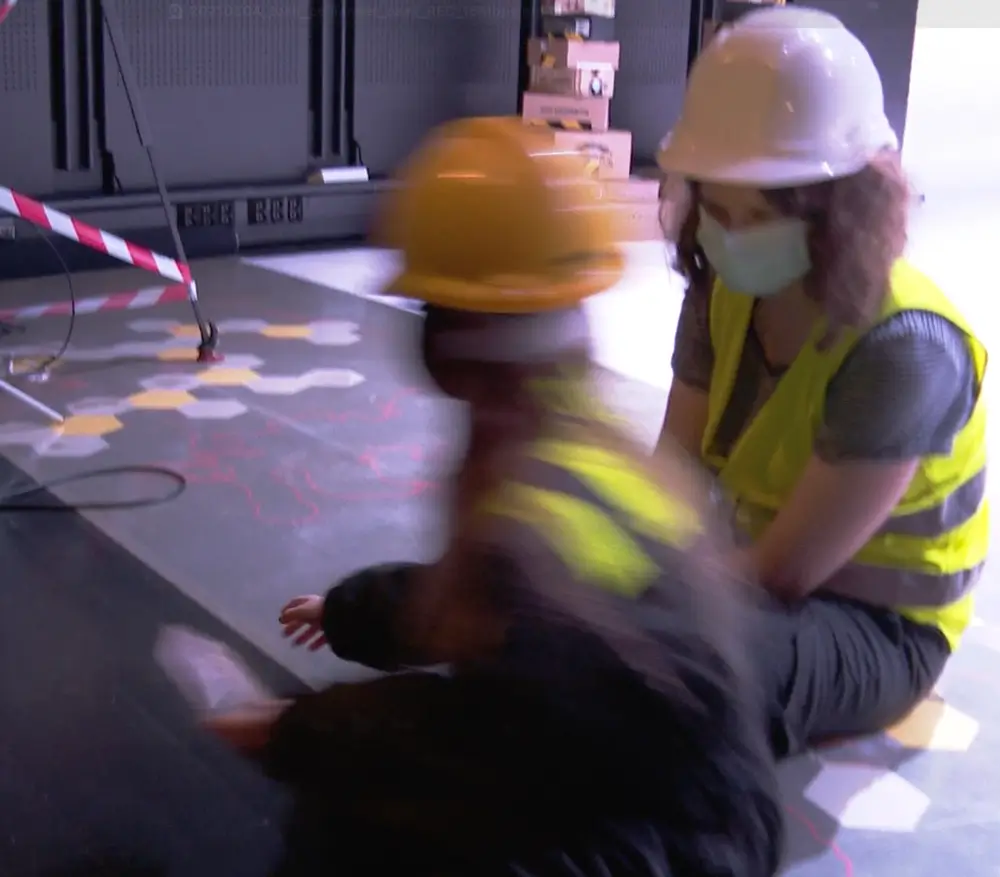
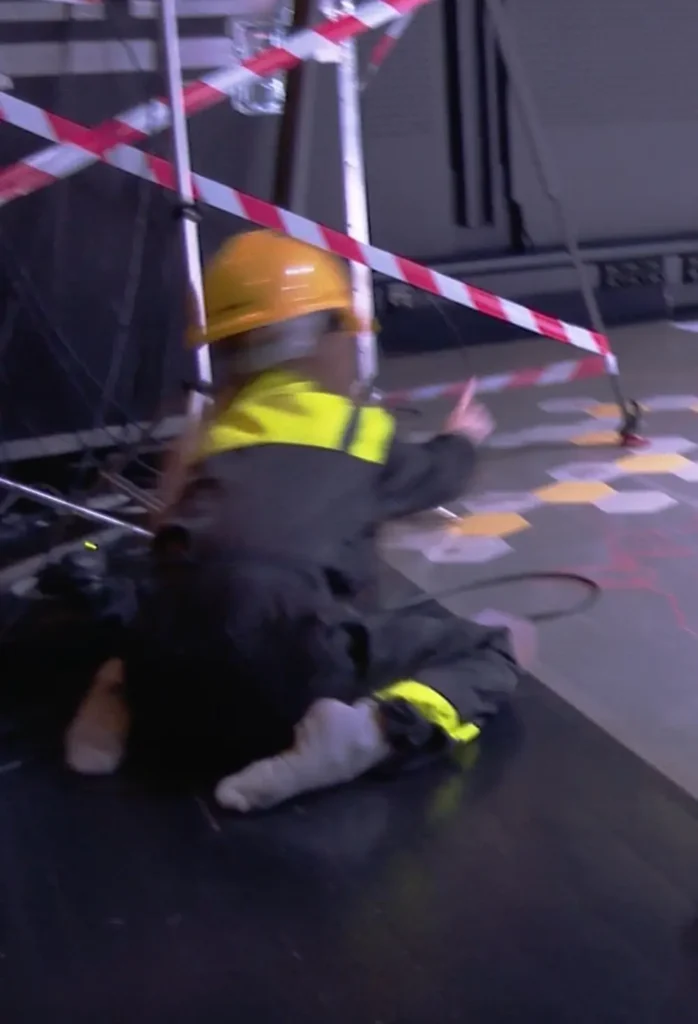
I begin by explaining the concept using the original French term ligne de fuite, which translates into English as line of flight and into Finnish as paon viiva or my own more dynamic translation, pakoviiva. The participating child sits on the floor, watching me attentively as I explain. Gradually, their focus drifts, prompting them to shift their position to lying on the floor. At that very moment, as the child reclines, I explain, ‘Sometimes, a line of flight appears, and your thoughts escape toward something utterly new’. There, I observe the child exploring the sensation of turning their head on the floor while wearing the helmet. In retrospect, this subtle inquiry registers for me as the appearance of a line of flight that could open various pathways to novel ways of dancing with the helmet. Or exploration of the weight of the head. Or how the body follows the movement initiated by the head. Or, or, or…countless other options. Yet during the event itself I don’t notice this. My rich verbalising continues, which I translate, with feelings of annoyance and dissatisfaction, into a drawing in which speech flows from my mouth like an open tap.
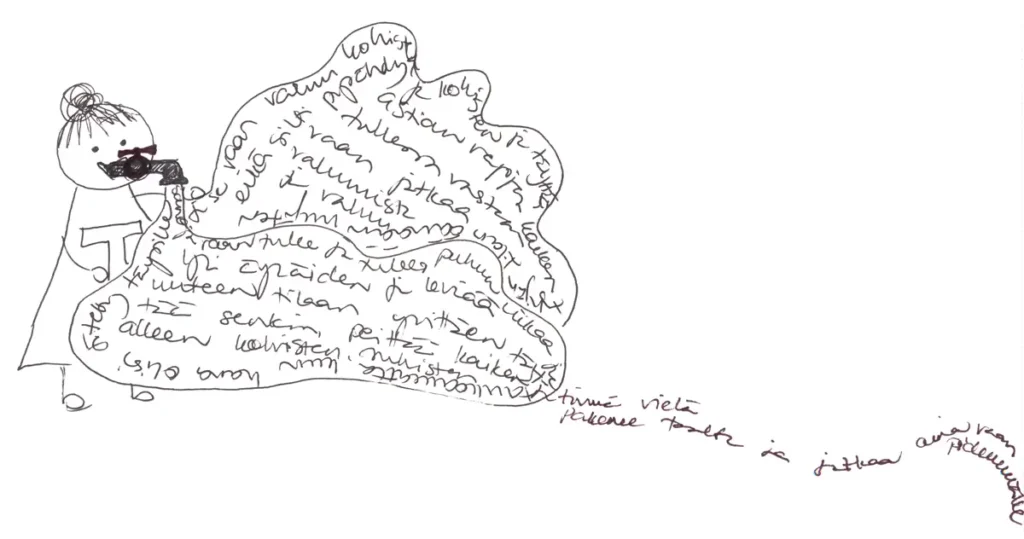
I use my power of verbalising which allows me to guide, instruct, ask, invite, and encourage. This creates a highly regulated, predefined space filled with control. By applying Deleuze and Guattari’s (1987) concepts of smooth and striated space, I can see how my speech shapes and constrains the space, what they call ‘striating’ it. Ideally, for new and spontaneous lines of flight to emerge, the space should be smooth, but my rapid guidance tends to cover and limit that possibility. The more I speak, the more the activity’s space and time become confined.
Having only a pair of visitors instead of a larger group makes me feel as if they were under a magnifying glass, aware that even the smallest actions within the space could become exaggerated. The absence of a collective dancing body alters the dynamics, making it difficult to create an organic shift into dancing. Additionally, the space becomes even more striated due to the pandemic and my health concerns, which limit opportunities for embodied interaction. As a result, there is less dancing and more speaking on my part at the event than I had initially hoped for. It seems that my increased speech reflects my sense of response-ability, as I aim to provide enough guidance to ensure a safe environment for both the participants and myself, who feel both excited and somewhat timid.
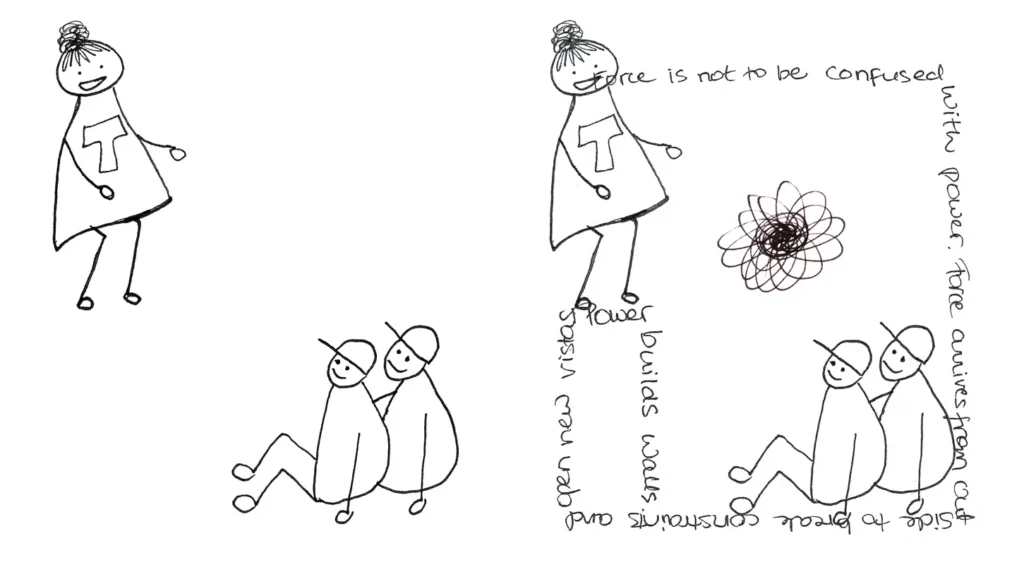
Scrolling through the textual materials during my diffractive reading–pedagogical documentation process, I come across a quote from Massumi’s foreword (Deleuze and Guattari 1987, xiii), that I have earlier underlined as a signifier of importance. Massumi states: ‘Force is not to be confused with power. Force arrives from outside to break constraints and open new vistas. Power builds walls.’ Diffracting through the videos, images captured from it, previous drawings, Massumi, the sequence of translations around Syherö, and my not-yet-verbalised experiences becomes pedagogical documentation as diffractive drawing.
Here, I understand the power of my words as constructing the very walls of a space I never intended to build. Instead of trusting a less detailed articulation as a grounding on which we could collaboratively re/de/construct, I speak to counteract the viral and affective agencies that have pushed me beyond what I understand as a safe space. At the same time, my analytical gaze as another force begins to expose this space and, in doing so, opens new vistas for my evolving understanding.
Finally, I let the participants start creating: ‘Let’s invite the philosophical concept to dance with us. You can let your lines of flight dance on paper, and then we will dance the lines with our bodies.’ The participants’ creativity is limited to following the task of drawing their thoughts on the sheets of paper they have received.
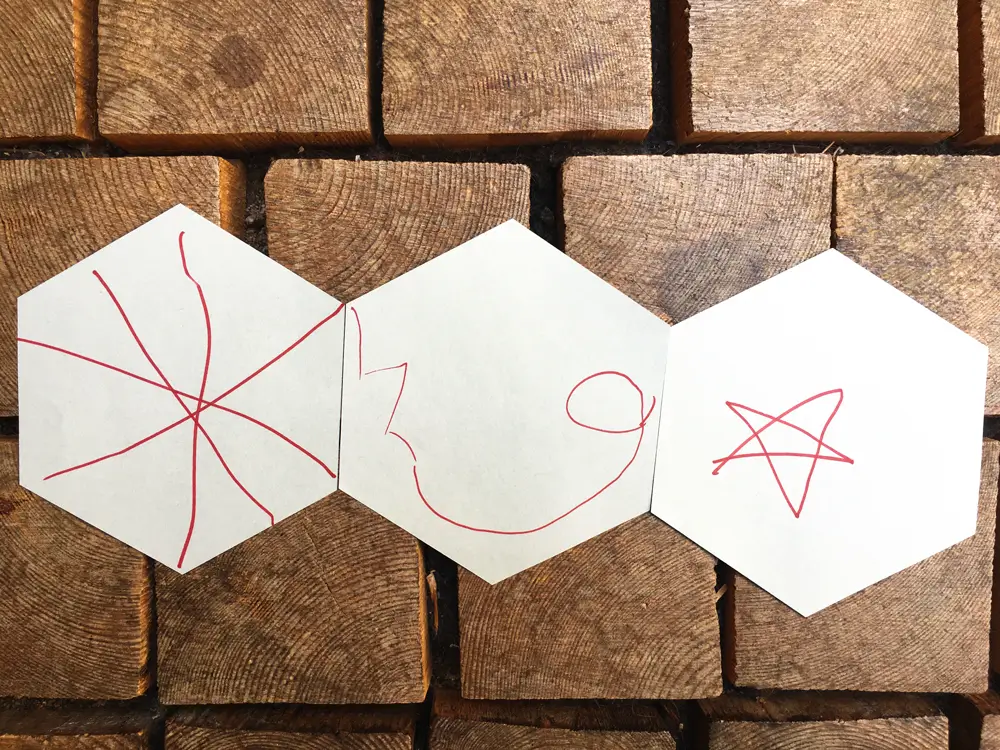
However, they place their papers on the floor, take the markers, and begin creating. The child works quickly, drawing straight lines across the hexagonal paper while declaring, ‘Viiva, viiva ja viiva’ (‘a line, a line, and a line’). The accompanying adult interprets this as ‘Teit tähden’ (‘you made a star’). Surprisingly, this comment steers the child’s subsequent drawing: the child renders a five-pointed star with a single continuous line.
Even though the adult’s comment may seem like an innocent remark, this moment heightens my awareness of how educators’ interpretations can shape creative trajectories, reinforcing my concerns about verbal dominance in these processes. However, in this pressurised situation, the adult’s interpretation may also have functioned as a warmly welcomed stimulus for the child’s creative process. As an educator, one can never fully anticipate outcomes in advance. Therefore, I acknowledge the importance of recognising the agency of our words and actions as impulses that shape the direction of activities.
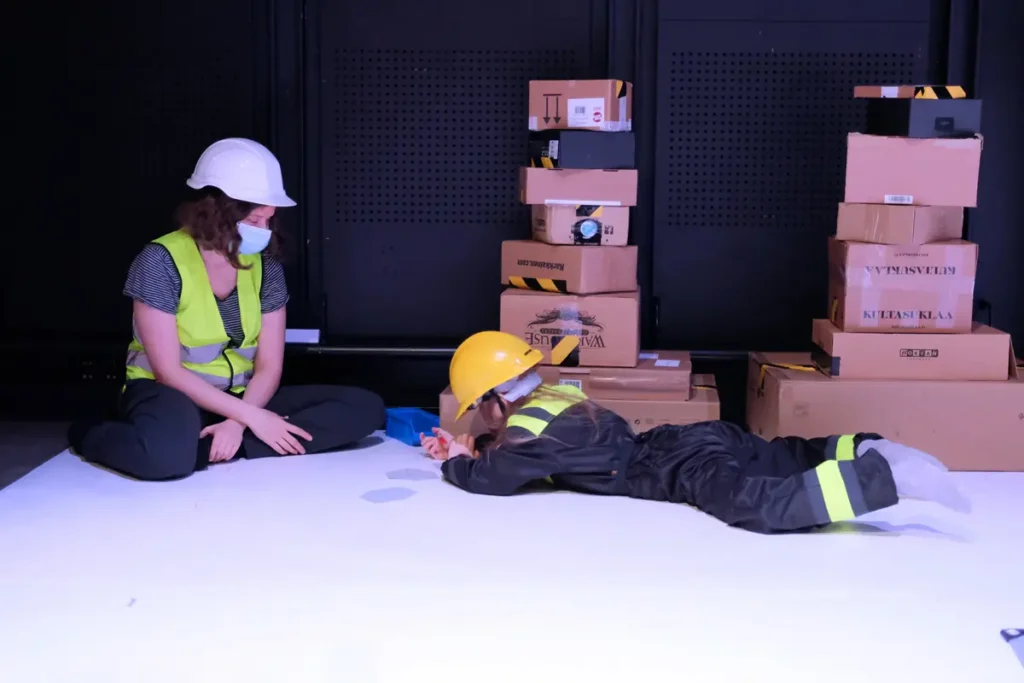
Fourth Translation: From Visual to Embodied
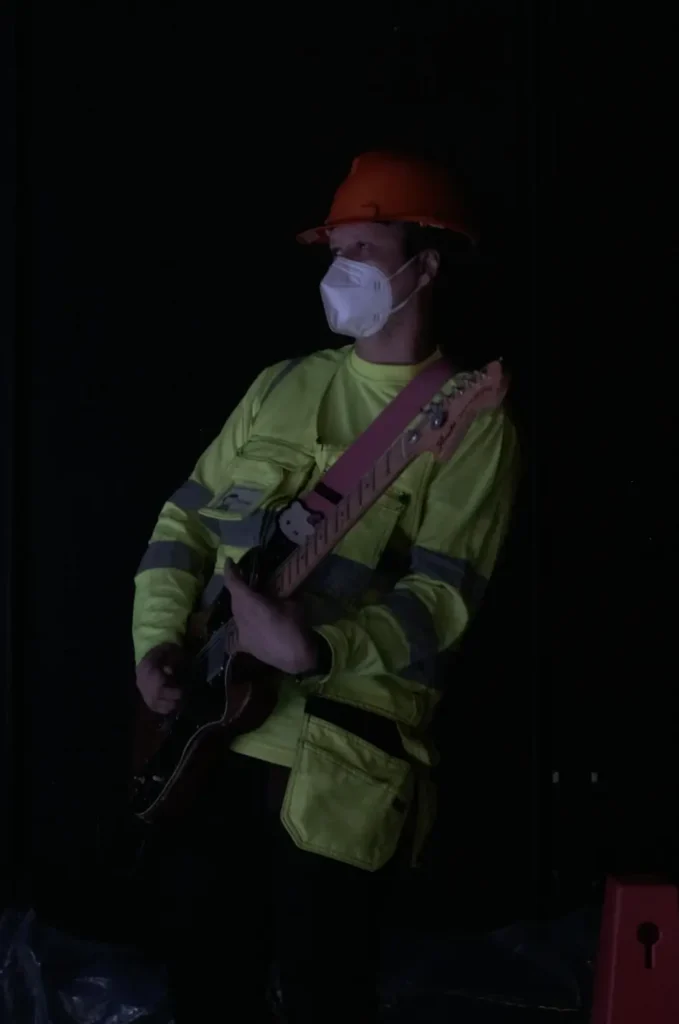
Next, the drawn lines are translated into movement. Simultaneously, a live musician transforms them into sound with his electric guitar. Everyone is invited to express what kind of movement, shape of the body, or pattern in space their line would become. In the video, this appears to be a very pressing situation: coming up with an idea like that on the spot. To my amazement, the participants take up the task and create movement. I am speaking–leading–guiding–dancing with them.
I propose that we start with my drawing as an example, trying out how to dance the line with our hands. Raising my hand diagonally upward, I wait for the music, which joins in as my hand initiates a twisting dance, leading me from an upright position down to the floor, where I end the dance with a spin on my knees. The children mirror this movement with instantaneous responsiveness. We repeat the exercise, interpreting the line with our feet. I then ask what other body parts might dance it. One of the children places a finger to their lips. Interpreting this embodied cue, I propose: ‘Suulla. Kokeillaan.’ (‘With our mouths. Let’s try it.’) The children execute the dance with striking precision, guided by their mouths. As they descend, their heads remain deliberately supported, yielding an unusual movement quality, irregular, angular, and free yet imbued with clear intention.
This is a conductive example of improvisation-based work with children as equal artistic agents alongside adults. In it, I invite them to explore unfamiliar ways of moving and using their bodies, with clear intention in their dancing. This process may lead to interesting approaches that allow for the simultaneous presence of playfulness and seriousness, creating unique, novel ways of moving.
29th April 2021
Working with video
Research year 4/8
There is an ongoing intra-action between music and movement. The impulse from music to movement and from movement back to music and then back to movement again. A back-and-forth movement, as in Gadamer’s (1960) theory of play or in dance improvisation. In this moment, the guitar’s live sound becomes a dance partner with powerful agency. The bodies and the sound move into an intra-active relationship and compose a more/other-than-human assemblage. This assemblage produces choreography without an individual author, as the dance emerges from a collective assemblage of our voices.
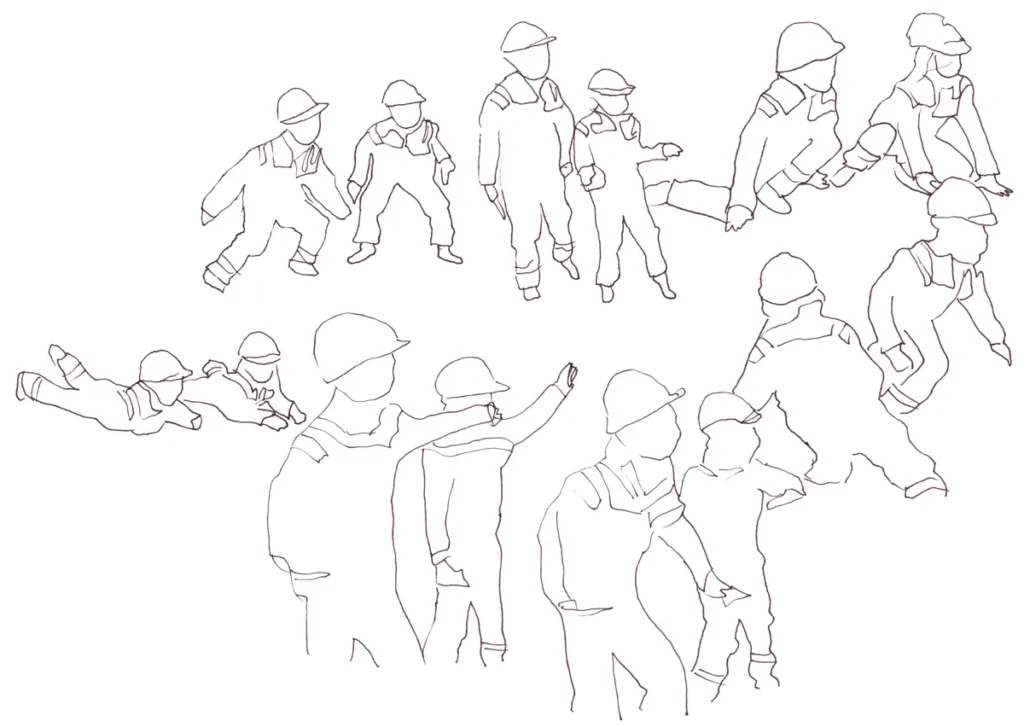
Although the moments of dancing are brief, the simultaneous translation of drawn lines into movement and sound creates a line–body–sound–space entanglement that feels more like an ongoing becoming of all the participating elements, rather than a deliberate interpretation of the visual images through dance. In the video, this experience becomes re-enacted and highlighted, as there are sections where only the participants are visible. Suddenly, my body intensifies. There is a fleeting sensation of perceiving ‘me’ through ‘them’ in ‘their’ movements—not as a reflection, but as an emerging diffraction of ‘us’ in constant becoming.
12th October 2021
Working with video
Research year 5/8
I love the reflection of my movement in the actions of the participants: I don’t see what I do, but I see myself through them. I see myself through their movement. I see ourselves becoming in our movement.
Surprisingly, this exploration of lines of flight through dance mainly unfolded as an embodied experience of intra-action—a complex theoretical concept central to my research. This process offered a deeper, experiential understanding of intra-activity and provided a way to explore and experience it within the context of early childhood dance pedagogy. Additionally, it reinforced my finding that dancing-with theory is a valuable and fruitful approach in dance pedagogical research. Or, ‘a bit difficult, and a bit strange’, as one of the children articulated it.
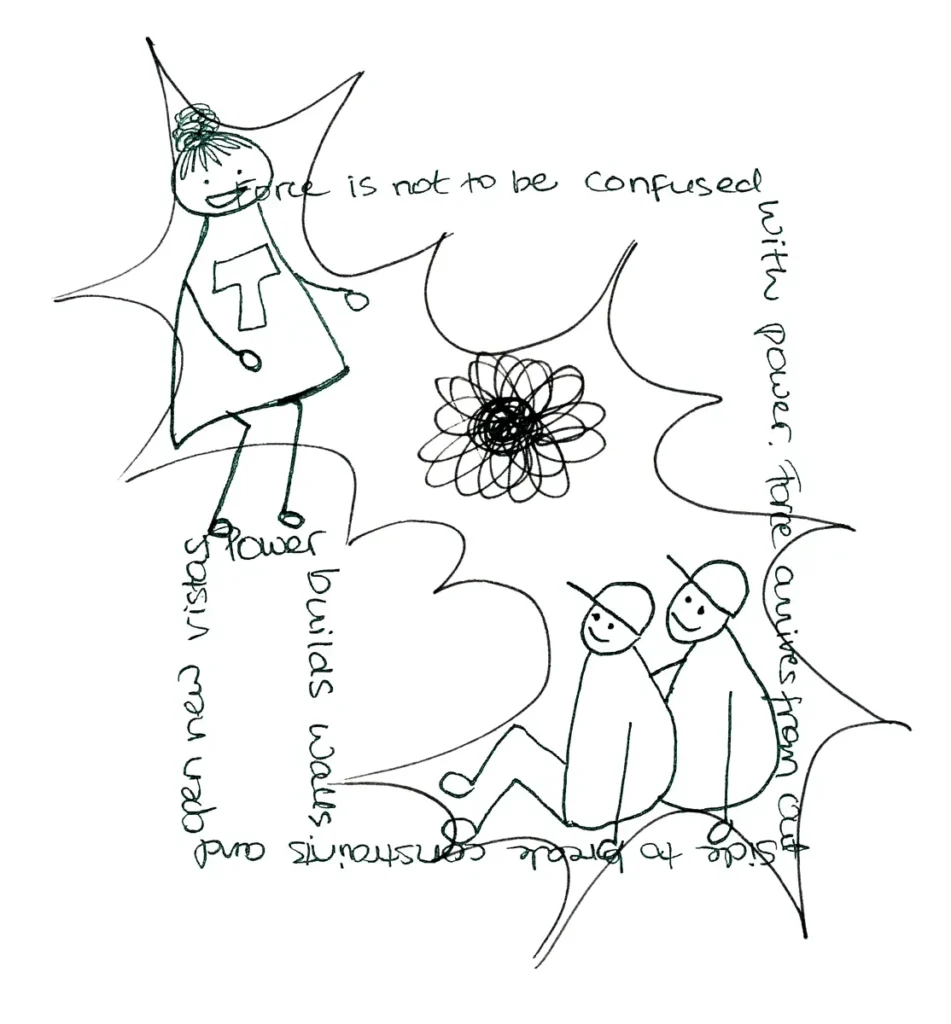
The intra-active space emerged around and through us, with the multiple nonhuman forces as our co-choreographers, pushing and pulling in different directions, working with and without the striations of the space.
Several months later, I re-turn to watching the same phase of activity, now from the pre-examined visit. The movements are shown, music is played, dances are danced, all very briefly and quickly.
12th October 2021
Working with video
Research year 5/8
These are little bits of movement, like little verses of a poem.
I rewind and watch the short movement phrases multiple times before I realise that I have to dance with the video, even though I have not prepared for dancing-with the video this time. I am at the Theatre Academy, in my office. The building is closed, which means I do not have access to the dance studios. The researcher’s lounge is spacious enough for dancing. I place my laptop on the dining table and start dancing-with the video. The video runs fast into the second and the third drawings, but I don’t care. I do what my body invites me to do: spend time with each thought–drawing–movement assemblage. The soundscape does not match anymore, but I don’t care. I breathe with the movement, with the participants, even with Massumi. I repeat this with all three drawings from the pre-examined event. After I feel that I have found the essential quality of all three drawings, I translate them into a storyboard choreography.
I dance the choreography a couple of times and document my process with the Verbs and Lines exercise.
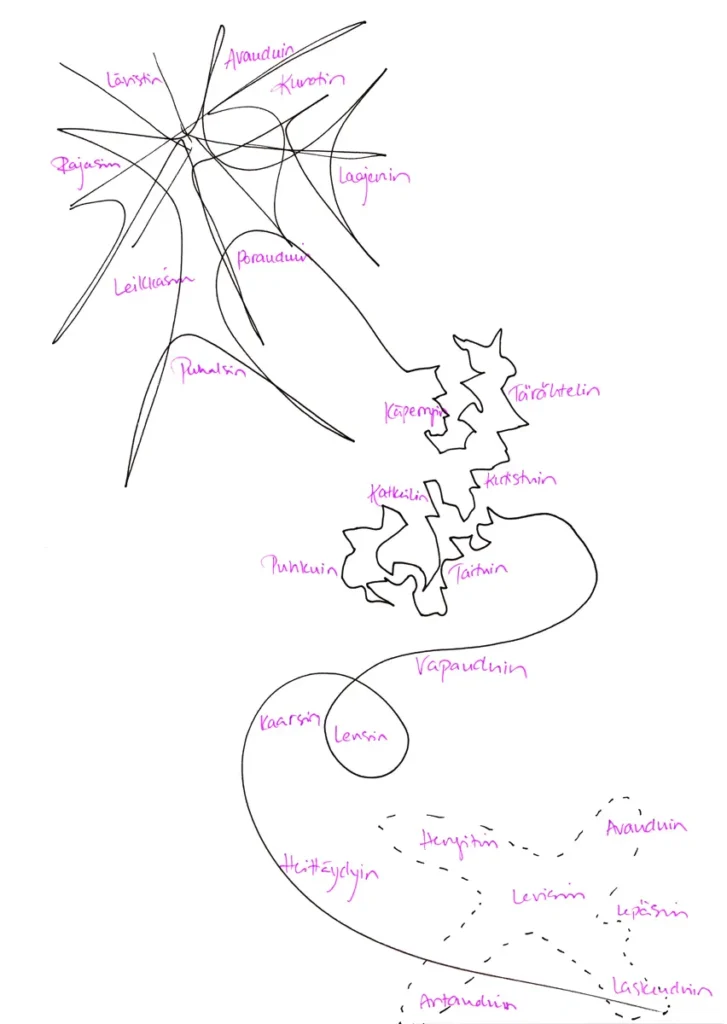
Verbs in the first phase: Opening, Cutting, Blowing, Drilling, Expanding, Penetrating, Outlining, Reaching.
Verbs in the second phase: Curling up, Trembling, Shrinking, Breaking/Snapping, Puffing, Folding.
Verbs in the third phase: Releasing, Flying, Rounding, Plunging.
Verbs in the fourth phase (marked with a dashed line): Breathing, Opening, Resting, Descending, Surrendering, Expanding.
This is my dance. This is also a reflective diffraction of my research process with the pre-examined artistic part, and the story of the fillyjonk.
The drawing could serve as a proposition for the reader: What kind of dance would you create in the space where you are encountering this proposition? Which verbs and lines would be included in pedagogical documentation of that dance?
Fifth Translation: From Artistic Expression to Pedagogical Documentation
After dancing, I ask the participants to attach their sheets of paper to a collective artwork on the studio wall, which continues to grow and expand throughout the event.
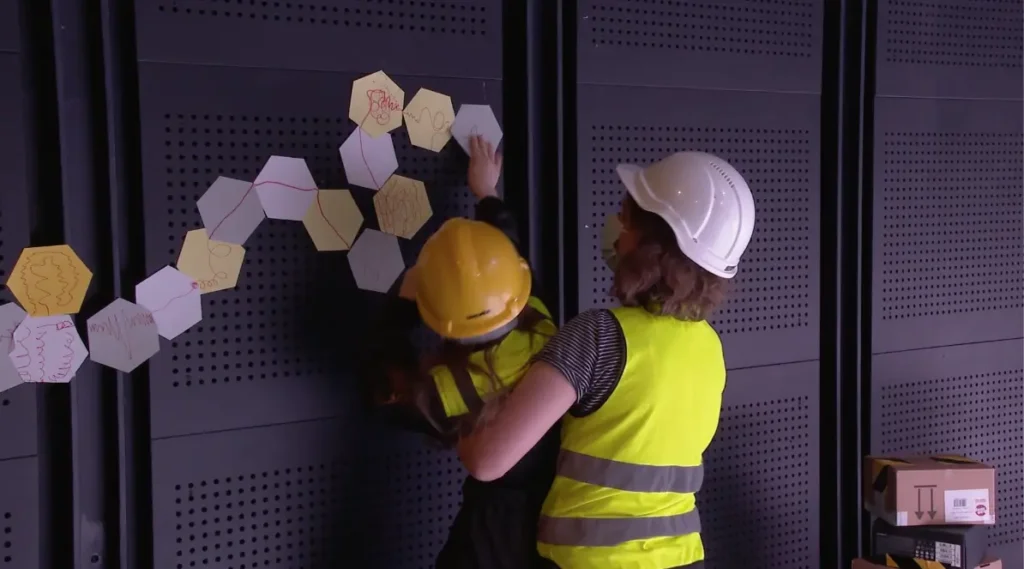
Viewing the captured moment as an image feels heavy and uncomfortable in my body. Memories of lifting a child and reaching high to attach something just beyond my reach reawaken sensations within me. Conversely, the long, linear structure of the work, with the red line as a connecting element, transforms into an image of a caterpillar with visible intestines. This image resonates with my transformation as a researcher into a caterpillar, providing a relevant visualisation of my thought process with the diffractive material serving as nourishment. Furthermore, I envision how inspiring it would be to create dances with children on themes such as caterpillars, food, the digestive process, and the eventual outcome of digestion, which could foster significant embodied learning opportunities.
Sixth Translation: From Explosion into Insights
As the concluding translation, I will present my diffractive reading of the lines of flight activity through the layered image of my pedagogical documentation, which is diffracted through the previous layers of the documentation and the subsequent drawing from the flyer.
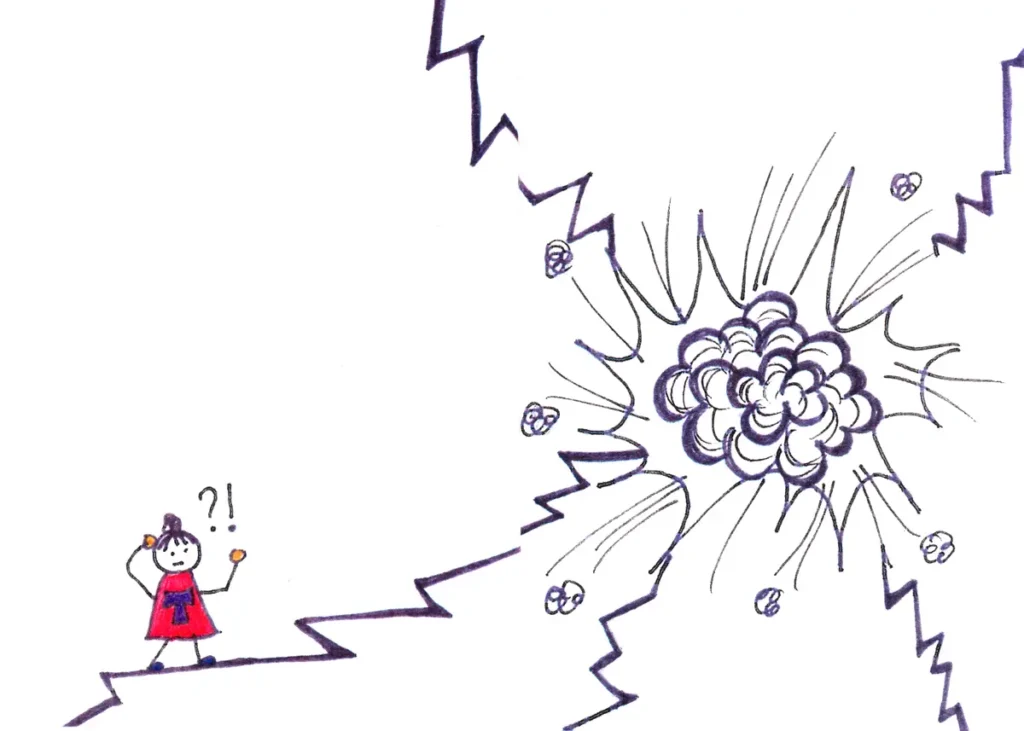
The process of drawing was guided by my research question: What new possibilities for dancing–teaching–researching does the pre-examined artistic component open up? This process re/de/constructed my assemblages of dancing–teaching–researching and writing–drawing–thinking, which unfolded through my pedagogical documentation of the iterative inquiry process. My aim was to articulate my evolving understanding, which is emerging through an assemblage of drawings, texts, and embodied experiences, thereby fostering multiple and emergent relational epistemologies.
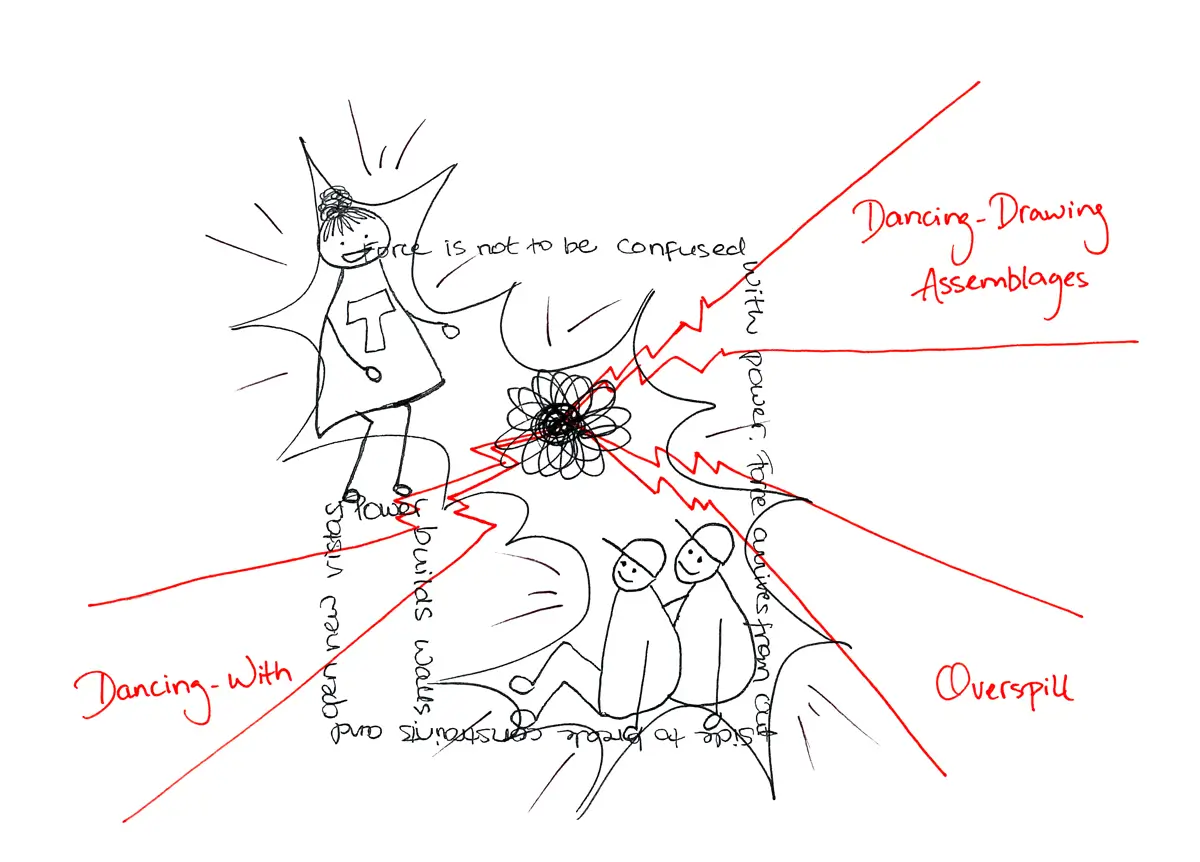
Here, following Massumi, the force has broken the constraints and opened new vistas. The further discussion proceeds through three interconnected openings: dancing–drawing assemblages, dancing-with, and overspills, which serve as extensions of the pre-examined artistic component. These will be addressed in the thesis piece ‘Reflecting’ on the Openings through Discussion.