In this section, I discuss avenues for further research that emerged from this study, theorising them as overspills of research (Millei and Rautio 2017). While the original meaning refers to material that goes beyond the initial research engagement, I use the concept here to propose future research directions and explore how insights from my study can be applied in ECEC and across various educational contexts.
6.3.1 Improvisation-based Intra-active Dance Pedagogy in ECEC
International research increasingly supports the idea that dance in ECEC provides multiple benefits, in line with holistic arts education frameworks (e.g., Anttila 2003; Anttila et al. 2017; Flønes 2025; Jusslin 2020). Beyond supporting the development of motor skills, dance can cultivate greater self-awareness and a more profound connection to the body (e.g., Payne and Costas 2021) while also encouraging the formation of sustainable relationships, not only with other humans but also with other living beings and the environment (e.g., Foster and Ojanen 2025; Svendler Nielsen et al. 2023).
Based on my understanding of dance’s positioning within ECEC, and shaped by an overview of current research, theoretical insights, and my own experiences, I have developed an illustration that visualises three different ways in which dance can be positioned in ECEC.
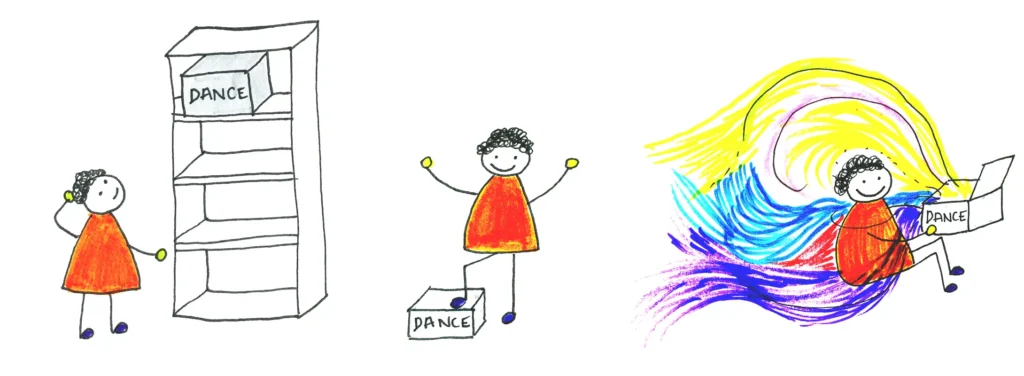
The left illustration represents a scenario in which dance is absent from ECEC settings, and hence is not within the reach of the child. This absence may stem from the lack of an adult with the competence or confidence to facilitate dance activities, coupled with a tendency to prioritise other forms of arts education over dance.
In the centre, dance is available to children, but its full pedagogical potential remains underutilised. This situation may arise from a narrow conceptualisation of dance and limited adult expertise, resulting in adult-led, structured activities that apply dance as a ready-made motor exercise, emphasising rule-following over embodied creativity and expression.
On the right, the full potential of dance in ECEC is realised. Children have access to dance in ways that enable diverse and holistic engagement. Here, dance is integrated into ECEC through a broad understanding that permeates multiple areas of learning and becomes embedded in children’s daily experiences. This integration is made possible through inclusive pedagogical approaches that support flexibility and response-ability in dance education.
In the following sections, I further diffract this illustration through a discussion of the potential of dance within Finnish ECEC. I address dance both as an integrated element of the curricular framework that extends beyond the domain of arts education, and as a site for inclusive practices that make dance accessible to diverse learners.
Dance as Integrated into ECEC
While the benefits of dance for young children’s learning and development are well established in the literature, as outlined in the previous chapters, and art integration is a common practice recognised by most ECEC teachers, the implementation of dance seems to be lacking in everyday ECEC both in Finland (Cortez 2024) and globally (Stevens-Ballenger and Wilson 2024; Areljung 2023; Chapman and O’Gorman 2022). Previous research on the integration of dance across school subjects suggests that dance can serve as an effective pedagogical approach to engaging learners holistically and enhancing their enjoyment of learning (Anttila 2013; Jusslin 2020). In addition to fostering learner engagement, dance has been shown to support dialogue among learners (Anttila 2015), promote a sense of communality (Anttila 2013), and contribute to overall quality of life (Anttila and Svendler Nielsen 2019). Furthermore, the incorporation of dance holds the potential not only to support subject-specific competencies but also to advance broader educational aims (Korpinen 2024).
In this research, I identify a promising approach to enhancing the integration of dance in ECEC through the concepts of play and embodiment, both of which are recognised in the Finnish ECEC curricula as central to learning through bodily experience and whole-body engagement. The curriculum highlights the development of body awareness, control, and expression as key learning objectives and emphasises the embodied nature of children’s initiatives, as well as the importance of respecting one’s own body and the bodies of others (EDUFI 2018; 2022). Positioning dance within the broader framework of embodied learning and as a form of embodied play can thus support these curricular goals.
Dance can be understood as part of a broader framework of embodied, movement-based approaches to learning, which I refer to as embodied learning. Following Anttila’s pioneering research in this area (e.g., 2017; 2015), particularly within Finnish primary schools (Anttila 2013), and her recent extensions into embodied language learning (Anttila et al. 2024; Jusslin, Lilja, and Anttila 2024; Jusslin et al. 2022), this connection aims to deepen the understanding of embodied activity as essential to children’s learning and meaning-making. This approach offers an alternative to conventional dance practices by shifting the focus away from the development of physical skills, motor abilities, or specific dance techniques and instead emphasising experiential, relational, and conceptual aspects of movement. This perspective closely aligns with my pedagogical aims in dance, which similarly emphasise bodily engagement and movement within improvisation-based, experiential learning. These aims position dance both as a distinct artistic domain and as what I term a more-than-dance phenomenon, highlighting its significant potential to foster interdisciplinary connections across diverse areas of learning.
Incorporating dance into the broader framework of embodied learning in curricula could be an effective way to promote it within ECEC to resist educational policies that threaten the value and existence of movement-related experiences in learning. However, embodied learning is a conception of learning that challenges us to rethink the role of the human body in education. Including dance and embodied learning in curricula would require an epistemological shift, a broadening and rearticulation of the conception of knowledge to encompass embodied, experience-based, and sensuous forms of knowledge. (Svendler Nielsen et al. 2023)
From a posthuman perspective, the integration of dance into ECEC can be theorised as an entanglement of dance with daily routines and materialities. This view supports the idea that learning does not occur only in isolated dance education sessions, but everywhere and all the time as children engage in becoming with their world, particularly through play. Whether I observe children’s play from the outside or participate in it from within, I see it as a physical mode of expression in which the child acts with full creative agency. This perspective establishes a strong connection between dance and play, positioning dance as a form of physical play. Extending the idea of play as a mode of being and learning through embodied dimensions, dance can become deeply integrated into ECEC practices.
Dance as an Inclusive Practice in ECEC
Inclusion, the equal participation of all children in pedagogical activities, has become a crucial issue in early childhood education, including arts education (e.g., Sutela 2023). The growing diversity in ECEC appears to lead to more complex learning events and varied demands, underscoring the need for more inclusive pedagogical practices. Dance could serve this purpose well, as highlighted by a study by Arvola, Liljeroth, and Reunamo (2023) on the connection of physical activity to children’s participation, focusing specifically on culturally and linguistically diverse children in the Finnish ECEC context. Their study showed that engaging in physical activity was associated with increased and sustained involvement in learning, suggesting deeper, more integrated learning processes.
Thus, approaches that focus on embodied activities rather than language might represent an easier way to establish a common context, benefiting all children in ECEC. This aim could be accomplished by enhancing learning methods through multimodal approaches, with dance serving as a prime example as it is inherently linked to music and other art forms (Pastorek Gripson, Lindqvist, and Østern 2022). Furthermore, presenting and allowing simultaneous alternative pathways to participation, and increasing collaboration with the teacher—who is equally engaged in learning on an embodied level—would be a valuable way of increasing the accessibility of dance, making it a counterbalance and an alternative mode of learning. Such an approach would offer children more equitable opportunities for active participation in learning, while also validating and empowering them by allowing space for their unique ideas, thoughts, and responses. The open-ended nature of these practices supports not only individual expression but also the further development and expansion of children’s personal meaning-making (Svendler Nielsen et al. 2020; Svendler Nielsen and Samuel 2019).
However, the increasing emphasis on enhancing inclusion appears to conflict with the limited resources available in educational contexts. This tension makes it challenging to ensure the equal participation of all children within our current educational framework (Sutela 2023). As such, teachers could greatly benefit from cultivating a heightened sensitivity through embodied and multisensory modes of listening—an attentiveness that might simultaneously enhance their capacity to respond creatively and flexibly. Such attunement could enable educators to acknowledge children’s needs for additional support while respecting and honouring their emerging initiatives, thereby fostering inclusive and responsive pedagogical environments.
This expanded sensitivity could be supported by the methodological assemblage of Hunting–Gathering with Embodied Listening, which involves a bodily mode of attunement—a becoming-with both human and more/other-than-human agents—that aims to privilege trust in the body’s responsiveness over reliance solely on verbal communication. This approach echoes emerging perspectives in embodied pedagogy, emphasising relationality and multisensory dialogue, enabling teachers to move beyond conventional instruction towards more inclusive, dynamic, and co-creative educational practices.
To conclude, inclusive approaches could advance democratic values and equal participation, not by assuming identical provisions for all, but by respecting individual needs and affirming everyone’s right to what they require. This orientation would provide all children with equitable opportunities for active engagement in learning and validate their unique ideas, thoughts, and responses. Such open-ended approaches also support the personal growth and expansion of creative ideas, fostering empowerment through inclusivity.
6.3.2 Future Directions
ECEC plays a critical role in shaping the accessibility of early childhood dance education, as it constitutes the broadest institutional context of childhood. One compelling future project for practice-based dance education research in the Finnish context could focus on the transition between preschool and primary education. I will explore this significant educational phase with the support of various research projects in this area of interest.
Early childhood education is becoming increasingly linked to Finland’s basic education system, both of which are grounded in shared values such as inclusion. A recent Finnish study, Lapsibarometri 2025, reveals both children’s appreciation for preschool, especially play, and their dissatisfaction with the growing school-like nature of preschool. At the same time, concerns about declining skills, widening background disparities, and increased learning needs in schools underscore the need to reevaluate early education approaches and curricula. (Tuukkanen 2025) My intra-active and emergent dance pedagogical views align with Ojala’s (2020) perspective that children must be allowed to enjoy their childhoods without premature pressure to adopt adult-like concentration. This view contrasts with the increasing trend of imposing school-like demands in preschool. Instead, it emphasises that early childhood education should prioritise joy, play, and creative exploration to support holistic development rather than exerting early academic pressure. Moreover, the OECD emphasises the crucial role of preschool as a carefully prepared transitional phase that ensures the benefits gained from early childhood education are sustained during the transition to formal schooling. (Tuukkanen 2025)
Research highlights that professional collaboration, understood as relational expertise (Rantavuori 2019), alongside learning through play (Parker, Thomsen, and Berry 2022), can effectively facilitate smoother transitions from preschool to formal schooling. These approaches support children’s engagement and adaptation by promoting continuity in relational and playful learning experiences during this critical educational shift. Extending this line of thought, my study advocates for the integration of embodied learning and play through dance as a supportive strategy to ease these transitions and enhance learning opportunities. Implementing such approaches inherently requires interdisciplinary collaboration, particularly with professional dance educators. This approach entails fostering a process of mutual learning in which pedagogical expertise and artistic practice inform and enhance one another to create a more holistic, movement-rich educational environment (Flønes 2025).
This focus on embodied and artistic approaches aligns with current initiatives in Finland, such as the 2023–2026 development and research project Scenkonst med i lärande (SMIL, in English Performing Arts in Learning). SMIL investigates the integration of performing arts—including dance—into the learning environments of primary and preschool education. By developing methods to support broader learning abilities, school satisfaction, and social skills, and creating a proposal for a performing arts curriculum as part of the national curriculum, SMIL exemplifies how embodied learning can bridge preschool and formal schooling while sustaining creative engagement across the educational continuum. (Uniarts n.d.)
Aligning with the aims of the SMIL project and MacRae and Arculus’ arguments (2020), I conclude that movement-oriented arts practices—including dance, music, and drama—can be effectively integrated into early childhood education through sustained, collaborative development. For smoother transitions between preschool and primary school, I advocate for long-term partnerships that bring together early childhood educators, primary school teachers, and professional dance educators. Building such partnerships between ECEC, primary schools, and dance education research requires sustained commitment, time, and substantial financial investment in contextually embedded initiatives, moving beyond the short-term, one-off project model that currently dominates development and research funding. (MacRae and Arculus 2020)
Looking ahead, expanding these collaborative, playful, and movement-based pedagogies holds the potential to support the transition from early education into primary school through more interconnected, creative, and embodied practices, enriching both children’s learning and educators’ professional work.