In this section, I describe how my collaboration with the daycare centre has continued as a long-term process, even after the abruptly ended fieldwork period, and how this continuation can be theorised as an overspill of research. This overspill includes the daycare centre’s involvement in my pre-examined artistic component, the prototype workshops to develop the children’s version of my thesis, and, finally, the pre-examination of the children’s version of the thesis together with its exploration by dancing in a public examination.
4.3.1 Not/Finishing the Fieldwork
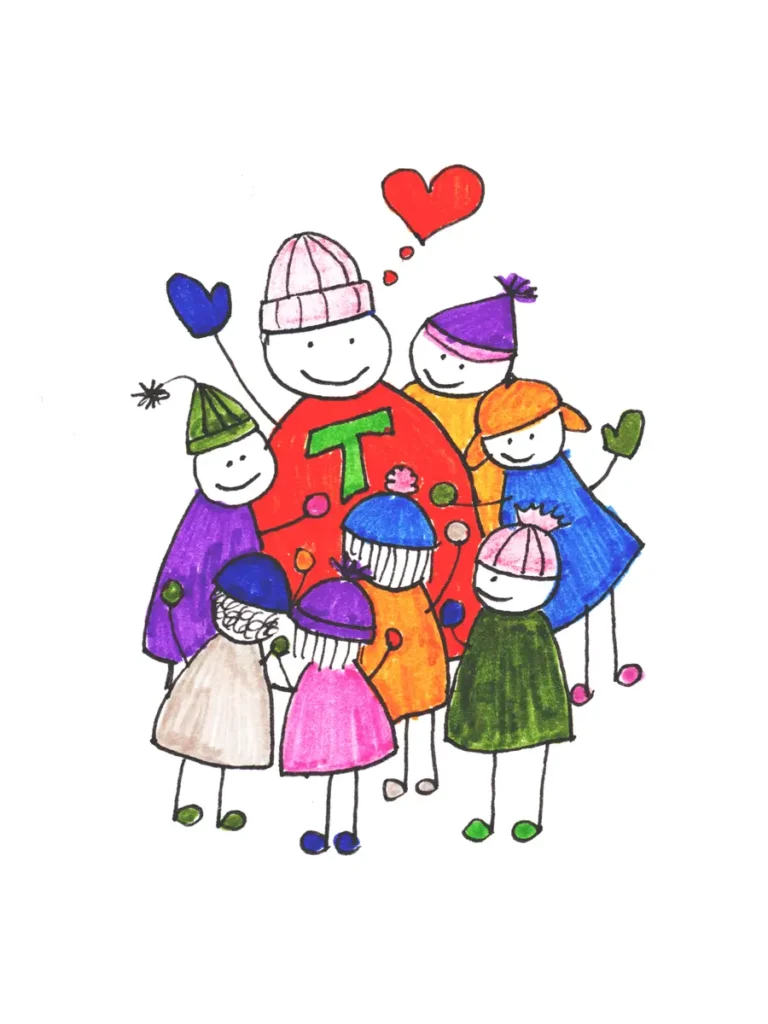
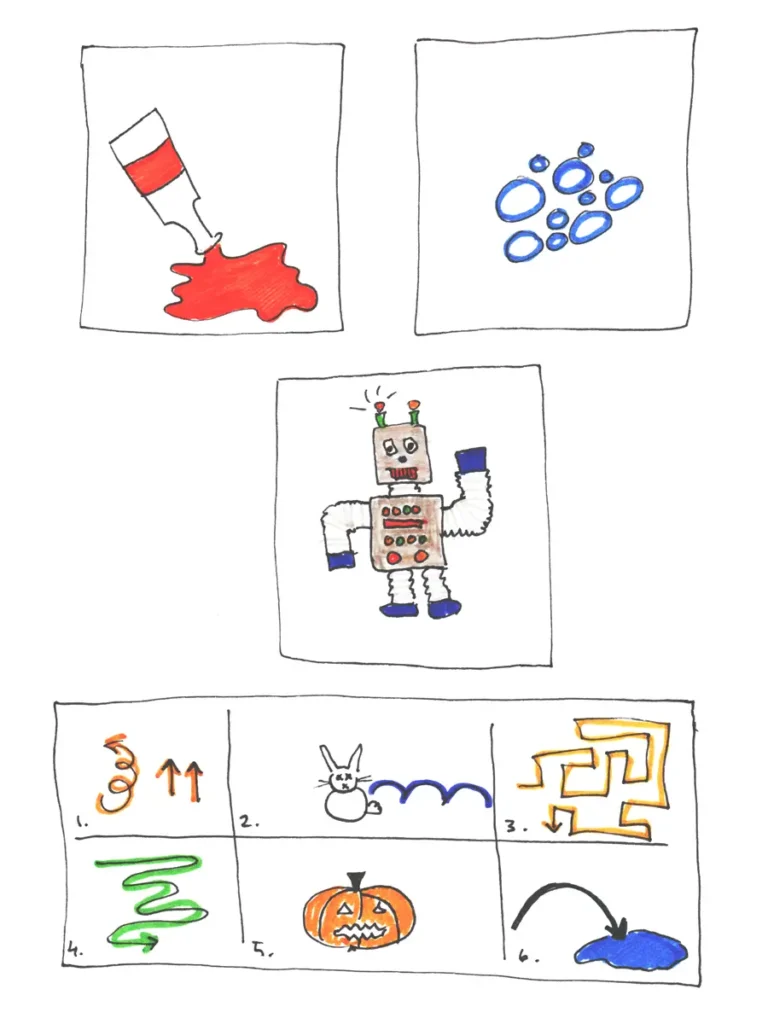
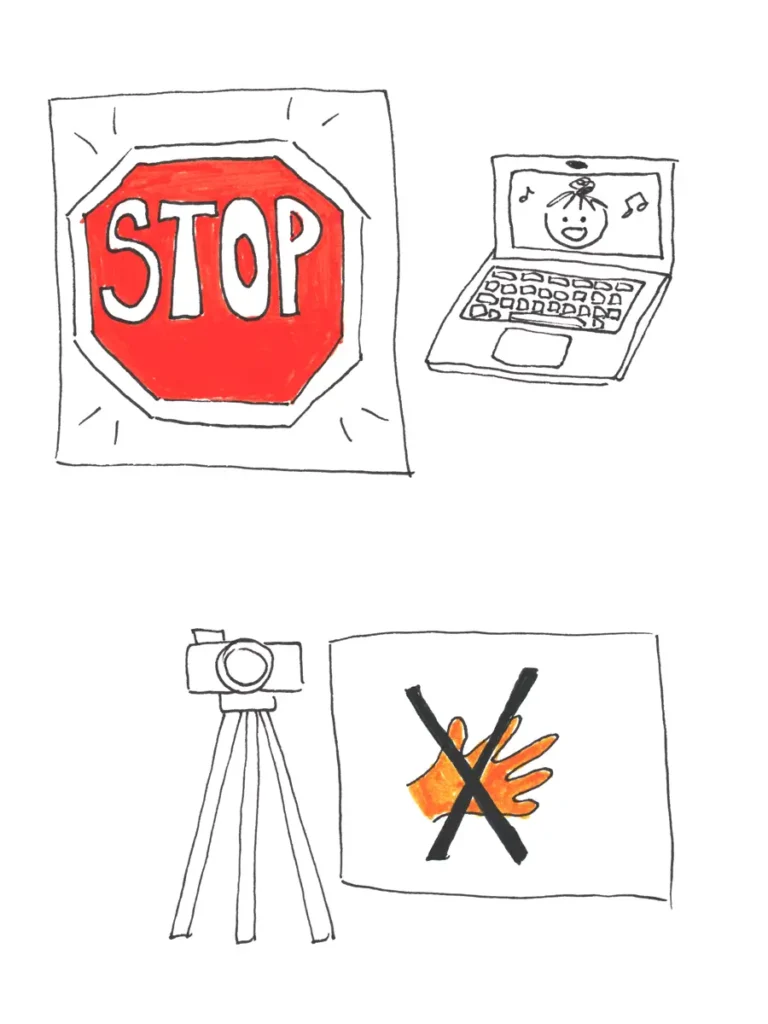
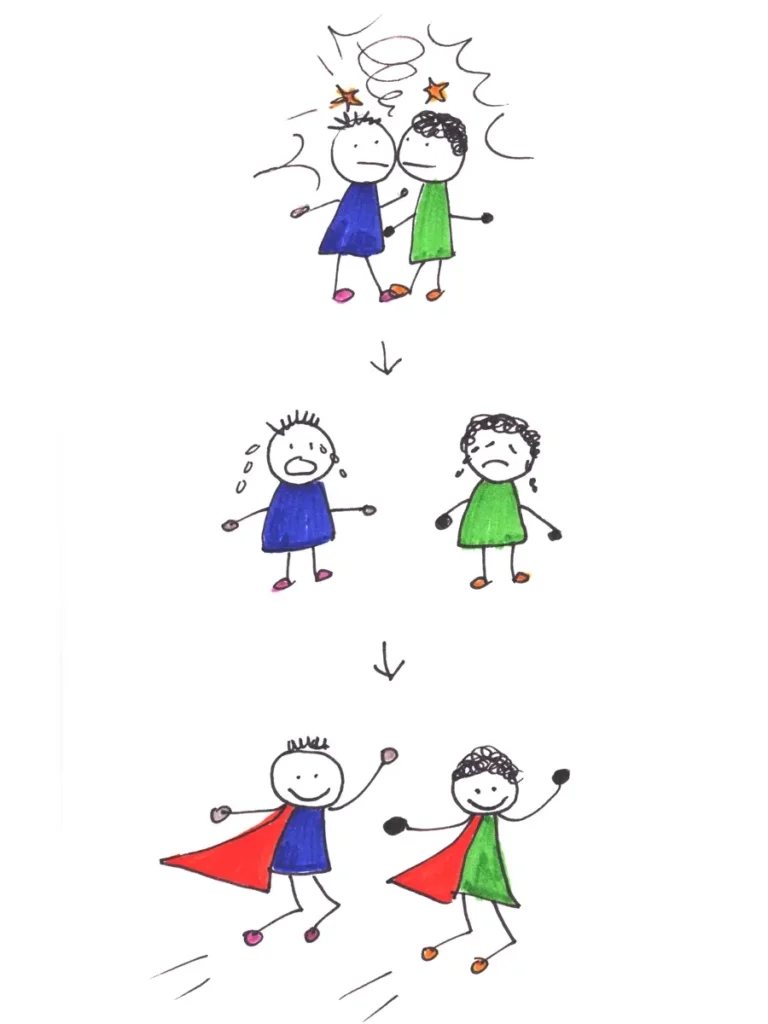
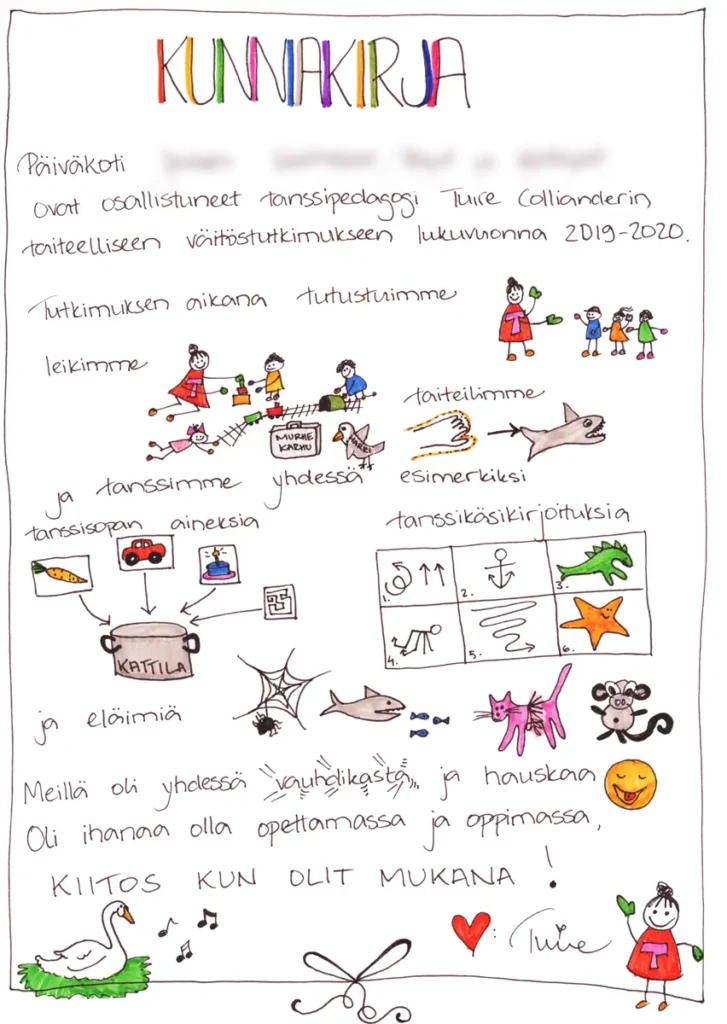
The pandemic interrupted my fieldwork, so the final summary I had planned to share in person was instead delivered as a letter, accompanied by an illustrated account of my insights and a certificate of participation.
24th May 2020
Hello Brook, Spring, and Pond!
When I first arrived at Forest Daycare, I was eager to discover new perspectives on teaching dance. Now, I would like to share some of the insights I have gained, along with a few cherished memories.
I fondly remember how you greeted me each morning with bright smiles and warm hugs, sometimes so enthusiastic we nearly toppled over. Few adults are lucky enough to begin their workday in such a joyful way. Among my favourite outdoor moments were playing Spider Tag, Sleeping Sloth, Elevator Dance, and inventing new dances together.
I would now like to share what I learned from dancing in the daycare centre. While you taught me many dance moves and even complete choreographies, what I truly gained were new approaches to dancing.
I discovered that drawing dance instructions on paper is very helpful. I would quickly draw the key points of a dance and pin the sketch to the wall with a blue sticker as a reminder. You often found the drawings beautiful, though at times they looked amusing or even a bit strange. The funniest was when I tried to depict Xylitol pastilles in a Dance Soup, but they ended up resembling butts—a mistake that kept everyone laughing long after the dance ended.
The Greetings Dance was a lively way to start our sessions. You inspired me to invent playful greetings, such as handshakes, fishtails, high fives, thumb kisses, and pinky hugs. I later shared a video of these with you. We also had great fun cooking up our Dance Soup with ingredients like carrots, potatoes, and even spilling ketchup. In Brook, the children developed the Storyboard Method, through which we created dances that combined our different ideas. Each group choreographed its own storyboard dance, and I also created a video of those.
I realised I needed to use STOP signs to indicate what children were not allowed to touch. I placed them by my computer, papers, and cameras, and occasionally on the sofa, bed, or shelf. It wasn’t always easy for you to remember the signs, and I sometimes felt frustrated when someone tried to touch my computer.
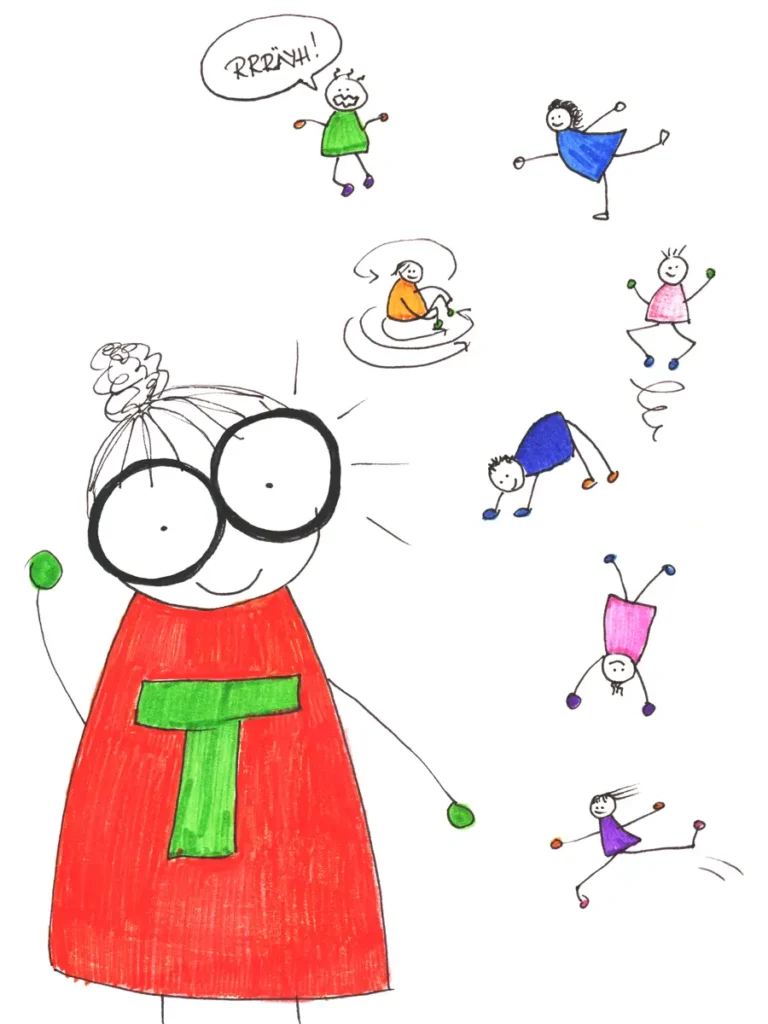
I also learned that dances should not involve too many long instructions, as you were often eager to start moving and show your skills. ‘Look!’ ‘Tuire, look at me!’ were the calls I frequently heard during our dances. I tried to notice everything, imagining my eyes as magnifying glasses to catch every detail you revealed. In doing so, I witnessed countless impressive tricks and moves.
Collisions were inevitable as we crowded the small spaces with our high energies. Thankfully, there were no serious incidents, only minor bumps and scratches, which are also common in the dance profession. Children like you proved far more resilient than adults, with bodies almost like superheroes, able to endure much more and recover quickly.
At times, our dance sessions became chaotic. Your excitement was so contagious that everyone ended up moving and shouting wildly, making it impossible to hear the music or my instructions. After one session, a child observed that ‘the dance didn’t work because we were running and fighting.’ It was an insightful comment, and we all agreed to focus more on the dance next time. And indeed, we did.
Although our dance sessions were often chaotic, I felt it was not due to a lack of fun, but rather from your overflowing excitement. You wanted to invent new moves, explore paths, and create games, which were often more thrilling than my guidance could provide. There was a clear desire for speed, challenge, and competition. Recognising the value of your creativity and autonomy, I often embraced the chaos, even though other teachers sometimes prefer stricter instructions and more structured dances. I felt that improvised dancing offered a rare and valuable experience for us all.
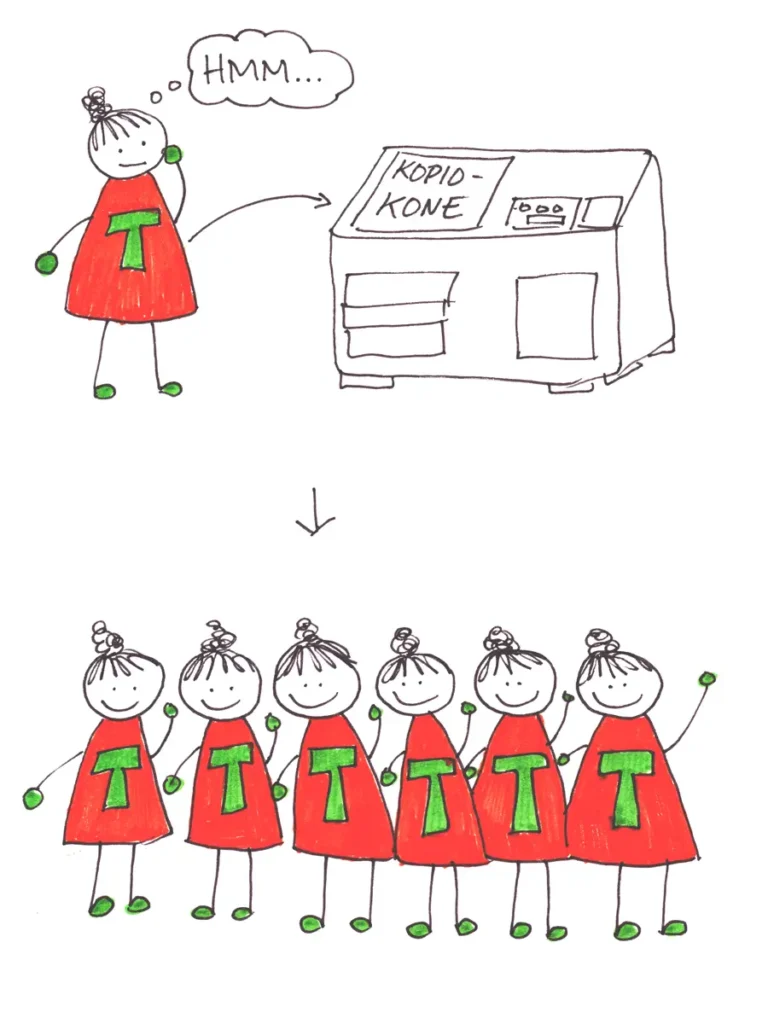
Did you know that the daycare centre has a photocopier that can produce multiple identical copies? If I had been able, I would have made enough copies of ‘Tuire’ for each of you. That way, everyone would have had their own partner who could see your abilities all the time. I’ve noticed that children love dancing with adults, as it allows them to climb, lift, and twirl. I tried this with you, too. Sometimes we would pretend to be rocks to climb on, tunnels to crawl through, or even waves to roll over. With the other teachers, we lifted you high, making it feel like flying or swimming, and you bravely joined in. I would have loved to do even more of these activities, but we would have needed more Tuires so no one had to wait too long for a turn.
A few dances stood out to me as exhilarating adventures. One was the spider adventure with Brook, when we moved through a spider’s web and built a nest. Another came with Spring, when we dove beneath a fishing net, discovered hidden treasures, and swirled like fish caught in it.
I’m curious about what you—both the children and adults of the daycare centre—may have learned. I would love to hear your thoughts! If you can, send me a message through a drawing, story, or dance.
As a token of my appreciation, I created a diploma for each child, highlighting some of the wonderful experiences we shared. You can take yours home as a special keepsake—like first prize for a winner! I am deeply grateful for my time at the daycare centre and in your Brook, Spring, and Pond groups. I loved dancing with you and discovering new things together.
Wishing everyone a fantastic summer!
I hope you continue dancing at daycare, at home, and throughout the summer holidays! Sending kisses with my thumbs!
Love, Tuire
4.3.2 Overspills of the Research
My emergent research approach highlighted the importance of recognising the role of the unexpected, as well as the possibility of attending to data that exceeds the formal boundaries of the research engagement. Millei and Rautio (2017) build on Michael’s (2012) concept of overspills in research, which allows for the inclusion of elements that fall outside the intended or feasible framing of a study. These overspills may include interruptions, complexities, seemingly irrelevant remarks, postures, and gestures that, while appearing insignificant, are in fact integral to the studied phenomenon. Millei and Rautio (2017) reinsert overspills into the data, thereby extending and deepening the potential for knowledge production. They also interpret overspills as indicators of the limitations inadvertently produced by the research framework.
The initially unintended continuation of my collaboration with the daycare centre gradually developed into a deliberate aspiration toward an ethically attuned practice of cooperation. In this way, subsequent cohorts of children entering the daycare have also had the opportunity to meet ‘Tanssi-Tuire’ (Dance Tuire)—the title by which I am now referred to by the daycare staff—as an arts-educational resource they can occasionally draw on. This extension can be understood through the lens of overspill. In this way, such complex engagements may be acknowledged as a valuable part of the research, for example, including the daycare centre’s involvement in the prototype workshops, where the children’s version of the thesis was explored. These workshops are only briefly addressed in this commentary, yet they served as a valuable site for developing insights into the inclusive dimensions of drawing-based dance pedagogical approaches.
The process of creating the children’s version of the thesis involved a pre-examination at the daycare centre, followed by a collective playful examination of the children’s version at the Theatre Academy. This examination included an engagement in dancing-with both the thesis itself and the children. However, this dimension of the overspill extends beyond the scope of the present commentary, as its timelines do not permit the inclusion of the children’s version of the thesis here, although it remains available for future research and publication.