As a dancer–pedagogue–researcher, the main challenges I have encountered in conducting artistic research relate to its inherently open and non‑prescriptive methodological nature, as well as to the difficulty of articulating in writing the embodied experiences and encounters that characterise my dance pedagogical practices (e.g., Borgdorff 2012). In this chapter, I discuss how postqualitative and posthuman research paradigms (e.g., Diaz-Diaz and Semenec 2020; Koro-Ljungberg 2015), together with an understanding of artistic research as a translational process that bridges different modalities through creative transformations (Farquhar and Fitzsimons 2011), have supported me in addressing these challenges.
3.1.1 Postqualitative and Posthuman Approaches to Artistic Research
Methods as Emergent
In the context of artistic research, Lilja (2015) argues that methods arise organically within the artistic process, taking shape iteratively through unfolding practices and being continually revised to remain relevant. Similarly, MacLure (2023, 217) articulates such methods to ‘follow the contours of what you’re examining’. In a related vein, Koro-Ljungberg’s (2015) notion of methodologies without methodology emphasises a commitment to continually reinvent and revise both methodology and methods, keeping them in motion and open to ongoing questioning. Within postqualitative inquiry, St. Pierre (2021; 2018; 2015) likewise advocates for inventing inquiry through the act of doing, an approach that closely aligns with artistic research. Engaging with emergent methods thus prevents premature closure, allowing methods to be articulated only retrospectively—once they have been enacted.
Building on these views, I do not present the methodological approaches and assemblages that emerged during my research as ready‑made methods for others to follow. Instead, I outline the starting points of my methods within existing methodological frameworks, offering this context as a grounding for my inquiry. From these premises, I narrate the novel methodological translations that emerged through this research. My hope is that these will serve as impulses and starting points for further dialogue, inspiring deeper exploration of how dance education research can be carried out.
To cultivate emergent qualities in research, I draw on the theorising of fluid methodology (Koro-Ljungberg, Löytönen, and Tesar 2017), interpreting it as a flexible approach to developing research that can support both ethical and response-able pathways. A response-able view on research is grounded in a deep engagement with encounters, relationality, sensation, and phenomena, rather than driven by the need to answer a pre-formulated question or solve a specific problem (Suominen, Kallio-Tavin, and Hernandéz-Hernandéz 2017). In this research, such a fluid yet committed approach has offered a generative way to engage with the entangled relationships between theory, teaching, learning, and living that often give rise to messy and complex phenomena. The strength of fluidity lies in its capacity to transform what might otherwise be seen as methodological failures into opportunities for regeneration and methodological innovation (Koro-Ljungberg 2015). This aspect is particularly significant in relation to my pre-examined artistic component and the development of my work through analysis of the process by diffractive reading.
Building on Earlier Research
Postqualitative inquiry has been employed by several early childhood researchers (e.g., Giorza and Murris 2021; MacLure 2013a; Rautio 2021; Vladimirova 2023). However, Giorza and Murris (2021) observe that posthumanist research in ECEC contexts has largely centred on adults, highlighting the need to include children and childhoods to further expand the field. My research addresses this gap by integrating posthuman theorising with postqualitative inquiry to develop an artistic research methodology grounded in experimental, intra-active dance pedagogical practices. This approach closely aligns with Osgood and Giugni’s (2015, 346) concept of ‘theory becomes method becomes art,’ whose framework examines how posthuman and arts-based practices can challenge and expand traditional notions of knowing and becoming in early childhood education.
3.1.2. Artistic Research as Translation
In the following paragraphs, I discuss translation in artistic research and explore it through practical movements across modalities, contexts, and languages. I then articulate the theoretical and philosophical perspectives that underpin these practices.
Translation in Artistic Research
In addressing the challenge of documenting and engaging with the artistic, embodied, and sensorial experiences that emerge through dance pedagogical practice, and of seeking relevant ways to share them, I have approached artistic research as a process of translation. Translation here is not understood as a metaphor for my work but as a structuring methodological principle, materialised and embodied throughout the research process. This approach entails a process of transfer not only across languages and contexts, but also between modalities such as movement, speech, and writing.
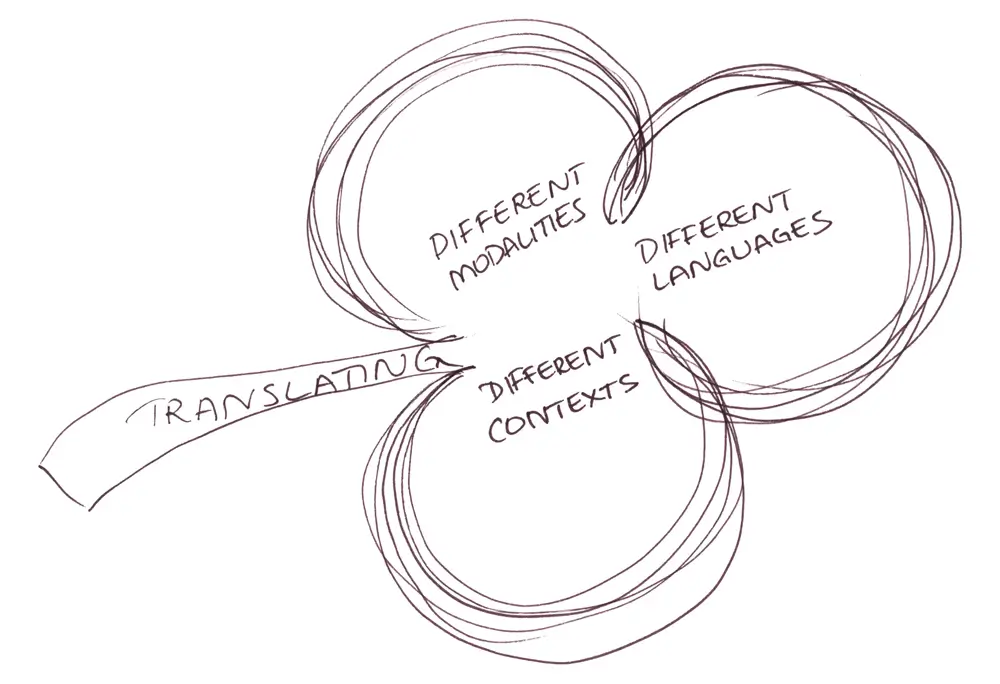
The concept of translation has been approached previously in the context of artistic research by Elo (2014), who compared the role of the artist-researcher to that of a translator, working within the interstices of different media. A central aim in this framing is to convey the feelof artistic practice, enabling transversal articulations that create meaningful connections between different modes of expression, without relying on pre-established hierarchies (Elo 2014). Translation can also be understood in terms of creating variations or adaptations, as seen in Huopaniemi’s (2018) artistic dissertation. However, I find the concept of translation more generative for my purposes, since my aim is not to adapt or vary the material, but to carry it over as such, even while acknowledging the inherent untranslatability that accompanies this process. With this approach, I aim to highlight the complexities of translation in artistic research—not merely as linguistic transfer, but as a more-than-linguistic act that involves navigating elements of untranslatability and carries an ethical dimension (Farquhar and Fitzsimons 2011).
Moving between Modalities
Artistic processes are rich, complex, and unpredictable, and thus not easily captured by conventional language, as Suominen, Kallio-Tavin, and Hernandéz-Hernandéz (2017) highlight in their discussion of arts-based research traditions. Similarly, in this research, a significant and complex form of translation concerns the articulation of embodied experiences, thoughts, and knowing in and through language. While acknowledging that language cannot fully capture the complexities of movement (Manning and Massumi 2014), I have explored ways of bridging this gap through multimodal approachestotranslation. Therefore, I understand multimodal meaning-making as an assemblage wherein different types of text, drawing, and other audiovisual materials are equally valid modes of expression. I have been particularly focused on experimenting with drawing, offering playful and pedagogically practical strategies for navigating translation.
Multimodal approaches acknowledge that language and communication also possess sensory qualities, including haptic and tactile dimensions. MacLure (2023) expands on this idea by highlighting how new materialist perspectives challenge traditional views of language as purely cognitive or representational. Instead, language is seen as embodied, affective, and situated within specific material contexts. This perspective foregrounds the emotional and sensory dimensions of meaning-making, allowing for a conceptualisation of translation as a creative process that intertwines linguistic, cultural, and philosophical layers, an idea I will explore further in the following sections.
Translating across Contexts and Languages
Artistic research is inherently multidisciplinary, allowing researchers to engage in dialogue across various discourses and to address diverse audiences and contexts (Gröndahl 2023). For my research, this approach entails engaging with fields such as art and dance education, early childhood education, and childhood studies, as well as dialoguing with various stakeholders, such as the university, ECEC, guardians, children, and other participants. The intention to meaningfully connect with a wide range of partners motivated me to develop fluency in multiple forms of communication in different contexts.
Contextual awareness has also been emphasised in earlier research on early childhood education. Frankenberg et al. (2019) used translation-based approaches to adapt findings for diverse audiences, even creating a children’s book for young participants. I have applied a similar strategy in producing an information booklet for my fieldwork and finally a children’s version of this thesis. Similarly, Kendall-Taylor, Erard, and Haydon (2013) used translation-oriented strategies in science communication, employing images, metaphors, and accessible language to make complex processes understandable for educators, children, and parents. Their goal of bridging research and practice by rendering research findings more accessible across diverse contexts aligns closely with the aims of my study.
Translation between languages is also a central element of my research, as most of the theoretical literature I draw on is in English—the dominant language of academia—while my meaning-making and understanding unfold primarily in my mother tongue, Finnish. The process of translating also became central during the fieldwork, as I needed to translate the informed consent forms into several languages, a process I discuss in detail in the Section ‘Exploring’ during Fieldwork.
Philosophical Aspects
For the philosophical grounding of translational processes in research, I draw on Farquhar and Fitzsimons’s (2011) thinking on translation as a paradigm for multiple modes of exchange and as a metaphor for education, where understanding is always evolving with and in relation to others. Their perspective brings into dialogue the contrasting conceptions of translation proposed by Derrida and Ricoeur. Of these, I have found particularly significant Derrida’s (1985) notion of creative transposition and Ricoeur’s (2006) concept of linguistic hospitality, which I discuss here in relation to the practical enactments emerging from my research.
Derrida’s (1985) notion of creative transposition emphasises the artistic dimensions inherent in the interpretive play that underlies all communication. In creative transposition, the aim is not to replicate the original but to transform it through a tentative, ongoing process. This understanding creates a tension between fidelity and adaptation, influencing both the meaning and reception of the work. This contrast played a central role as I worked toward the pre-examined artistic component, seeking ways to creatively transfer key fieldwork experiences into an artistic–pedagogical event. In this process, I balanced familiarity and unfamiliarity so that translation would produce difference with repetition (Deleuze 1994). For example, the art exhibition under a bench was spatially translated to under a bridge, and photos of the original artworks were expanded with images from the fieldwork.
Ricoeur’s (2006) notion of linguistic hospitality emphasises that translation can accommodate difference by allowing multiple meanings to coexist, acknowledging its generative potential. Farquhar and Fitzsimons (2011) bring this perspective into dialogue with Derrida’s (1985) view through the concept of linguistic hospitality, recognising that differences need not be overcome or normalised. Rather, even through disagreement, new understandings can emerge. Similarly, the dancing–drawing assemblages may function as a form of linguistic hospitality. Here, the drawn lines and their translation into movement can simultaneously be an impossible task to complete and a generative source of artistic expression.
This mutual inclusion was vividly embodied in the dance pedagogical improvisation sessions of this research, where shared tasks generated diverse responses, as illustrated in the collective pedagogical documentation of the lines of flight exploration, which showcases the coexistence of difference, tension, and collective recognition. As Farquhar and Fitzsimons (2011, 655) note, ‘rather than think of getting things right or wrong, we might accept that many kinds of descriptions and many kinds of true statements are possible.’ The impossibility of perfect translation, referred to as nuances getting lost in translation, need not lead to despair, but towards striving for good enough translation. This approach involves engaging in the process while accepting uncertainty about the outcome. It is open, generative, and ethically attuned to difference, and it also aligns with my dance pedagogical aims. (Farquhar and Fitzsimons 2011)