My theorisation of intra-active dance pedagogy draws on Barad’s (2007) concept of intra‑activity, as interpreted through Lenz Taguchi’s (2010) development of intra‑active pedagogy. I use this concept both as a theoretical lens and as a practical framework, approaching it as an intra‑active orientation. Such an orientation shifts education from an individualising endeavour to one that foregrounds our complex interdependence with material and physical agencies. As Lenz Taguchi (2010, 58) contends:
The challenge for pedagogy is then not to do away with the ‘I’, but to start thinking about how this ‘I’ is constituted in a total interdependence with, not just other ‘I’s but all matters, artefacts and physical intensities and forces around it.
This quote highlights the central idea of this study and prompts me to consider what is ‘at play’ in the various dance pedagogical settings I have examined in this research. My initial research interest focused on how dance might enrich the embodied interactions in ECEC, inspired by my earlier explorations of dance improvisation as an interactive approach with children and adults (Colliander 2016). Lenz Taguchi’s (2010) theorisation of an intra-active pedagogy offered a promising framework that I could employ to expand the thinking and practices of early childhood dance education. This shift initiated a transformative journey in my thinking that was deeper than I had initially anticipated, leading me to learn from various material and affective agencies, such as a tiny Styrofoam ball, a crafted spider, enthusiasm, annoyance, and microbes, to name just a few.
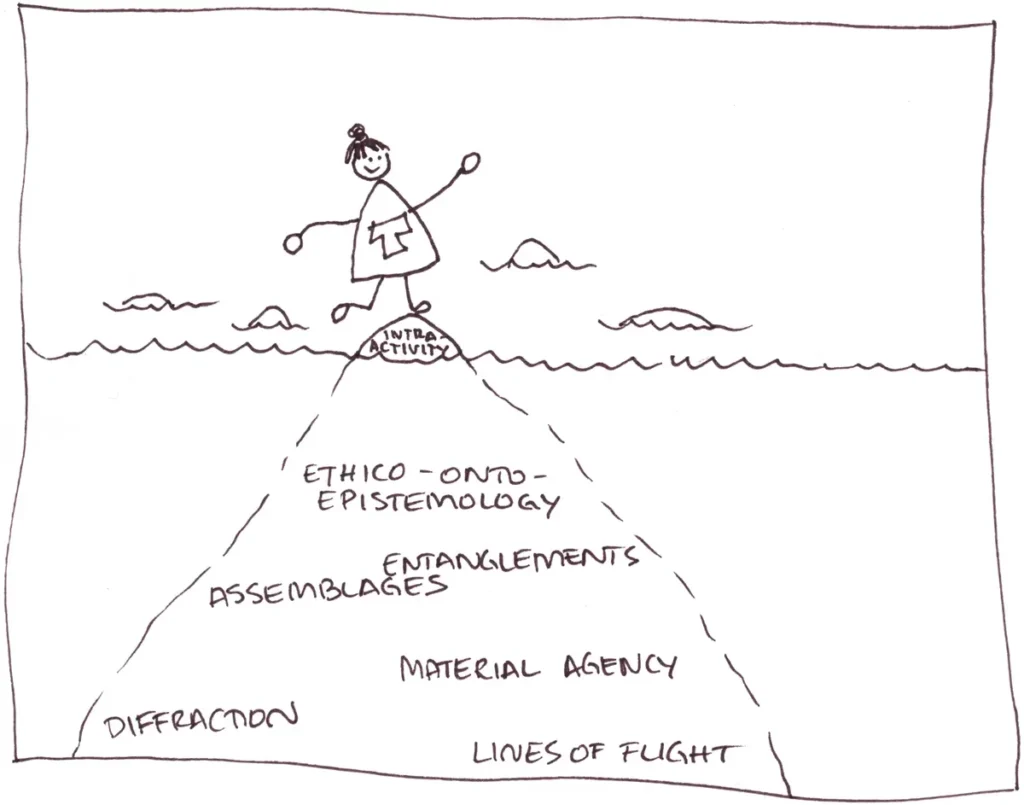
2.1.1 Ethico-onto-epistemological Grounding
As part of the broader ontological turn in contemporary research, Barad (2007) introduced an agential realist framework in which ontology (being), epistemology (knowing), and ethics are understood as fundamentally entangled within an ethico-onto-epistemology. This reconceptualisation emphasises the inseparability and non-hierarchical nature of ‘the intra-activity of becoming, the ontology of knowing, and the ethics of mattering’ (Barad 2007, 36).
The Landscape of Relational Ontologies
Approaches that emerge from an ethico-onto-epistemological orientation are often described under the umbrella term of relational ontologies, which aim to highlight the interconnected and interdependent nature of our existence in the world (Ylirisku, Slotte Dufva, and Snellman 2024). Relational ontologies form part of a broader theoretical and philosophical landscape associated with posthumanism,which encompasses a wide range of interdisciplinary frameworks (e.g., Braidotti 2013). These include new materialism (e.g., Bennett 2010), material feminism (e.g., Haraway 2016), affect theory (e.g., Massumi 2002), the philosophy of immanence (e.g., Deleuze and Guattari 1987), sociomaterial perspectives (e.g., Fenwick, Edwards, and Sawchuk 2011), and non-representational theories (e.g., Vannini 2015), among others.
While these theoretical approaches are diverse, they can be understood collectively as post-approaches within research and practice, united by a shared commitment to relational and material conceptions of the world (Jusslin et al. 2022a). The prefix ‘post’ signifies a departure from and difference within the more traditional approaches to research in different fields (Koro-Ljungberg 2015). However, it is essential to recognise that thinking through relational ontologies is not a novel concept. Long before posthumanist theory emerged, a multiplicity of non-anthropocentric, situated Indigenous knowledges understood and theorised the world as fundamentally interconnected, reciprocal, and relational, both ontologically and ethically (Nxumalo and Peers 2024).
The development of intra-active pedagogy has been influenced by various overlapping paradigm shifts, including the linguistic turn and the material turn. While the linguistic turn emphasised the constitutive role of language in shaping reality, the material turn extended this view by recognising matter as an active agent in the construction of discourse (Lenz Taguchi 2010). Barad (2003) challenges the conventional division between matter—understood as the physical world—and discourse—understood as language and meaning—arguing instead for their fundamental entanglement. For Barad (2007, 152), ‘the material and the discursive are mutually implicated in the dynamics of intra-activity,’ leading to what she terms material-discursivity.
During my fieldwork, this holistic intra-active approach translated children’s everyday interests and play into dance. Conversely, I also applied dance pedagogical methods in everyday contexts, as playing with plastic superhero figures transformed into an embodied exploration of their postures and movements through our bodies. Building on this grounding, I approach my research practice as an exploration of entangled relations between myself and the participants—children, teachers, and more/other-than-human agencies—where we co-emerge through dancing, teaching, and researching in a continuous flow of events.
The Concept of Knowledge as Relational and Situational
The material-discursive framework opens up the possibility of recognising embodied modes of knowing as equally valuable and essential as those traditionally grounded in linguistic expression (Anttila 2009; Grosz 1994; Manning 2009). In my research, this entanglement enables exploration of dance pedagogical practices through an orientation that respects the holistic and intertwined ways children think, exist, and perceive the world. In this way, it becomes possible to acknowledge and respect children’s modes of relating to more/other-than-human agencies, their bodily ways of thinking, and their tendency to blend activities fluidly, as discussed also by posthuman childhood scholars Rautio (2013) and Tammi and Hohti (2017).
I conceptualise knowledge as emerging from embodied experiences within material-discursive entanglements, understanding it as multiple, relational, processual, and continuously evolving. From this perspective, knowledge is relationally constituted and situated rather than fixed or autonomous (Braidotti 2019). Intra-active theorising emphasises that knowledge and learning emerge through engagements with the world (Barad 2007; Lenz Taguchi 2011; Gherardi 2022). This fosters active, sensorial, and embodied forms of knowing where ‘knowing does not come from standing at a distance and representing something, but rather from a direct material engagement with the world’ (Barad 2007, 49, italics original).
Thus, knowing and thinking in dance can be understood as enactments of Barad’s conception of embodied engagement that exceeds linguistic articulation. In my pedagogical practices, such embodied knowledge shapes the ongoing decisions that may feel intuitive but are grounded in bodily awareness. I argue that this form of knowledge holds epistemological value equal to traditionally legitimised forms, which others have also acknowledged (see, e.g., Anttila 2009). My research, therefore, seeks to challenge, expand, and reconfigure orientations to knowledge construction and relational ethics. I discuss these issues further in the section ‘Warming Up’ with Methodology.
2.1.2 Intra-active Orientation
While traditional notions of interaction assume discrete, pre-existing entities, Barad (2007) conceptualises intra-action as a process through which agency is mutually constituted within entangled relations. This orientation offers an alternative lens through which to understand educational settings as emergent spaces. I elaborate on this perspective by interweaving connections between my research and earlier work on intra-active dimensions in educational contexts and childhood studies.
Related Research with an Intra-active Approach
Over the past decade, Barad’s (2007) agential realism and the concept of intra-action have gained significant influence across disciplines, including early childhood education (e.g., Taylor and Pacini-Ketchabaw 2015), arts education (Springgay and Truman 2018), and other fields of education (Morales and Zarabadi 2024; Tolksdorf et al. 2023). I will outline here the key studies that are most relevant to my inquiry.
The extensive body of work of Rautio (2013; 2014; 2019; Rautio and Winston 2015), which integrates posthumanism, new materialism, and process philosophy across environmental education, the arts, and early childhood studies, serves as a significant theoretical influence on my research. Particularly interesting are the posthuman views on play by Rautio and Winston (2015) and the study by Hackett and Rautio (2019), which addresses young children’s embodied meaning-making through activities such as running and rolling, conceptualising human bodies as entangled with the more-than-human world and constitutive of complex assemblages.
Snellman’s (2018) work on intra-active orientations in contemporary visual art education in Finland offers another important precursor to my work. Snellman emphasises the ability of embodied, affective, and participatory practices to create learning environments outside traditional, teacher-led structures and language-based instruction. This repositioning of the pedagogical space has the potential to alter the relational dynamics among teachers, students, art, and the environment, providing a compelling foundation for extending such approaches to early childhood dance education. (Snellman 2018) Snellman’s intra-active pedagogical approach aligns with sensitive listening as a pedagogical practice, which Davies (2014) further explores. This approach aims to deepen understanding of relational encounters in education and offers a compelling foundation for my conceptualisation of the embodied aspects of listening, thereby fostering the holistic facilitation of improvisation-based dance pedagogies.
Flønes (2025) explores relational approaches to dance education within primary education, while Hovik (2017; 2022) and Dahl-Tallgren (2024) investigate intra-active pedagogies within early childhood drama and theatre education. Jusslin and Østern (2020; Jusslin 2020) integrate creative dance into primary school literacy education, demonstrating how an intra-active perspective contributes to the development of a performative research paradigm (Østern et al. 2023). Higher education studies further extend this field, with Bruzzone and Stridsberg (2023) and Hickey-Moody, Palmer, and Sayers (2020) highlighting dance-centred embodied pedagogies grounded in posthuman feminist and new materialist theories.
Intra-active perspectives have also been applied in early childhood education through approaches that focus on material and environmental aspects. Pacini-Ketchabaw, Kind, and Kocher (2017) reconceptualise materials as intra-active companions, emphasising their active role in pedagogy and advocating for more sustainable educational approaches through relational engagement with materials. Valtonen (2022) employs posthumanist and relational frameworks to reconceptualise multispecies education, underscoring ethical and ontological shifts to foster more inclusive educational relationships with the more/other-than-human world. Nxumalo (2019), in turn, emphasises the benefits of relational and decolonial perspectives within environmental education. The Common Worlds Research Collective is a framework that reconceptualises children’s relationships with human and more/other-than-human companions, emphasising collective, ecological, and relational forms of education that move beyond human-centred perspectives and foster ethical and decolonising pedagogies (Common Worlds Research Collective 2025; Taylor and Giugni 2012; Taylor, Zakharova, and Cullen 2021).
I seek to further expand these theorisations, specifically within early childhood dance education. As intra-active pedagogy is still emerging within early childhood education and remains less established in early childhood dance educational contexts, this presents a promising space for my research to make a valuable contribution by advancing theory and practice in these overlapping domains.
Intra-active Pedagogy as an Emergent Space
Within an intra-active framework, pedagogical spaces entail a dynamic interplay of multiple agential forces within entangled learning assemblages. Consequently, learning does not unfold through easily articulated linear cause-and-effect relations but emerges in and through unpredictable and complex relational processes. (Lenz Taguchi 2010) I find a strong resonance between this nonlinear view of learning and the nature of artistic processes, particularly those grounded in improvisation-based dance. To conceptualise the complexities of pedagogical spaces, I employ Deleuze and Guattari’s (1987) concepts of smooth and striated space, which offer useful perspectives on the qualities and dynamics of these spaces.
The concepts of smooth and striated space originate in Deleuze and Guattari’s collaborative work A Thousand Plateaus (1987), in which they develop these as contrasting yet interrelated spatial logics. They describe smooth space using the image of a sea or desert, emphasising its open-ended, nonlinear, and continuous qualities, and its association with free movement with no fixed limitations. In contrast, they use a city as the image of striated space, which is organised, segmented, and linear, comprising structures that guide and restrict our movement paths. (Deleuze and Guattari 1987)
Early childhood educational spaces tend to become highly striated, with planned activities, set rules, fixed materials, and adult-organised routines that limit opportunities for creative invention, as I will discuss through my practical experiences in the sections ‘Exploring’ during Fieldwork and ‘Sharing’ in the Pre-Examined Artistic Component Käännöksiä – Transpositions. However, Olsson (2009) highlights that even within highly striated systems, moments of ‘leak’ occur as interactions and desires escape predetermined rules, offering opportunities for experimentation and transformation. Tammi and Hohti (2017) observe how children frequently shift into smooth space—characterised by openness and imagination—even within these structured environments, with play proving especially conducive to such transitions. This understanding underscores the importance of playfulness in both early childhood dance education and research, a theme central to my research, which I address in detail in the section ‘Warming Up’ with Methodology.
When an educational space becomes sufficiently smooth—or is non-striated from the outset, as in free play—it frees participants from habitual patterns, allowing lines of flight (Deleuze and Guattari 1987) to emerge. This concept describes events or activities that extend creativity and transform thinking and activities in new, unexplored directions (Lenz Taguchi 2010). Davies (2014) emphasises that lines of flight are generative yet complex and interdependent, resisting binary judgments; they can simultaneously create powerful wholes or disrupt existing cohesion. I apply this concept to theorise on the complexity of dance pedagogical learning events, exploring how such transformative moments arise and can be harnessed to foster novel, productive activities. I detail my embodied explorations of lines of flight in the section ‘Sharing’ in the Pre-Examined Artistic Component Käännöksiä – Transpositions, aiming to enhance educators’ capacities to navigate emergent directions through the lens of lines of flight and assemblage thinking—building on my earlier work with these concepts (Colliander 2024).
2.1.3 Entanglements of Assemblages
The conceptualisation of an intra-active orientation to pedagogy can be further informed by the concept of assemblage, which offers an additional perspective for understanding how learning and dancing take shape. While intra-action emphasises the mutual constitution of learner and knowledge, assemblage thinking, following Deleuze and Guattari (1987), extends this view by highlighting the dynamic entanglement of bodies, materials, and forces. This perspective supports a non-hierarchical understanding of dance events, in which all participants—human and more/other‑than‑human—are interconnected, embedded, and continually active within complex relational configurations. In the following paragraphs, I examine how this perspective operates within this research.
Assemblages as Sites of Collective Expression
Drawing on Deleuze and Guattari (1987), DeLanda (2006) describes assemblages as wholes composed of heterogeneous elements that include both human and more/other‑than‑human components. This perspective redirects analytical attention from isolated individuals to the complex interplay of relational and agential forces. Lenz Taguchi, Palmer, and Gustafsson (2016) employ the concept of assemblages to analyse early childhood experimental dance practices. In their view, dancing assemblages dissolve participants’ separateness, intertwining them bodily, materially, cognitively, and sensorially with one another and their surrounding environment. These assemblages comprise not fixed components but dynamic acts, moments, and performances that continuously explore new possibilities for what bodies might be and produce (Lenz Taguchi, Palmer, and Gustafsson 2016). Within assemblages, each participant remains integral, yet no single individual controls the flow. Consequently, concerns about not knowing what to do or lacking specific motor skills recede from significance, as the focus shifts from individual achievement or technical mastery to relational expressions of collectivity and shared creativity.
According to Deleuze and Guattari (1987, 8), theorising relations through assemblages embraces multiplicity: ‘An assemblage is precisely this increase in the dimensions of a multiplicity that necessarily changes in nature as it expands its connections.’ DeLanda (2006) extends this idea by framing assemblages as wholes whose properties emerge from the intra-actions among parts, rendering them more than their sum. Crucially, their dynamic nature allows components to detach and reconfigure into new assemblages, altering interactions (DeLanda 2006).
This idea of plugging in and detaching reminded me of working with Duplo; as with these blocks, parts of assemblages also do not form a ‘seamless whole’ (DeLanda 2006, 4), rather assemblages may be both ‘analysable into separate parts and at the same time have irreducible properties, properties that emerge from the interactions between parts’ (DeLanda 2006, 10). However, the theory of intra-action suggests that elements do not pre-exist their relational connections and cannot be disentangled, which complicated my view on assemblages. Therefore, I extended my explorations to another playful material, playdough, which I narrate in the following paragraphs.
Thinking-with Materials: Duplo Blocks and Playdough
At the outset of my doctoral studies, I engaged with Duplo blocks as I traced my playfully serious and seriously playful research methodology. They helped me explore and play with the central concepts of my research. More than paying attention to new constellations of concepts themselves, my interest was guided towards the quality of being together which the Duplo produced and how building diffracted my growing understanding of the nature of assemblages in an intra-active orientation.

Duplo exemplifies how assemblages can be more than the sum of their parts, as their elements can be continuously reconfigured in endless combinations. The practice allows for both adherence to pre-set guidelines, akin to predetermined choreography, and free-form constructing reminiscent of dance improvisation. Translating this idea into dance pedagogy, I have explored movement exercises that align the body like a Duplo block to re/de/construct formations in relation to one another. Each body, like a Duplo block, offers a stationary posture onto which others build by joining or complementing, creating embodied relations from a given starting point. When one participant disengages and seeks a new way to connect with the group, the dance evolves into a dynamic interplay between static forms and movement, with each new construction re-shaping the collective embodied relation. This approach offers a simplified model of conventional interaction, where participants act as distinct individuals yet remain continually connected through their relational engagement.
Intra-action is translated into Finnish as yhteismuotoutuminen, which implies a process of shaping together. Driven by this meaning and my interest in deepening my understanding of assemblages and the concept of intra-action, I began to experiment with visualising these concepts and their entanglements using playdough as an alternative material in the prototype workshops and later in the children’s and adults’ dance pedagogical research group. This hands-on methodology enabled me to explore the inseparability and co-constitution of relational forces in tangible, malleable form, resisting reduction to separations and simple cause-and-effect frameworks. Unlike working with Duplo blocks, which begins with separate blocks, my playdough explorations start with a single piece, representing an already entangled world that we are part of from the outset. Through moulding, we can enact and visualise separations. However, if we continue shaping and rejoining pieces, any seams quickly fade as elements intertwine and become inseparable, reflecting the ongoing and dynamic nature of assemblages and intra-activity.

My explorations of assemblage and intra-action through playdough draw on my background in contact improvisation for all ages, a dance practice wherein movement and communication emerge from ongoing physical contact and a shared point of touch, transcending words. According to Pallant (2006), in contact improvisation, dancers attune to each other’s weight, energy, and balance, allowing movement to arise from embodied relationality rather than predetermined choreography. Similarly, playdough-inspired dance improvisation offers a tangible experience of intra-activity and assemblages, emphasising relationality and collective becoming. The choreography emerges through shared movements, such as bending, rolling, spiralling, and shifting, as dancers yield to and influence one another in a continual flow whereby individual boundaries dissolve into a shared mixture of connections (Pallant 2006). This reciprocal embodied communication, along with its potential to facilitate transindividual transformation—paralleling Massumi’s (2014) perspective on play—aligns with Barad’s (2007) concept of response-ability. Working with and through playdough also highlights the idea that the body is not a form but a force, continually affecting and being affected in its becoming (Manning and Massumi 2014).
In conclusion, the concept of assemblage offers a valuable lens for extending the educational gaze beyond individual agency toward a more relational understanding. I continue this discussion in the following section by addressing the notion of agency.
2.1.4 Agency as Relational
In this section, I explore the concept of agency through intra-active and posthuman theorising. I begin by examining how an intra-active orientation fosters an understanding of agency as relational and entangled with more/other-than-human elements. I then consider the implications of this relational view for the hierarchies and power dynamics that might be ‘at play’ in early childhood dance education.
Agency as Intra-active
Barad (2007) views agency as not limited to humans but defined through our intra-active relations with more/other-than-human materials, elements, and forces. As Myers (2019, 231) acknowledges, the intra-active perspective suggests that agency is ‘not something to be possessed, but instead lies in the intra-connections and the collectivity of actions’. Thus, agency is not an individual characteristic of humans, beings, or things, but a force that emerges relationally through our interdependent actions and decisions, and a phenomenon that moves within and beyond the human body (Diaz-Diaz and Semenec 2020; Myers 2019).
Posthuman theorising adopts a post-anthropocentric view that challenges the centrality of the human subject and opens up ways of thinking about knowing and being beyond human-centred perspectives (e.g. Malone, Tesar, and Arndt 2020). In this study, such a view entails attentiveness to the things, beings, and forces that are present and actively participating in the research (Diaz-Diaz and Semenec 2020; Koro-Ljungberg, Löytönen, and Tesar 2017). Within this framework, anthropocentrism is often countered through a conceptual move that decentres the human (e.g., Barad 2007; Haraway 2008). The aim of decentring is to attend to how human beings are always entangled, not only with one another but also with more/other-than-human others. In contemporary childhood studies, this movement has served both as an alternative to child-centred pedagogies (Spyrou 2017) and as an ethical pedagogical method (Lock 2019). The inherent controversy of decentring the child in childhood studies and early childhood education—where the child remains unavoidably central—is often addressed by clarifying that decentring does not remove the child from the centre but rather ensures they are not alone in the focus (Diaz-Diaz and Semenec 2020).
However, for me, decentring the human did not feel like a fruitful step. I therefore question this terminology, as both education and research remain inherently human-centred. For instance, I narrate this study through a human voice, however entangled with and inclusive of more/other-than-human others I aim to become. Therefore, drawing on Myers (2019), I reframe decentring as an act and movement involving making space for multiple agents and forces, situating agency as one interdependent influence among many, including those that emerge from the inquiry itself. This approach envisions a centre that can continually expand and shift, offering a dynamic alternative that resonates with my movement-based inquiry.
More/other-than-human Agency
Barad’s (2007) ethico-onto-epistemological account of inseparability posits that knowing emerges through agential intra-actions within the material world. This view, supported by Bennett’s (2010) theory of vibrant matter, extends agency beyond humans to matter itself, rendering humans—as entangled, knowing subjects—inseparable from this relational reality. More/other-than-human elements thus co-participate in our learning, in and through processes of ‘part of the world making itself intelligible to another part’ (Barad 2007, 185). This perspective prompts a re-examination of human agency in education and research that attends equally to children and to their entangled materialities.
An intra-active theorisation of agency, inclusive of material aspects, aligns particularly well with children’s openness to becoming entangled with their everyday environments and companions. Children constantly view more/other-than-human companions as participants in their play imbued with creative significance (e.g., Cele 2019). Thus, Lenz Taguchi (2010, 66) posits that children possess a unique ‘intra-active and agentic realistic grammar,’ enabling them to perceive the ‘language’ of non-human agents—such as invitations from furniture or the voices of wooden sticks, to mention concrete examples from this research—and their role in learning. Bennett (2010) characterises this orientation as keen sensory attentiveness to non-human forces, an openness to surprise, and an aesthetic-affective attunement to material environments.
Agencies in Improvisation-based Dance Education
Posthuman conceptions of agency, as interdependent and inclusive of more/other-than-human entities, support the theorisation of intra-active orientation to improvisation-based dance education. This artistic practice enacts collective, creative embodiment, in which all participants serve as active agents while remaining relationally intertwined. For agency to emerge and flow between dancers and materials through movement, it needs to be understood as arising from openness to the other and the not-yet-known, rather than from controlling others (Davies et al. 2009). Such arts-educational spaces, particularly within the institutional framework of ECEC, could offer a unique environment in which all, including educators, can cultivate their artistry (Kind 2020).
During this research, as a dancer–pedagogue–researcher in the context of ECEC, I became acutely aware of my own agency and of the power I held in relation to the children. This position was produced by the institution, regardless of my views or aims. Recognising that I occupied a more agential role than the children, I sought to challenge established hierarchies by designing dance sessions that reconfigured agency as shared and relationally enacted. To open space for such alternative configurations, I adopted a playful orientation that foregrounded play in our dancing, allowing me to loosen the pedagogical weight of predetermined goals or guidelines and cultivate a state of playful seriousness through my serious playfulness. Although this approach did not eliminate the asymmetry among our institutionally grounded agencies, it enabled them to temporarily shift within the dance pedagogical practices, as the children were considered equals to adults in our artistic embodied explorations. These temporary reconfigurations correspond with my understanding of dialogical pedagogy as culminating in dialogical moments that both acknowledge asymmetry in education and recognise the impossibility of an all-encompassing, continuously sustained dialogical orientation (Colliander 2016).
In the ECEC context, Hujala, Turja, and Alijoki (2020) note that the difference between the agencies of children and adults is quantitative, as adults often know more and have more life experience, but not qualitative. Extended to improvisation-based dancing, this means that the artistic agencies of children and adults are qualitatively similar, equal, and compatible with each other. However, practical challenges arise from traditional views of teaching and educational power relations, which privilege goal-oriented instruction and top-down authority. Yet this approach does not imply giving up teaching or simply following the children’s lead. Rather, it demands attending to power imbalances and actively creating spaces where they can be stretched, explored, and even played with. Here, the focus shifts from adults wielding power over children to examining the dynamics these educational power relations produce—and exploring how to enact them in alternative, generative ways through playful, improvisation-based approaches to dancing.
One compelling way to attend to these contradictions is by considering Kokkonen’s (2017) concept of weak human agency as an aesthetic–ethical–political mode of agency. I extend this idea to intra-active pedagogy, emphasising approaches that support the emergence of and interactions between more/other-than-human and children’s agencies alike. From an educator’s perspective, this approach requires active passivity, in which one consciously weakens one’s authority, cultivating attentive observation, patient waiting, and a stance of not knowing. In dance improvisation, this approach entails restraining the urge to help the children or to resolve moments that seem insecure, nonlinear, or full of doubt. While these methods do not guarantee outcomes, they open up social and mental capacities that enable richer human and non-human interactions, thereby transforming relationships with the self and others (Kokkonen 2017).
To conclude, by broadening the understanding of agency, I aim to acknowledge that it is not expressed exclusively through humanist, adult‑centred orientations. This approach opens up possibilities for reconceptualising agency in and through dance education. Through such reimagining, adults can encounter children amid their ongoing entanglements—as dynamic assemblages—not aiming to know, understand, or interpret their dancing, but to relate to it in context-specific, sensitive ways, as I discuss later in this section.