In this section, I describe my approach to the elements of research that, in a more traditional research vocabulary, correspond to data collection and analysis. However, both artistic research and postqualitative inquiry challenge the conventional view of research data as something separate to be collected and analysed (e.g., Gröndahl 2023; Koro-Ljungberg 2015). Instead, data is understood as a material and agential force that can be used generatively to produce new knowledge. Following these views, I have employed diffractive reading, grounded in Barad’s (2007) conception of diffractive methodology and further elaborated on by scholars such as Lenz Taguchi (2012) and Murris and Bozalek (2019). Building on their work, I understand diffractive reading as an approach that engages research materials relationally and in entanglement, rather than comparing or contrasting them. I discuss this practice in more detail at the end of this section.
3.3.1 Pedagogical Documentation
In Lenz Taguchi’s (2010) intra-active pedagogy, the concept and practice of pedagogical documentation play a central role. Her theorisation builds on the Reggio Emilia approach to early childhood education (Rinaldi 2021). I draw on both perspectives in developing my approach to pedagogical documentation and its use as data.
Pedagogical Documentation as Material and Agential Translation
The Reggio Emilia pedagogy’s conception of pedagogical documentation is described as ‘listening made visible as traces of the learning event’ (Rinaldi 2021, 68). Making listening visible involves shifting between different modalities, which aligns with my view of artistic research as a process of translation, emphasising the multimodal nature of the evolving interpretations and knowledge. This connection between pedagogical documentation and translation is also acknowledged by Anttila, Tuovinen, and Jaakonaho (2024), who discuss translation in relation to pedagogical documentation, observing that artistic researchers often treat documentation not merely as a means to capture practice but as a medium that translates those practices into other forms through an ongoing, experimental, and methodological process.
However, Rinaldi’s (2021, 68) emphasis on capturing ‘traces’ of the event through pedagogical documentation highlights the inherent incompleteness and partiality of this process. Recognising the partiality of documentation as an inherent part of its nature has supported my analytical process. In my previous experiences of using my working diaries as material for analysis, there has always been an inevitable entanglement of the documentation and my memories of the experience that are not fully and satisfactorily—if at all—verbalised in the documentation. This layer has felt like an invisible extension of the content of the documentation, which nevertheless actively influences how I read and interpret the documentation, even though it is not officially acknowledged as part of the data.
In contemporary educational contexts, documenting learning is widely recognised as a vital pedagogical practice, serving multiple purposes and being employed in diverse ways to support and enhance learning. Within the tradition of developmental and behavioural theories, including those that inform Finnish ECEC, pedagogical documentation is typically viewed as a tool for assessment and representation of learning. It is used to identify children’s skill levels, competencies, and developmental stages, and often serves to describe or present activities, for instance to show parents what has been done or experienced. (Lenz Taguchi 2010)
In contrast to this view, the key distinction in the intra-active approach is that pedagogical documentation is not merely a representation of what occurred, but rather functions as a material-discursive apparatus, aimed at producing a ‘multiplicity of differentiated knowledge from a specific event’ (Lenz Taguchi 2010, 67). Through pedagogical documentation, for instance in video format, the learning event becomes not only visible but also material, allowing it to be collectively examined, discussed, and interpreted. In this way, documentation plays an active role in the learning process. It can support shared meaning-making and help flatten traditional hierarchies between educators and participants, allowing everyone involved to act as co-learners and co-creators of knowledge—together with the surrounding material elements (Lenz Taguchi 2010; Snellman 2018).
This perspective on pedagogical documentation as an embedded practice resonates with Barad’s (2007, 67) concept of entanglement, which emphasises that documentation is not separate from the phenomenon it captures but is inherently part of it, as ‘we are part of that nature we seek to understand.’ From this perspective, research practices and the researcher are also understood as entangled with the phenomena they explore. Documentation, therefore, doesn’t offer a neutral or objective account of an event.
In conclusion, my reconceptualisation of pedagogical documentation as a partial and multimodal translation positions it in a markedly different role than when it is employed primarily as a tool for observation and representation for purposes of evaluation and evidence. My perspective on pedagogical documentation is further extended through postqualitative views on data and on how pedagogical documentation itself can be understood as data, which I discuss in the following section.
Pedagogical Documentation as Data
The expansion of my profession from dance teacher to an assemblage of dancer–pedagogue–researcher has led to a process whereby pedagogical documentation emerges in the context of research and thus appears in a new way, as research data (Koro-Ljungberg, Löytönen, and Tesar 2017). This understanding has shifted the role of my pedagogical documentation, which I previously viewed as a practical tool for educators, due to my awareness of the possibility that any of my private research diary reflections could become public later, as part of this commentary.
Along with an intra-active view on pedagogical documentation, postqualitative approaches have expanded my considerations of what counts as data. Koro-Ljungberg and MacLure (2013) problematise conceptualisations of data as known, familiar, and inert objects and recommend more complex, creative, and critical engagements with data. Koro-Ljungberg (2015) encourages researchers to consider the relationality, movement, entanglements, and multidirectional epistemological flows of data. This perspective acknowledges that knowledge produced from data shapes both researchers and research, thereby multiplying the directions of knowledge production in research and practice. Due to the performative nature of artistic research—the focus not on what something is but what it does (Østern et al. 2023)—and the centrality of embodied becoming, the role of data in the research is questionable. Artistic practice is therefore not primarily involved with gathering and analysing data, but rather deals with ‘the configuration of compositional elements and materials that come together as forms of aesthetic or material thinking’ (Rouhiainen 2017, 69).
In a broad sense, my pedagogical documentation as data includes not only written, drawn, and audiovisually recorded material, but also all the perceptions I was able to record through my body. For instance, the pedagogical documentation of Embodied Listening through the Verbs and Lines method is inherently partial. Its aim is not to produce a detailed or all-encompassing account of the experience, nor to function as evidence of the activity, but rather to serve as a visible translation and an articulation of certain affective and ephemeral aspects of the experience that otherwise elude direct capture. In this way, the documentation may facilitate memory, awaken embodied awareness and sensorial dimensions, and enable a re-turn (Barad 2007) to the experience in a broader, more expansive manner than the material record alone permits. Through this process, data becomes a more/other-than-human assemblage.
The postqualitative reconceptualisation of data is particularly compelling in ECEC research, especially when adopting a collaborative approach that actively includes children’s ideas and perspectives. This perspective supports the uncovering of ways to make the mundane and taken-for-granted aspects of everyday life visible (Denzin 2013). It allows even the most seemingly insignificant or illogical encounters to be recognised as valid data with the potential to generate new knowledge. Through these views, I have also been able to include aspects that seem exterior to pedagogical documentation either as experiences that do not ‘belong’ within the scope of the research, or experiences that are not documented anywhere but rise as affective moments and memories in the process of being-with the data. This shift in my understanding of documentation as constructed with fluid borders results in extensions that I theorise as overspills (Millei and Rautio 2017).
3.3.2 Research Materials
In this section, I outline the various forms of pedagogical documentation that were created and gathered during the different phases of the research. Although I do not treat them as separate categories in my diffractive analysis, I present them here for clarity under the headings of writings, drawings, recordings, and gifts.
Writings
Writings as research materials encompass a wide range of different texts that I produced throughout this research, from diary notes to research communication and presentations. I wrote research diaries as logbooks of my research, both on my laptop and in notebooks. During the practical artistic-pedagogical phases, I also used notebooks as working diaries, carrying them with me during activities. These notebooks contain plans and guidelines for dance sessions, followed by notes on the actual flow of events. They also include keywords describing the most significant events and ideas written down quickly afterwards, as well as reflective texts which aim to capture and describe events from within the practice.
As inherent to pedagogical documentation, these writings remain partial. Re-turning to them has revealed instances where I recall potentially valuable details not captured in my notes. For instance, during the realisation of the pre-examined artistic component Käännöksiä – Transpositions, I lacked the time and energy to maintain a working diary, forcing me to rely solely on event plans and subsequent reflections as my written research materials for diffractive reading. Similarly, regarding the previous example of using wooden sticks in dance improvisation, my diary notes did not present children’s voices as direct quotations or an all-encompassing description of the children’s enactments. But as an extension of these notes, a vivid sensory memory of the high energy, loud voices, and enthusiasm remains in my body.
This way of narrating practical research moments in this commentary—through my body as an extension of concrete materials, based on my impressions and interpretations of the situations—has given rise to a mode of writing I refer to as research stories. These stories aim to draw on multiple modalities in the writing process, and may at times take on a playful character. At the same time, however, this approach brings heavyweight ethical considerations to the forefront, as thoughtfully captured in an often cited passage by Barad (2007, 12):
It matters what matters we use to think other matters with; it matters what stories we tell to tell other stories with; it matters what knots knot knots, what thoughts think thoughts, what descriptions describe descriptions, what ties tie ties. It matters what stories make worlds, what worlds make stories.
Building on this view, narration becomes an ethical act; what and how I choose to tell matters deeply. I have tried to carefully select words to do justice to the situation and the various agencies involved, attuning to the relational nature of writing by inviting others into the text as agents rather than objects. At its core, this process of relating to children as creative collaborators extends beyond their explicit words and actions to encompass what they leave unsaid, undone, or refuse to express directly. As such, sensitive listening is essential to acknowledge such inputs, which can range from enthusiastic shouting to nearly imperceptible subtle expressions.
This relational attunement has been embodied through embodied listening and multiple additional approaches in my writing process. For example, when working with video recordings, I have re-turned to the moment not merely as an observer but by physically joining the improvisation, enabling a deeper engagement that informs ethically responsive writing. Additionally, I have included diverse diary entries as research stories to enhance accessibility and provide insight into my dynamic, often unpredictable research process, shaped by broader circumstances. Aware of the tendency to impose coherence on lived experience, I employ multiple perspectives and methods to resist idealisation or smoothing of events. I selected research stories that demonstrate relevant engagement, creative potential, and insights into fostering such engagement.
Drawings
During the course of the research, drawing emerged as a multifaceted practice that gradually evolved to take on several uses, including as a means of enhancing communication and a method for composing choreography, offering a playful, artistic yet practical strategy for navigating translation processes in research and pedagogy. I discuss these directions in detail in the sections ‘Exploring’ during Fieldwork and ‘Sharing’ in the Pre-Examined Artistic Component Käännöksiä – Transpositions. Here, I describe diverse aspects of drawings as research materials—from those produced in practical sessions and thinking processes to those created as an ethical approach to sharing video material in research.
Drawings from the dance pedagogical sessions include guideline signs I created to meet our practical needs, drawings that capture ideas for dancing, storyboard choreographies, and drawn lines from explorations between drawing and movement. Most of the ideas for dancing and the storyboards were drawn by me—sometimes based on my own proposals, but more often while listening to the children’s ideas. The exploratory drawings, however, were mostly created by the participants during the activities.
Another mode of drawing also emerged during the research process, functioning as an extension of thinking. This mode involves an entangled practice of writing–drawing–thinking, in which I use drawing as an exploratory way of thinking and as a more/other‑than‑human companion, resonating with Tervahartiala’s (2022) distinctive approach to drawing. These drawings often appear unexpectedly, for instance blended with writing in my working diary or in the margins of printed research diaries and theoretical texts. In these moments, I feel a need to expand my thinking into a material, more illustrative form than words can offer in order to access new perspectives or greater depth in my reflections. I understand this form of drawing as a multimodal process of meaning‑making within an assemblage, whereby different kinds of materials, such as text and recordings, act as equally valid agents in the production and expression of knowledge.
Furthermore, drawing emerged as a practical way to share recorded documentation, offering a response to the ethical dilemma of not being able to share video material of children. Inspired by MacRae’s (2022) creative approaches to documentation, I began creating shareable research materials from video recordings by drawing multiple successive paused moments from the footage onto paper placed directly on my laptop screen. During the pre‑examined artistic component Käännöksiä – Transpositions, the children were also invited to draw their experiences in the guest book at the end of our session. These documents appear in the event outline as expressions of the children’s voices and perspectives on the activities, serving as a substitute for the direct presentation of filmed material from the event.
Recordings
I obtained video recordings of only four dance sessions during the fieldwork, using a camera mounted on a stand in the corner of the dance space. This arrangement allowed me to gather material to re‑turn to, even though the static camera occasionally missed parts of the activity and the voices were at times too quiet to be heard. In contrast, all eight visits to the pre‑examined artistic component Käännöksiä – Transpositions were filmed by a professional videographer, who closely followed the movements and dynamics of the activities. These videos provided valuable material for my diffractive reading and also allowed a few moments to be shared in this commentary as screenshots of selected frames.
During the fieldwork, I also explored allowing the children to use digital cameras during some of our dance sessions to document their dancing. This experiment yielded more than 400 photographs, none of which identified the photographer. Consequently, I began to approach these images as products of a collective assemblage of bodies and activities—a shared and blurred enactment of dancing and documenting. Furthermore, I documented the research process by occasionally photographing certain glowing moments or research assemblages, such as my thinking‑with Duplo blocks or the construction site that affected my planning of the pre‑examined artistic component Käännöksiä – Transpositions.
Gifts
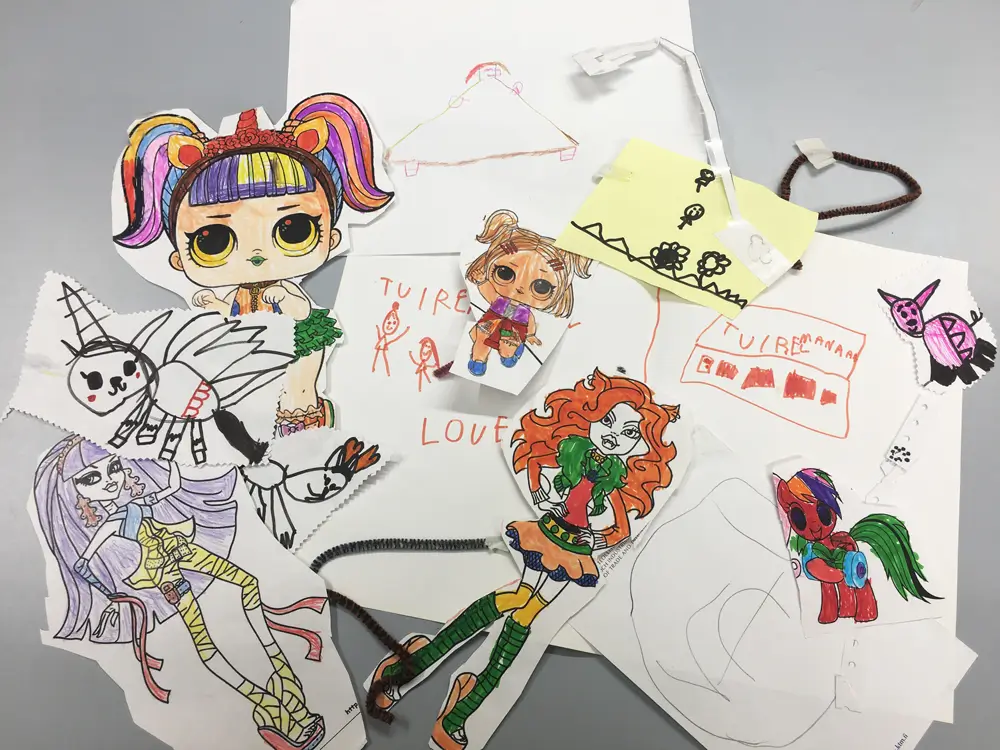
In addition to the research materials listed above, whose collection was planned, a miscellaneous category of material artefacts emerged that I had not anticipated. Most of these items were gifts given to me by children during the fieldwork and included spontaneous drawings of me, the children, or other themes meaningful to them. I also received several coloured pictures and crafted assemblages made from paper and pipe cleaners.
3.3.3 Diffractive Analysis
In this section, I examine how the interplay between reflection and diffraction shaped the development of my approach to analysis, a creative act of engaging with different elements of my research materials. This approach includes using writings, drawings, and recordings to engage in diffractive reading of selected moments in dialogue with relevant theoretical texts. Furthermore, I elaborate on the iterative nature of this process through Barad’s (2007) concept of re‑turning and through my application of MacLure’s (2013) notion of glow as a guiding force in the analytical process.
Reflective Diffraction
My professional journey as a dance educator has led me to adopt critical reflective practices as an integral part of my pedagogical work. These practices involve analytical reflection on one’s actions, either in real-time (reflection-in-action) or retrospectively (reflection-on-action) (e.g., Anttila 2014; Schön 1983). I have found reflective practices to be particularly valuable in supporting critical analysis of my pedagogical activities, deepening my understanding of my role as an educator, and fostering ongoing professional development.
However, during the doctoral process, I soon encountered a fundamental tension between reflective practices and relational ontologies where diffractive approaches often take the place of reflection. Both concepts are borrowed from physics, where they are used to describe the behaviour of wave motion. The phenomenon of diffraction has been explored as a metaphor by Haraway (e.g., 1997) and further developed by Barad (e.g., 2007; 2017). Scholars working within relational ontologies often view reflection as presupposing a researcher separate from the world, whereas diffraction emphasises intra-action, whereby human and non-human phenomena are entangled and the researcher is not an independent subject (e.g., Bozalek and Zembylas 2017; Davies 2014a; Dolphijn and van der Tuin 2012; Murris and Bozalek 2019; Myers, Smith, and Tesar 2017). This perspective conflicted with my experience. Although diffractive approaches initially seemed complex, I was driven by a need to adopt an analytical methodological approach that resonated more closely with the theoretical framework underpinning my work. This goal led me to critically explore diffractive practices, with the aim of developing an application of diffractive reading that would align with my ethico-onto-epistemological perspective. In the following paragraphs, I provide a more detailed account of the development of this approach.
Pedagogical documentation is often associated with other documentation practices in education, often considered forms of reflective practices. In contrast, from an intra-active perspective, pedagogical documentation is not a passive tool of representation but an active agent capable of producing difference. It contributes to the emergence of new thoughts, actions, and relationships by making space for further intra-actions to unfold. In this sense, pedagogical documentation can generate learning and becoming in a diffractivemanner. Here diffraction is understood as a dynamic, ongoing process of mutual transformation, each encounter shaping and being shaped by those that follow. (Lenz Taguchi 2010)
Diffractive approaches have been taken up by scholars across a range of disciplines, both as research methodologies and analytical tools. In educational contexts, Bryce-Clegg (2024) applied diffraction in school-based research, while in arts-based educational research diffractive methods have been explored in dance (Flønes et al. 2022; Jusslin and Østern 2020) and theatre pedagogy (Dahl-Tallgren 2024). In the field of childhood studies, Lucas-Oliva, Guzmán-Simón, and García-Jiménez (2024) also engaged with diffraction as a productive analytical framework. In early childhood education, Nxumalo and Peers (2024) and Merewether (2019) explored diffractive methodologies to rethink children’s relations with the world. Similarly, Jamouchi (2019) used a diffractive lens to investigate felting as a pedagogical tool in teacher education, while Sayal-Bennett (2018) examined the art studio as a site of embodied experimentation through diffractive analysis. Hickey-Moody, Palmer, and Sayers (2020) introduced the concept of diffractive pedagogy within their exploration of new materialist approaches to research and teaching. They argued that using a diffractive approach to learning—particularly through dance and embodied creative practices—enables pedagogy to become both theoretical and embodied, opening imaginative possibilities for educators and students alike. Murris (2020) proposed the figure of the diffractive teacher as an educator who moves beyond unidirectional knowledge transmission toward an entangled, dynamic, and multidirectional understanding of relational learning.
Despite the tensions that often exist between reflective and diffractive approaches, both have contributed valuably to my thinking, and I do not view them as mutually exclusive but as overlapping and interrelated practices. This perspective is supported by Anttila, Tuovinen, and Jaakonaho (2024), who explore reflective documentation as both a pedagogical and artistic practice. They argue for its methodological potential across diverse research contexts, including artistic research. Rather than reducing reflection to a mere mirroring of reality, they propose an understanding in which reflection and diffractive documentation occur simultaneously in a reciprocal relationship. Therefore, I adopt reflective diffraction as my methodological approach, enabling both aspects of my understanding to coexist in practice. In this way, they produce difference rather than sameness, aligning with Deleuze and Guattari’s (1987) notion of repetition with a difference.
Diffractive Reading
Diffractive reading, as an analytical approach, is grounded in Barad’s (2007, 30) conception of diffractive methodology, which she describes as ‘a way of attending to entanglements in reading important insights and approaches through one another.’ Building on this idea, scholars such as Lenz Taguchi (2012) and Murris and Bozalek (2019) have characterised diffractive reading as an approach in which research materials are not compared or contrasted, but engaged with in a relational and entangled manner.
I employ this methodology in my analytical work with the research materials and related theories and research, treating them as entangled, intra-active forces that co-constitute meaning with and through each other. The research materials that I work with encompass a diverse range of multimodal artefacts, including written and drawn notes in my working diaries, audiovisual recordings, photographs and physical artefacts. The objective of my approach is to identify entanglements within my research assemblage that produce what MacLure (2013) describes as glow—those materials and moments that captivate attention as moments of surprise, resonance, or disruption and hold the potential to generate new lines of flight in my thinking and bring forth novel pedagogical insights and openings for further research. The diffractive method I use does not provide a ready-made and systematic method of conducting analysis.
Adopting a diffractive approach can also foster an appreciation for the multiplicity of knowledge forms produced in artistic and dance pedagogical research, while acknowledging the dynamic nature of knowledge as continuously evolving and subject to iterative re-formulations (Lenz Taguchi 2010). This means that my analytic practice of diffractive reading is not a fixed or observable entity that I would simply outline and reflect upon. Rather, it is a dynamic series of movements that have unfolded over many years. The research stories I construct and the analytic work I undertake with them are entangled within intra-active encounters, whereby the act of writing itself becomes yet another element in a complex web of entangled movements, encounters among meaning, matter, and ethics. (Davies 2014)
My detailed engagement with diffractive reading is narrated in my analytical work with the thesis piece ‘Sharing’ in the Pre-examined Artistic Component Käännöksiä – Transpositions.
The Glow of Data
My engagement with data as an embodied practice has led to encounters where certain moments have moved the research assemblage in new directions. By moving, I refer both to being in motion and to the moment’s capacity to affect by touching and stirring my thinking through embodied sensations (Cozza and Gherardi 2023). These significant encounters are well captured by MacLure’s (2010; 2013) concepts of glow and wonder, which emerge from the entanglement between the researcher and the research process. I understand glow and wonder as capacities within the data to intensify the moment of encounter, drawing my attention, sparking curiosity, heightening awareness, causing disruption, or even initiating a line of flight. However, it is important to note that glow is neither permanent nor stable; rather, it emerges through the constructed cut the researcher creates within the evolving research assemblage (MacLure 2023). Within educational research, several scholars have drawn on the concept of glow in their analyses (e.g., Anttila 2024; Chappell, Natanel, and Wren 2023; Jusslin and Østern 2020). Furthermore, Flønes (2023) describes a similar data quality as producing ‘itching,’ whereas Svendler Nielsen (2009) characterises such encounters as ‘significant moments.’
As methodological apparatuses, I observe parallels between the concept of glow (MacLure 2013) and the stop moment as described by Fels (2012, 334), who draws on Appelbaum’s (1995) original formulation. The notion of stop moments has been applied in dance educational research, for example by Pape-Pedersen (2022) and Flønes et al. (2022). A stop moment is characterised by its capacity to capture attention, interrupt the flow of experience, and offer the researcher a pause in which something of particular significance may be noticed (Flønes et al. 2022, 75). Both concepts, therefore, can serve as valuable tools in artistic and postqualitative research, enabling researchers to attune to affective intensities or significant moments within embodied forms of inquiry. In this research, I choose to rely on the concept of glow as it emerges from a new materialist framework that aligns more closely with my intra-active approach, as Anttila (2024) did recently in her work on embodied language learning. The sensation of glow compels me to engage with specific materials and opens possibilities for new creation. Importantly, this affective pull is not limited to positive emotions like joy; it may also provoke discomfort, tension, or wonder as an uneasy feeling. (MacLure 2013) Such moments emphasise the intra-active and reciprocal relationship between myself as a dancer–pedagogue–researcher and the research materials. The interaction is not one-directional; rather, the data also acts upon and transforms the researcher (Cozza and Gherardi 2023).
To enable the analysis of activities from multiple perspectives, I employed a range of modalities for documentation, including writing, drawing, photography, and video recording. Working with video, in particular, has allowed me to revisit learning events in detail—re-watching moments of interest, fast-forwarding and rewinding, and reviewing specific situations during the process of writing this commentary. It is crucial to acknowledge, however, that any video recording is only a partial interpretation of an event—a constructed cut. The broader context beyond the frame is equally significant. Various factors can influence the nature of the dancing observed, such as its placement within the daily schedule, preceding activities, earlier stages of the learning process, or group composition, all of which can shape the dynamics. These variables, along with numerous personal and contextual elements that often remain inaccessible, inevitably affect the conditions and possibilities of the dancing. In the following section, I narrate how I combined different elements from my data using words, drawings, and visual representations to create diffractive readings about selected moments.
Re-turning
During the five-year-long phase between the fieldwork and finishing the commentary through my application of the approach of slow scholarship (Berg and Seeber 2013; Bozalek 2017), I have iteratively returned to my research materials and experiences. Through my diffractive approach, these returns evolved into a practice of re-turning (Barad 2017), whereby I could view the research with new conceptual tools—including seeing the propositions as lines of flight to think with, and entangled agency—as my process evolved, creating ‘thicker’ understandings (Davies 2020; Murris and Bozalek 2019).
Manning (2019) poses the question of ‘how to return to the trace of time’s passing the intensity of what could only really be felt in its own time?’ My initial view on the re-turnings was that the present experience of the past would somehow be inferior or inadequate compared to the original experience. However, I gradually noticed that the distance enabled a detachment from the immediate intensity of events, facilitating a more profound understanding. This idea resonates with my observations during my morning practice of Embodied Listening, when I observed that a certain distance is essential to truly comprehend events. Furthermore, my iterative and diffractive process of re-turning aligns with Deleuze’s (1994) philosophy of difference and repetition, which proposes that meaning emerges through difference unfolding within and across repetitions. Peach and Haynes (2025) employ the concept of re-turning similarly in their research, using it to challenge rigid age categorisations by fostering more fluid generational encounters through intra-generational practices.
Furthermore, depending on my perspective and circumstances, the same material presents itself differently each time I re-turn to it. Over the past five years, I have revisited my research materials in various life situations, approaching them with open curiosity and a willingness to be surprised by what they reveal. This ongoing process has shown me how the same material can ‘speak’ in new ways each time, highlighting the dynamic, evolving nature of research, which I conceptualise as its ability to create moments of glow (MacLure 2013).