In the context of artistic research, methods usually emerge from the practical processes of making art (e.g., Borgdorff 2012; Gröndahl 2023). Consequently, my goal has been to explore how my dance pedagogical practices with children developed into research methods throughout the process. This approach connects the methods with the focus and context of my inquiry while highlighting emergent, collaborative, and playful strategies. In this manner, these methods bridge the theory–practice divide between pedagogy and research, extending into both and moving fluidly across them.
Since dance pedagogical settings with children are complex and dynamic, particularly when working with improvisation‑based approaches, the forms of knowledge production need to respond to these qualities by remaining multiple and open to continual critical reflection and transformation. This responsiveness can be cultivated through inventive methodological approaches, which Lenz Taguchi (2020) also encourages. Accordingly, I engaged with pre‑existing approaches both seriously and playfully, treating methods as a diverse collection of things to play with, which can serve multiple purposes and connect in various assemblages.
In this chapter, I examine how improvisation-based approaches to dance fostered the emergent quality of research, the use of research propositions in place of traditional questions, and my adaptations of ethnographic methods alongside writing-as-artistic-research to address collaboration. I further explore play as an encompassing quality of this inquiry.
3.2.1 Emergent Approaches
Improvisation-based Dance Pedagogy as Research Practice
In this research, improvisation-based dance pedagogy serves as the central research practice. The fieldwork involved collective movement explorations of how to integrate embodied practices into the everyday life of an ECEC community through inclusive dance pedagogy. This integrative approach led me to follow various impulses presented by children, materials, and everyday circumstances.
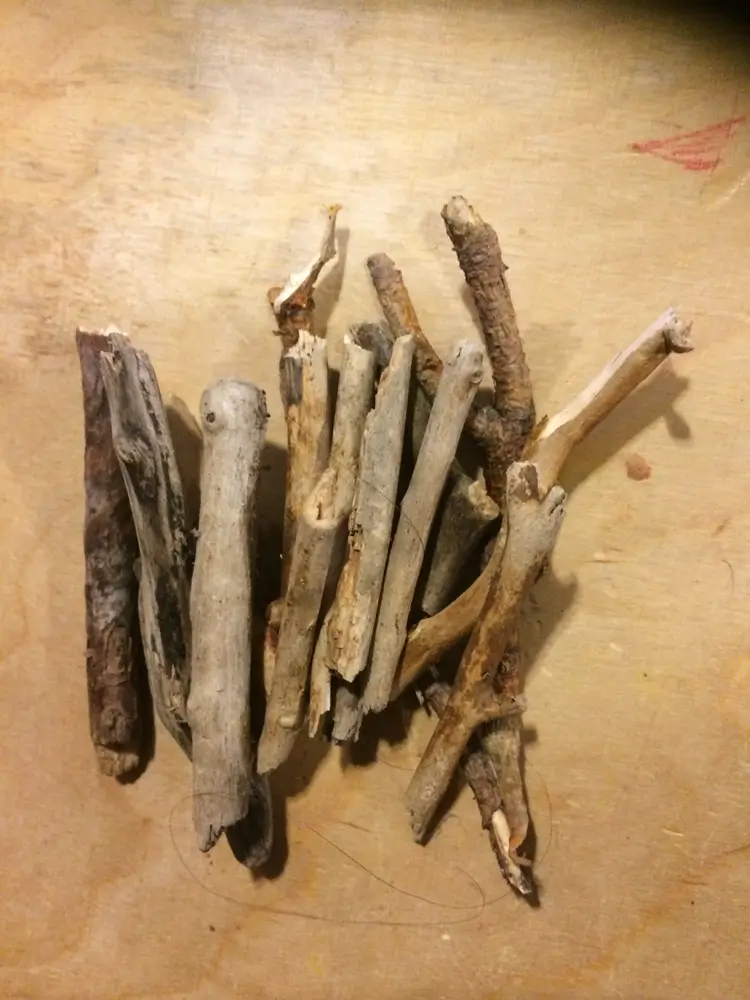
Once, children discovered and collected dry wooden sticks in the yard, presenting them to me as treasured finds. Sensing their significance—what MacLure (2013) describes as a glow—I brought the sticks into our dance session, unsure of their role but trusting that a way to include them would emerge. As we danced, possibilities for their use gradually unfolded, transforming a spontaneous encounter into a meaningful pedagogical moment.
25th February 2020
After a dance session at 12:25 p.m.
Fieldwork day 40/46
Research year 3/8
We started with MARCH+STOP and DANCE+STOP. The wooden sticks became keys that were used to unlock the statues and set them in motion. All eight participants got a turn to unlock the other statues and set them dancing. It was great and inspiring. I managed to stay in waiting mode. I allowed the children to lead, and gave them space and time to dance out their ideas. This was the best moment of the whole dance session. Experimenting together, working with the moment’s own weight and flow. It’s a good thing I didn’t overdo it.
Moving and stopping to music represents one of the most common approaches to children’s dance and served as the starting point for this session. This choice responded to the need for a shared, easily understandable, non-verbal grounding for exploratory work. Yet the strength of improvisation-based dance practice lies in its capacity to flexibly transform and integrate new directions within pedagogical settings. Here, following the music became a point of departure that transformed through exploration with the sticks, as they became agential materials for thinking‑with during our dancing session.
I observed how the children’s bodies responded enthusiastically and collectively to the music through synchronised moving and stopping. Stopping became more than simply ceasing to move, as one child noted that it transformed them into statues. Children’s obedient unison in dancing and becoming statues prompted me to seek more diverse approaches to timing dance activities. This observation inspired me to reimagine the sticks as keys, transforming the simple synchronisation of movement with music into a nuanced relation between one’s dancing and the tactile sensation of ‘unlocking’ a statue with a stick, culminating in individually chosen endings.
The children grew excited about the new idea of sticks as keys, with everyone eagerly wanting one. Some statues lacked the patience to wait to be unlocked and danced according to their own embodied agency instead. Boundaries between dancers and keyholders blurred as the children claimed full agency in wielding keys, dancing, and becoming statues. The moment evolved from structured unison into a playful, intricate interplay of overlapping openings, dances, statues, and excited anticipation of new key-wielding possibilities.
Here, introducing everyday materials, such as sticks imaginatively transformed into keys, seemed to enhance children’s motivation and engagement in this shared dance activity. This approach empowered them to exercise agency by reshaping others’ bodies and modes of being within the dance. This example further highlights the intra‑active nature of our collaborative work, in which I sought to regard children’s everyday activities and ideas as creative impulses, and to take them up, transform them, and return them as new impulses for the children to respond to. For me as a dancer–pedagogue–researcher, the pedagogical key to being able to withdraw from an active guiding position and to allow this kind of messy, collaborative and emergent working with the ‘moment’s own weight and flow’ resided in adopting a playful approach to dancing and viewing it as embodied play, underscored by my trust in children as experts of play. I re-turn to a more detailed exploration of play as a methodological orientation in research in the section Play in This Research.
The Hunting–Gathering Method
15th November 2019
Gymnastics hall in Forest daycare centre, Spring group
Fieldwork day 9/43
Research year 3/8
Daycare gym. A group of eight children and their teacher are already familiar with me, but dancing is new territory for most of them. I start by leading a warm-up dance with music, moving close to the floor. I give instructions verbally and by dancing. I notice some uncertainty in the participants, but I also sense the enthusiasm and curiosity that are bubbling up under the confusion. The tension is released as we move and begin forming a shared idea of dance. I raise my imaginary antennae as high as possible. I try to sense the events, attempts, and bodily thinking that emerge in our shared moment, while responding through my own movement. I see an interesting movement made by a child and name it in front of the group. Without stopping the flow of the movement, I ask the child to repeat it and suggest that we all try it, in our own way, before continuing with our own movement again. Numerous ideas emerge, which I take up and try out as if I were acting on my hunter-gatherer instincts. (Colliander and Anttila 2022, 158–159, my own translation)
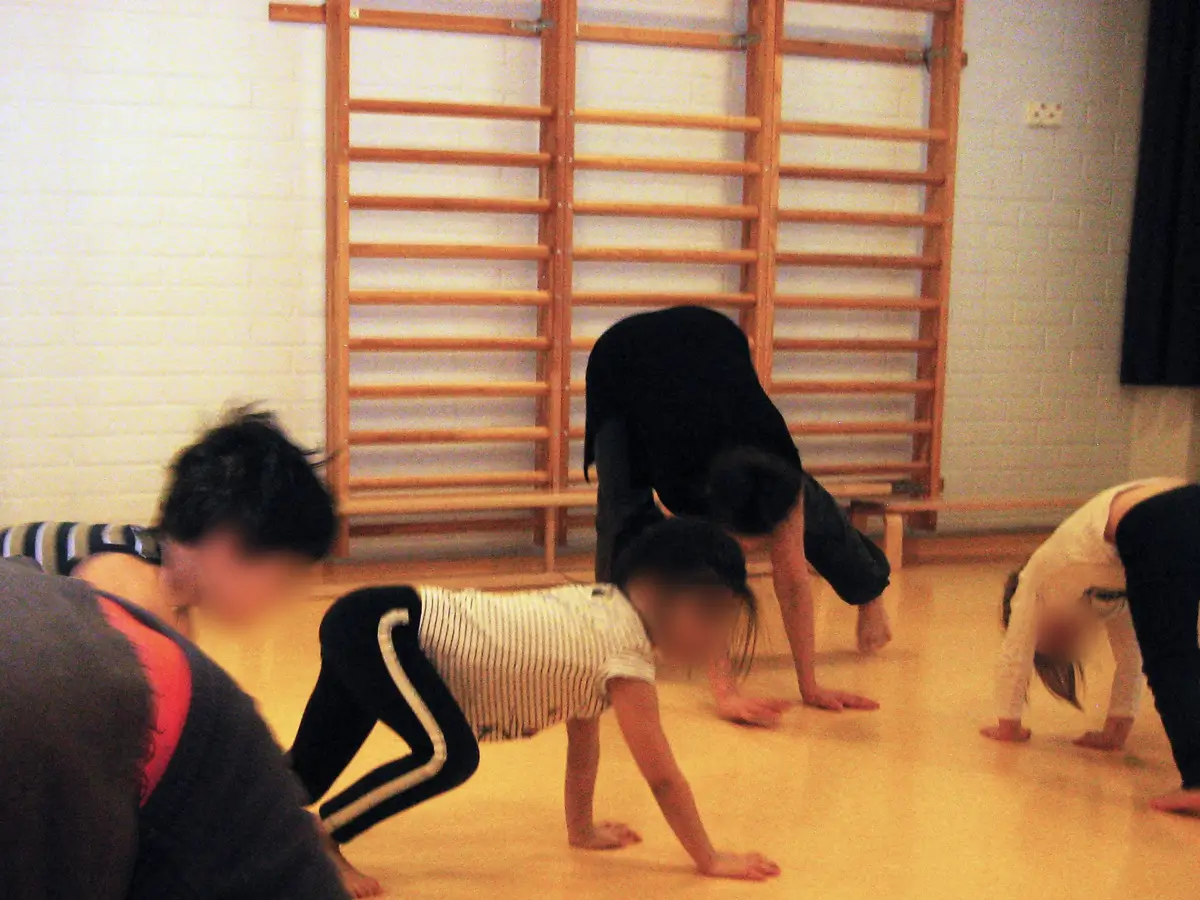
This research story narrates how improvisation-based dancing extends into improvisation-based pedagogy, where teaching becomes a collaborative learning partnership and, ultimately, an improvisation-based research method. This moment captures an episode from my work with the Hunting–Gathering[1] method, one of my central dance pedagogical approaches, which emphasises improvisation, participation, and emergence, nurturing both collective and individual creativity while facilitating artful transformations through dance (Colliander and Anttila 2022).
The Hunting–Gathering method is my adaptation of Turpeinen’s Raw Board Working Style (2015), where the pedagogical goal is to cultivate collective meaning-making in dance improvisation through a practical artistic and iterative process that involves improvising, naming, exploring, and reflecting on the movement material generated during dance improvisation. Since the method’s starting point is the movement created by the participants, the approach allows for flexibility and is therefore suitable for dancers of all ages and skill levels. Any movement, or even an affect, can work as a source to be gathered for further exploration, as illustrated in the following example of a turtle dance, which I narrate based on the video material and my diary notes.
Improvisational dance exploring the theme of turtles
Re-turning to research material: Observations on video footage
We gather sea-themed dancing ideas with the seven participating children. Based on these ideas, I propose turtles as our first theme to counterbalance the children’s restless energy, which manifests as overlapping chatter and uneasy swaying. ‘Can you show me what kinds of turtles you can become?’ I ask, ignoring a whining question of ‘But who gets to show first?’. By applying the Hunting–Gathering method, I notice two children already curled into balls: ‘Oh, how wonderful, can you show me how tiny you can all become?’ The children quickly find their way onto the floor. Accompanied by peaceful music, I encourage them: ‘Now show me how turtles move.’ ‘They’re slow!’ one of the children shouts. I gather this verbal idea: ‘Yes, they are slow.’ Amidst all the slowness, a negative affect circulates in the group, and moaning is blended with crawling. I gather this affect and turn it around, suggesting wordless, friendly turtle greetings. A handshake emerges, which I gather as an activity to explore. Beautiful connections begin to form alongside the mournful atmosphere.
In practice, dance improvisation for Hunting–Gathering often develops around a common theme, such as the turtles illustrated in this example. The participants dance and explore the theme, and I facilitate dancing in a shared direction and an exchange of ideas by collecting emerging ideas. Usually, I say the name of the creator of an idea and ask them to present the movement as a proposal for others to try out and adapt. Throughout the research I employed the Hunting–Gathering method in various sessions, and it evolved into a novel methodological assemblage with the holistic process of Embodied Listening, which I will narrate through this same example of the turtles’ dance in the section ‘Exploring’ during Fieldwork.
Propositions Enabling Emergent Research
Embracing emergence requires relinquishing control and personal goals, which connects to an intra-active orientation that foregrounds relational contexts beyond the individual (Lenz Taguchi 2010). Adopting an emergent approach to research raised concerns that pre-formulated questions might unduly narrow my analytical focus. This concern was further validated by situating my methodology within a postqualitative discourse, which is distinguished by its experimental characteristics, making research an inherently unpredictable and uncontrollable process (e.g., Koro-Ljungberg 2015; St. Pierre 2015).
Fieldnote from the forest: Berry picking methodologies
Summer 2022
Research year 5/8
Walking through the forest with my bucket, I gather blueberries for the first time in decades. Though not an expert, I am surprised at how my gaze sharpens to find the dark blue berries. Focused on them, I overlook the cloudberries until my friend points them out. Once I notice their orange glow, I broaden my perspective and collect both. I suddenly recall my hesitation over my research questions, and the experience with berries takes on a different glow (MacLure 2013) as an embodiment of being guided by preset goals.
To sustain openness for the emergent nature of the research, I decided to apply open-ended research propositions (Murris and Bozalek 2019; Springgay 2015; Truman and Springgay 2016), which also served as my research question during the fieldwork:
What emerges when a dancer–pedagogue–researcher spends several months in an early childhood education context, using her artistic expertise creatively and intuitively in child and adult encounters? Allowing time for discovery. To see and to become seen. To listen. To move and to be moved. To dance. To play. To be with. To not know.
The concept of research propositions originates from Murris and Bozalek (2019) and is employed within their methodology of diffractive reading. Their practice is grounded in Springgay’s (2015) interpretation of propositions as catalysts that can activate self-organising potential in research, a concept also discussed by Manning and Massumi (2014). Building on Whitehead’s theorising, Springgay (2015; Truman and Springgay 2016) argues that propositions should not be treated like methods or instructions that impose pre-determined guidelines on interactions. Instead, they function as triggers for movement that encompass nonhuman elements and avoid simplistic causal relationships of action and reaction. A key advantage of open-ended propositions is their capacity to guide me similarly as I facilitate dance improvisation: offering impulses that propel thought and foster discovery rather than pursuing predetermined outcomes.
In practice, the propositions shaped my approach and supported the embodied presence I sought to cultivate, involving deep immersion and adapting my actions according to evolving dynamics, guided by emerging impulses. I describe this mode of engagement as a dance-oriented presence, connected to Hilton’s (2017) concept of dancerness and informed by my expertise in dance and improvisation across all activities. Playfully, I frame it as a bodily, sensorially tuned state—one in which I might exclaim, ‘oops, I let out a dance!’—humorously likening dance to fart. In essence, this way of being reflects heightened kinaesthetic attunement that employs the dancer’s body even beyond explicitly artistic contexts. Such an approach resonates with embodied ethnographic methods (Ellingson 2017), as I will discuss in the following paragraph, and is expressed in dance pedagogy through my approach to Embodied Listening.
3.2.2 Collaborative Aspects
An intra‑active orientation implies an active commitment to collaborative forms of inquiry. This orientation is enacted in my work through deep hanging out, the practice of thinking‑with, and embodied being‑with in and through research. I will elaborate on the central aspects of these approaches in the following sections.
Deep Hanging Out
During this research, my aim has been to build knowledge through the practices of being-with and dancing-with the research and the participants. During the fieldwork, this aim was enacted through an immersive being in the daycare community through participation in the centre’s everyday life for several months. I began my fieldwork at the daycare centre in October 2019, just before obtaining my official research permit. This phase functioned as a mode of participant observation (MacRae 2019), as informal hanging out gradually developed into a mode of being-with in research. Closely attending to the children’s everyday lives and situated knowledges shaped my approach, reflecting my commitment to take the children seriously—by listening, encouraging, comforting, and sometimes also questioning.
My mode of hanging out can be seen as an adaptation of the anthropological method of deep hanging out (Clifford 1997; Geertz 1998), which emphasises reciprocal and equal researcher–participant relationships. Walmsley (2018) suggests that deep hanging out is especially valuable in contexts where participatory decision-making is sought, and it highlights the role of engagement in the arts. I aimed to be perceived by the children not as a visitor or a special educator with unique dancing skills, but as an approachable and relatable person. Crucially, deep hanging out enables the research agenda to emerge through the dynamics between participants and the researcher (Walmsley 2018).
The children were curious about my dancing, creating dialogues like this one:
Child: ‘Can you do a split?’
Me: ‘Yes, I can.’
Child: ‘Can you show us?’
Me: ‘No, because to do that I need to warm up’ or ‘Yes, let me see if I can do it here…´
Child: ‘How did you become so skilled at dancing?’
Me: ‘I’ve practised for a long time.’
Looking back, I realise that my last response was misleading, as it suggested that extensive rehearsal is necessary to dance well. What I meant was that practice supports growth, but everyone can dance from the start. I would now phrase my answer as: ‘I have gained experience in dance and learned through those experiences.’ However, such dialogues exemplify what Walmsley (2018) describes as deep hanging out’s capacity to foster multiple modes of communication and to support the development of longer-term, authentic relationships.
During the fieldwork, being free from formal educational responsibilities allowed me to be present as a different kind of adult. This positioning enabled me to engage with children in unhurried ways and to attend to the micro-moments of their everyday lives. In these encounters, my intra-actions with the children were fluid, and I often felt more like one of them, embodying childing as described by Murris and Borcherds (2019). In addition to sensitive and responsive being-with the children, humour and playfulness emerged as natural ways of connecting, aligning with recognised approaches to relationship-building in early childhood education and care (Stenius 2023). In this way, play emerged as a mode of being that felt like a shared language between the children and me, as illustrated in the following research story, in which I accompany a child in their play.
24th October 2019
Fieldwork day 2/46
Research year 3/8
Recollection of a research encounter
Leo[1] plays on the floor as I lower myself to their level. Amid scattered toys, a gentle conversation unfolds. Leo’s gaze peeks from beneath their bangs, initially evasive, but their shyness melts away as they enthusiastically share their experiences with video games. I suspect this five-year-old should not yet be familiar with the game they describe, but I choose not to dwell on that. There’s a palpable sense of strength and expertise in Leo’s descriptions. Leo enriches the story with sounds and animated expressions. I adapt my body instinctively, maintaining a comfortable distance, avoiding intense gazes, and listening attentively. Later, the teacher is surprised at Leo’s talkativeness, noting that they typically avoid interaction with visiting adults.
Ingold (2016) discusses the researcher’s immersion in the field as a grounding setting for collaborative work. Similarly, Gibbons and Nikolai (2019) advocate for researcher participation in the daily life of the research community as a way to deepen contextual understanding and foster dialogue, with the aim of rendering both the research and pedagogical practice as participatory. My immersion in the fieldwork was so holistic that it became a deeply embodied and affective experience, contrasting with my earlier experiences in ECEC as a visiting dance educator, where my familiarity with the community was limited to the dance sessions. This experience led to an imaginary transformation of the dance pedagogue–dancer–researcher, which I will discuss in the section ‘Exploring’ during Fieldwork.
Thinking-with Multiple Agencies in Research
A posthuman, ethical, and sustainable view of knowledge entails that we construct new knowledge in relation to the agencies and contexts we share in and through the research, as Lenz Taguchi contends (Lenz Taguchi 2020). My methodological approach foregrounds the material, sensory, and affective dimensions of research, understanding it as entangled with the broader web of life. Accordingly, I aim to recognise the roles and influences of more/other-than-human agents—such as viruses, water, and other everyday entities—and seek to foster deeper, more generative engagement with them as partners in thinking-with (Ulmer 2017).
Thesis chapter draft
Autumn 2023
Research year 6/8
In a diffractive analysis ‘the researcher’ is not the only agent. Storm clouds, regulations that pilots must abide by, friends, colleagues, the children observed in the preschool, books, all are actively interfering with my thought processes.
(Davies 2014, 5.)
As I read this, I can’t help but think about the many human and more/other-than-human agents that have shaped my research journey: My youngest child, who redirected my original plans. My supervisors, who encouraged and guided me towards new knowledge. Persistent illnesses during fieldwork and the pandemic. The neighbouring construction site that became part of the artistic component. The pre-examiners, who revealed the gaps in my thinking. The water that flooded and the other water that froze, both complicating our lives as a family. Alongside these, friends amid changing seasons, who have continually supported me through this all.
I draw on the concept of thinking with theory (Jackson and Mazzei 2023) to translate it into an artistic research practice that engages with dance pedagogical practices and related theories, rather than merely thinking about them. This view creates a relational mode of thinking that recognises embodied aspects of knowledge building, whereby sensorial, experiential, and artistic dimensions are valued as legitimate ways of generating knowledge. The practice of thinking with stems from feminist, posthumanist, and new materialist scholarship, offering both a methodological and ethical orientation that resists hierarchical, detached, or extractive modes of knowing. (Jackson and Mazzei 2023) It resonates with the work of scholars such as Haraway (2008; 2016), Despret (2016), Barad (2007), and Braidotti (2003; 2013; 2019), who advocate for relational, entangled, and embodied ways of producing knowledge. Boileau (2024) employs the practice of thinking-with, expanding it to include more/other-than-human elements in posthuman research with young children in the context of early childhood environmental education.
I extend the practice of thinking-with into the collaborative aspects of my research. I planned the fieldwork in collaboration with the ECEC staff to understand their needs as a community, while also aligning it with the aims of my research. I describe this orientation as a generous approach to research, drawing on Koro-Ljungberg’s (2015) notion of generosity and generativity as experimental practices that both support participants and collaborators and foster scholarship oriented toward promoting change and enabling unexpected actions. This orientation is grounded in my commitment to adapt dance to the existing culture of the daycare centre rather than requiring the centre to adjust to the demands of the research.
Initially, I aimed—somewhat idealistically—to involve children as co-researchers throughout the process, using participatory methodologies to highlight their voices and societal impact, building on discussions on co-research (see, e.g., Kulmala, Spišák, and Venäläinen 2023). However, as the project progressed, I realised this idea was not the direction I sought. Instead, I view children as creative partners in thinking-with through embodied, dance-based explorations. In practice, I avoid pressurising children to participate through prescribed roles in research. Instead, I foster collaboration via spaces for being-with, dancing-with, and thinking-with them, allowing authentic enactment as dancing, playing beings. This approach resonates with the concept of time as aion—duration—evoking childhood as ‘a child playing,’ or ‘childing’ (da Rosa Ribeiro et al. 2023). Murris and Borcherds (2019) develop this idea into a methodological approach wherein the child-subject emerges as processual, indeterminate, and porous, challenging fixed notions of age, development, and progress while underscoring the intense being-in-time of childhood. This transformative enactment of childing informs both children’s collaborative roles and my own research practices, as explored later in the chapter Play in This Research.
During my diffractive reading for the pre-examined artistic component, my collaborative aims expanded into a broader concept of dancing-with, reflecting my understanding of intra-active dance pedagogy in practice. Participation remains the guiding principle, intersecting bodily experience, social context, and institutional frameworks. Thus, the knowledge produced is co-created within and for the community, including all human and more/other-than-human agencies, making it embodied, situated, and inseparable from its context.
An important aspect of thinking-with as a collaborative practice is that it goes beyond language-based thinking. Posthuman and new materialist theorists have critiqued the dominance of language in knowledge production, advocating for embodied and relational meaning-making (e.g., Barad 2007; Lenz Taguchi 2010; Murris 2020a). This view is especially relevant when working with children whose first language is not Finnish, as was the case with most participants in this study. Relying on spoken language could be limiting and exclusionary, making interviews misaligned with the study’s aims. Furthermore, the research centres on the educator’s experience and pedagogical aspects of dance education, prioritising knowledge generated through dancing and other embodied encounters rather than verbal exchange. As dance scholar Svendler Nielsen (2009) notes, articulating embodied experiences is not effortless for either children or adults, reinforcing the value of focusing more on actions than words.
Building on these perspectives, I extended the practice of thinking-with to several new methods during the research. In addition to thinking-with theory, I began using materials as partners to think-with, such as a translation of the seminal work by Hultman and Lenz Taguchi (2010) which presents a new materialist analysis of a girl playing with sand. They propose that the relationship between the girl and the sand is intra-active, meaning that they mutually influence each other. As a result of these intra-actions, both the girl and the sand undergo transformations. Additionally, Hultman and Lenz Taguchi (2010) suggest that the sand offers various possibilities in its intra-actions with the girl. Through their mutual engagement, new challenges arise within the intra-action between the girl and the sand, prompting further exploration and problem-solving. This example prompted me to explore my understanding of the concept of assemblage through Duplo blocks and playdough, each material revealing different yet tangible aspects of how an assemblage is constituted. I discuss this exploration in the section ‘Tuning-in’ to Intra-active Early Childhood Dance Pedagogies. It also encouraged me to think-with a crafted spider I accidentally encountered during the fieldwork, leading to the creation of an installation‑like dance pedagogical space that I later translated further in the pre‑examined artistic component.
Furthermore, my practice of improvisation‑based dancing transformed the concept of thinking-with theory into a method of dancing-with theory (Colliander 2024), deepening my theoretical understanding through improvisation‑based movement and allowing concrete, embodied insights to emerge from and around abstract concepts. I applied this approach to a collective exploration of the concept of lines of flight (Deleuze and Guattari 1987), which I narrate in the section ‘Sharing’ in the Pre-Examined Artistic Component Käännöksiä – Transpositions.
The practice of thinking-with and the method of dancing‑with further evolved into a research practice of dancing‑with a dance‑pedagogical research group of children and adults, which I had facilitated since autumn 2023. The child–adult practice proved to be a productive methodological approach to exploring dance pedagogy as an intra-active, relational, reciprocal, and multidirectional process. Although the presence of both children and adults introduced complexity into the pedagogical dynamics, it simultaneously enriched the practice by fostering reflection, translation, and new forms of collaboration. In this way, the child–adult practice operated not only as a methodological support within my research but also as a site where dance could be reimagined as a shared, intergenerational process of co-creation. As this work lies outside the central scope of my inquiry, I include it primarily as methodological support. I will discuss its dynamics, ethical symmetry, and related complexities in more detail in future publications.
Embodied and Entangled Being-with in Research
I emphasise the embodied dimensions of being, doing, and knowing within my dance pedagogical practices to highlight how the body is actively engaged in all aspects of the research process. Embodied engagement supports the production of knowledges that are plural, situated, interconnected, processual, and affirmative. Therefore, my body, family, and surrounding circumstances, such as the pandemic and the nearby construction site, are not merely contextual for this research but constitutive of the research and the knowledge constructed. To support the process of including the body and surrounding circumstances in knowledge building, I build on methodologies such as embodied ethnography (Ellingson 2017) and sensory ethnography (Pink 2009). These approaches emphasise the relational nature of research, focusing on being-with and attending to the ongoing becomings of embodied, situated participants—including the researcher. They recognise that meaning is co-produced through shared activities, positioning the researcher as an integral participant rather than a detached observer. The close connection between researcher and researched was recognised before postqualitative approaches, notably in Habermas’ philosophy, which frames inquiry as an intersubjective, collaborative, dialogical, and ethical engagement (Habermas 1984). Such foundational ideas about the co-constitutive nature of inquiry both predate and inform postqualitative perspectives by highlighting the entangled positionalities of researcher and researched.
In embodied ethnography, the ethnographer’s body is conceived as a sensitive, permeable instrument, continually intra-acting with others and the material environment (Ellingson 2017). This view resonates with postqualitative and posthuman research paradigms, which reject dualistic separations between the researcher, bodies, materials, and contexts within the research assemblage (Jusslin and Østern 2020; Østern and Hovik 2017). Similarly, my approach of Embodied Listening cultivates sensitivity to relational aspects of dance pedagogical events. During analysis, I engage with research materials through diffractive reading, informed by my position as a dancer–pedagogue–researcher. Thus, my body serves both as research material and an epistemological site—both producing and constituted by the phenomena under study (Lenz Taguchi 2012). In other words, while shaping the research, I am simultaneously shaped by it (MacLure 2021). Although posthuman and embodied paradigms challenge dominant humanist and Western epistemologies, my aim is not outright rejection but critical expansion—bending and stretching these paradigms beyond their limits.
3.2.3 Writing as a Research Practice
In both artistic and arts-based research, writing is commonly understood as a creative, performative, and epistemological method in its own right (e.g., Borgdorff 2012; Burrows and Heathfield 2013; Cocker, Gansterer, and Greil 2024; Manning 2013). Kontturi (2018) advocates for writing that remains connected to the artistic process, so that art is not separated from its conditions of production. She (2018, 11, original emphasis) stresses writing ‘about art, with art, in a way that simultaneously appreciates and demystifies the creative process’. This principle informs this artistic research, in which writing becomes a form of artistic inquiry and knowledge emerges through the act of making. As Cocker, Gansterer, and Greil (2024) note, writing in artistic research is more closely connected to its use as a verb than as a noun: it is not primarily a product for transmitting information, but rather an active form of doingthat holds infinite potential for transformation and translation.
Writing has also been extensively theorised on within posthumanandnew materialistframeworks. For example, Springgay (2019) conceptualises writing as an expanded practice, examining what writing does in the interstices between research and creation through atransmaterial approach involving felt. Similarly, Zapata, Kuby, and Thiel (2018), drawing on posthumanist scholarship on intra-activity, view writing as a translingual assemblage. They argue that writing should not be seen merely as a finished product but as a set of practices and processes rooted in potentiality. Ultimately, they see it as an ethical endeavour aimed at fostering more inclusive approaches to research and teaching, which resonates with my own holistic understanding of writing and engaging in research.
Writing as Artistic Research
While I employ a broad and inclusive understanding of writing in this research—encompassing multimodal forms of expression—my focus in this section is specifically on writing as a textual mode of artistic inquiry and discovery, extending beyond acting as a vehicle for reporting research findings. This form of writing is inherently unfinished and in motion, remaining open-ended rather than conclusive (Koro-Ljungberg 2015). I have approached writing as one of my most significant tools, experimenting with various strategies and methods. Still, even with a generative view of translation as working between different modes of articulation and striving to create translations that are ethically sound and aligned with my values as a dancer–pedagogue–researcher, the process has not been without its challenges.
The uncertainty and inaccuracy inherent in writing in a foreign language—in my case, English—introduce a sense of vulnerability into the creative process, suggesting not mastery but rather a form of survival within academic and scholarly work. Spivak (2004) warns that translation can carry violent dimensions when conducted without sufficient sensitivity to linguistic and cultural context. Translation, therefore, must be approached through deep, immersive engagement with the original language and its cultural situatedness. This concern resonates with new materialist perspectives, particularly in the work of Irni, Meskus, and Oikkonen (2014), who explore the translation of Barad’s concepts from physics into the social and human sciences. They argue that such conceptual transfers inevitably involve shifts in meaning—a transformation that is both linguistic and material.
In my research, I engage in a material-discursive reworking of concepts such as Barad’s (2007) diffraction, originally rooted in physics, adapting it to my artistic research methodology. Here, translation is not only a linguistic act but also a material process—an embodied negotiation across epistemic, cultural, and disciplinary boundaries. With a posthuman and new materialist orientation, translation becomes an ongoing navigation between material realities, involving not just texts but also the cultural, historical, and physical environments that both shape and are shaped by language. This perspective reframes translation as dynamic, relational, and evolving, opening new ways to understand how meaning emerges and transforms across linguistic and cultural thresholds. In doing so, it foregrounds the embodied dimensions of language, emphasising that language is enacted through non-verbal expression involving the whole body and is not confined to the organs of speech. (MacLure 2013a) Such insights affirm translation and language as inseparable from the affective, sensory, and material dimensions of lived experience.
Writing with the Body: The Verbs and Lines Method
I present the Verbs and Lines method as an example of body‑based artistic writing—a reflective and diffractive practice that intertwines verbal and visual expression to translate embodied experiences into a visible mode of attentive listening. This process can deepen one’s understanding of an experience and render it shareable with others. The method is an outcome of my research and emerged only after the pre-examined artistic component; therefore, it is not included in the sections on the artistic-pedagogical practices of this research.
4th April 2023
Working diary
Research year 6/8
Putting dance into words feels nearly impossible. Rather than adjectives, and inspired by Dewey’s idea of learning by doing, I turn to verbs and lines as expressions of dance, a method that emerged through practice. A formative moment was a collaborative exercise with my doctoral colleague Pauliina Laukkanen, where we improvised and drew our dance experiences, translating movement onto paper. Another influence was a session with postdoctoral colleague Joa Hug, whose embodied approach to writing helped me stay true to my practice and shape what became my Verbs and Lines method.
A breakthrough came during a Skinner Releasing session led by my postdoctoral colleague Kirsi Heimonen. After gentle, awakening exercises, we were invited to write or draw our experiences. With pen, paper, and the warm wooden floor beneath me, something clicked: my drawing, a minimalist composition of thin black lines on translucent white paper, began to mirror the curves and movements I had just danced, capturing the essence of the experience. It felt as though the work was created not by me alone, but through the experience itself. This surrender to process—free from the pressure of performance—was empowering and joyful.
As the page filled with lines, I began to long for words. I turned the paper over and started writing. Verbs emerged naturally in soft, rounded handwriting, forming a cloud of actions—light and gentle, yet rich with experiential depth. I accepted each one without judgment, spiralling outward until the flow ceased, leaving a powerful sense of wholeness and being enough. It felt like the beginning of a new artistic method—one I will continue to grow with.
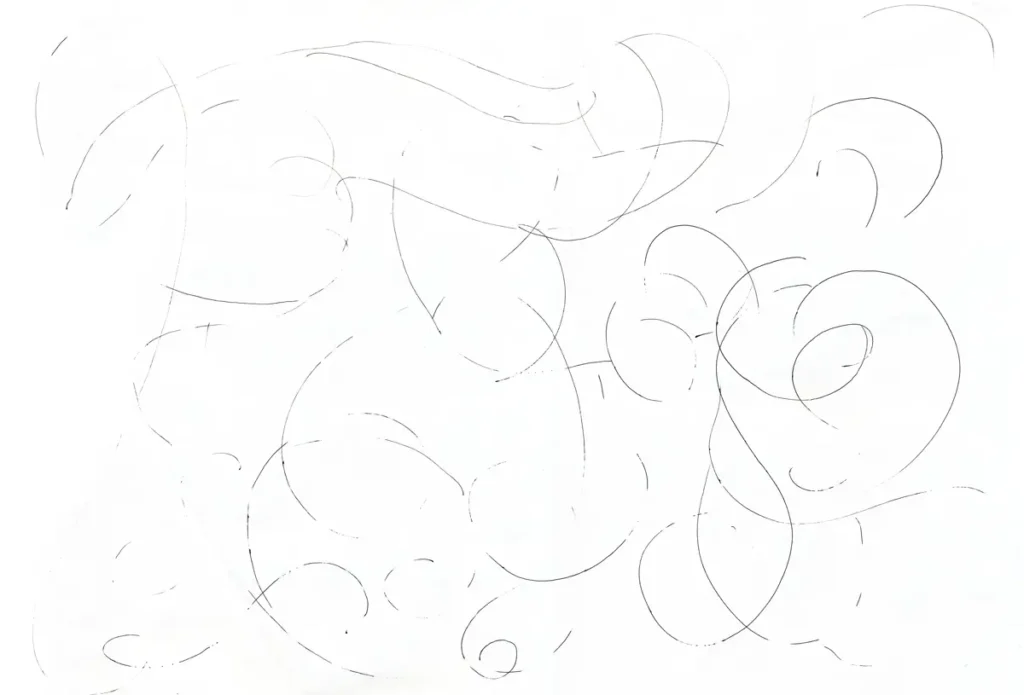
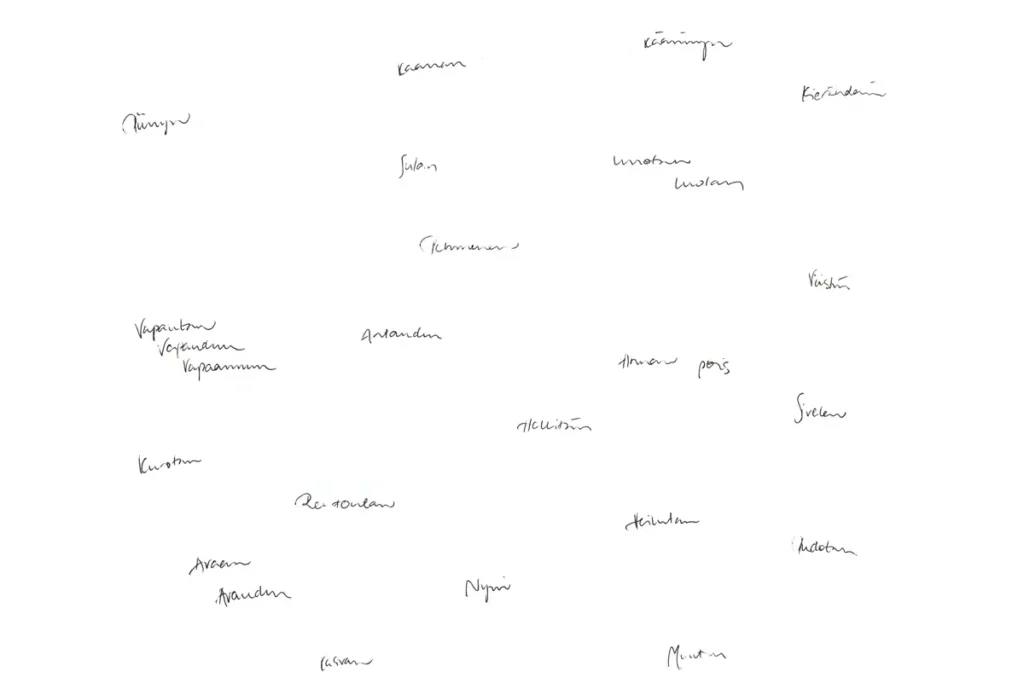
I first used this practice to reflect on my own embodied experiences of dance improvisation and pedagogy. Gradually, it developed into a method I could share with educators in my dance pedagogy course for early childhood education. While introducing it, I spontaneously named it the Verbs and Lines method—a moment that marked its emergence as a pedagogical and research method. With participants, it also evolved into a form of pedagogical documentation with aesthetic value and the potential to serve as artistic material later, for instance, when creating choreography through the Storyboard Method. In this way, the exercise invites playful translations between modes of expression in the assemblages of dancing–teaching–researching through thinking–drawing–writing.
3.2.4 Play in This Research
In this section, I will articulate how play emerges in my research as a nomadic practice (Deleuze and Guattari 1987), encompassing theoretical, practical, artistic, and methodological aspects. I elucidate my views on play and dance as connected and overlapping practices, and conclude with a discussion on playful approaches to research.
Play as a Nomadic Research Practice
Play is not only integral to children’s lives but can also be understood as their vital mode of being and an orientation toward the world through creative, embodied, and improvised practices (MacRae 2022). As I have sought to adopt a holistic approach to examining dance with children, I regard the inclusion of play as essential, even if it does not constitute the primary focus of my research. Therefore, the concept of play has always been around within my research, occupying what might be described as a nomadic position (Deleuze and Guattari 1987). It has moved fluidly from a theoretical and philosophical grounding (Bateson 1972; Caillois 1958; Dissanayake 1974; Gadamer 1960; Huizinga 1949; Massumi 2014; Mouritsen 1998) to becoming a starting point and methodology for dancing, a relational mode of being with children during fieldwork, and a quality of being-with my research that I have sought to sustain throughout the research process. Gradually, this evolving presence of play has led to its conceptualisation as a methodological principle within my research practice. At the same time, its pervasive and shifting role—its all-overness—reflects the nature and inherent potential of play itself: to emerge unexpectedly, whenever and wherever, as it also does in children’s lives.
In my research, defining what play is has not been my central concern, given its inherently ambiguous and diverse nature (Sutton-Smith 1997). Rather, I approach play through an open and broad conception, focusing on what it can do and become. My aim has been to emphasise play as a relational practice closely connected to artistic activities. The relationship between play and art-making is well recognised across scholarship (Eisner 2002; Hermans 2022; Kofman 1988; Pääjoki 2004; Schulte and Thompson 2018; Deans and Wright 2018) and has been widely acknowledged within dance pedagogical research (e.g., Anttila 2007; Bond and Deans 1997; Bond and Stinson 2000; Lindqvist 2001; Sansom 2011). While my analysis does not primarily focus on developmental theories (e.g., Piaget 1972; Vygotsky 1978), contemporary pedagogical perspectives in ECEC (e.g., Hakkarainen and Brėdikytė 2013; Kyrönlampi and Koivula 2024), or games as a form of play (e.g., Friman et al. 2022), these perspectives remain important background considerations.
Dance Improvisation as Embodied Play
My pedagogical approach to dance positions it in close connection with play, as both are grounded in improvisation, which forms a bridge to the imaginative and creative realm of discovery (Deans and Wright 2018). Also, Herman’s (2022) considerations of physical play and dance improvisation support my thinking of their nature as dynamic and fluid practices that can simultaneously be unpredictable and predictable, risky and safe, spontaneous and planned, offering a richer relational perspective that transcends binary thinking.
Focusing on dance education and embodied modes of being, I argue that within most early childhood curricula, the concept of play could be replaced by the word dance without altering the content in any fundamental way. This idea becomes evident in the following quotation on conceptions of learning from the Finnish Core Curriculum for ECEC, which I present with such substitutions.
Play Dance is significant for the learning of children of ECEC age. It motivates the children and brings joy while allowing the children to learn many skills and acquire knowledge. In ECEC, it is necessary to understand the intrinsic value of play dance for the children as well as the pedagogical significance of play dance in learning and children’s holistic growth and well-being.
(EDUFI 2022, 19.)
In education, play has traditionally been viewed through a binary lens: it is either valued as free play in its own right or seen as a means to achieve various ends related to children’s developmental stages. As such, free play tends to become regulated through educational striations, such as with a defined space, time, and available materials. (Sellers and Chancellor 2013) This perspective aligns with my view that dance in ECEC often becomes overly structured, thereby limiting its artistic and educational potential. Posthuman approaches challenge instrumental views of play that frame it as a means to achieve developmental or predetermined outcomes, such as skill acquisition (Rautio and Winston 2015). In my research, I extend this perspective to dance through an intra-active lens, which seeks to dismantle binary frameworks and reimagine both play and dance as fluid, complex, and open-ended practices. In this view, play and dance can function simultaneously as both means and ends in educational and research contexts. This shift redirects attention from outcomes of achievement toward processes of becoming (Rautio and Winston 2015).
Researching Playfully
From intra-active and posthuman perspectives, play is seen as an emergent and co-created process involving humans and more/other-than-human entities, such as objects or technologies. These entities are not passive tools but active agents that shape the experience of play by opening up possibilities while also introducing constraints. In this view, play arises through entangled intra-actions, whereby emotions, sensations, and bodily movements extend beyond individual internal states and are distributed across the entire play assemblage. (Lenz Taguchi 2010; Rautio and Winston 2015) Hovik (2022) emphasises the link between intra-active thinking and play, suggesting that intra-activity in children’s performing arts could simply be another term for play, breaking down rigid categories of what it means to be human, animal, alone, together, and in between. This understanding supports my intra-active view of play as a form of material-discursive improvisation that can be approached as an extension of dance (Rautio and Winston 2015).
Adopting play and playfulness as research practices has enabled me to connect my background in dance and dance education with my evolving position as a researcher, as playfulness constitutes a mode of being in and with research that resonates with my experiences of dancing.
As I illustrated earlier through the practical example of using wooden sticks in dance improvisation, treating dance sessions as playful encounters has enabled me to relinquish my role as the traditional dance teacher who knows, steers, and controls. This approach has enabled me to embrace a collaborative way of working, responding to emerging impulses rather than directing activities. Such an approach fosters curiosity and a non-judgmental orientation toward mistakes and error—qualities also recognised by Summers and Clarke (2015) in their exploration of the in-betweenness of being a mother, academic, and artist. Their reflections closely relate to my positioning as dancer–pedagogue–researcher, situated within the entanglements of work, family, and private life. In the section ‘Sharing’ in the Pre-Examined Artistic Component Käännöksiä – Transpositions, I narrate how play became a mode of working at home during lockdown, as I planned the pre-examined artistic component.
Wolgemuth et al. (2018) explore play as a method of qualitative inquiry by combining critical, poststructural, and new materialist perspectives. Through an experimental session organised around work/think/play, they conceive play as an engaging and intrinsically motivating—though not always pleasurable—research practice, and propose it as a form of academic self-maintenance, likening it to ‘gym time for researchers’ (Wolgemuth et al. 2018, 8). For me, the equivalent of this ‘gym time’ would be my efforts to engage with challenging philosophical theories, yet I share their emphasis on self-maintenance in my own playful approach to research. Playfulness has enabled me to ‘research without researching,’ creating spaces for research that sustain creative thinking, while avoiding the rigidity and pressures of predetermined success and production.
Pedagogically, play may support the redirection of attention away from predefined aims and content, helping researchers take on a more emergent, playful, and child-centred approach to co-learning through dance (Bond and Deans 1997). This idea is further supported by Sansom (2009), who claims that the dance that originates in play not only produces experiences of joy and pleasure but also fosters a growing understanding of self, others, and the world. I propose that adopting a playful attitude in research may serve as a central means for adults to move beyond the habitual and the logical. By qualitatively altering the nature of a situation, the performative gestures of play can produce a transformative force and open possibilities for transindividual change (Massumi 2014).
Engaging in diffractive reading of humanist philosophical views on play alongside intra-active theorisations reveals nuanced resonances, for example between posthuman perspectives and Gadamer’s (1960) conception of play, which emphasises play as unfolding through the subject rather than being an activity performed by the subject. This reorientation shifts the view of play as a subject-centred developmental framework towards an understanding of it as a relational and processual phenomenon, aligning conceptually with posthuman approaches. Similarly, Huizinga’s (1949) depiction of play as not merely an expression of culture but a constitutive element of it relates to how being-with circumstances through play and the playful approaches in my research operate not just as contextual background but rather are constitutive of the research process itself. This link became particularly evident during the process of my pre-examined artistic component.
Note
1 The name of the method stems from my interest in and respect for the hunting–gathering lifestyle, as a dancer–pedagogue–researcher–mother. The hunting–gathering philosophy aligns with my pedagogical objectives: the cooperation between children and adults is conceived as a collaborative partnership with a bi-directional flow of knowledge, the primary objective of education being the cultivation of autonomy rather than fostering independence (Doucleff 2022).